Labuan Campaign: The Allied Invasion and Battle for the Pocket
In June 1945, Allied forces launched a strategic operation to reclaim Labuan, a key island in the Brunei Bay area of North Borneo. This campaign, led primarily by the Australian 9th Division, was designed to secure vital airfields and infrastructure to support further operations in the region. The operation combined meticulous intelligence gathering, amphibious assaults, and a grueling battle of attrition against a determined Japanese garrison.
Pre-Invasion Operations
The road to the landing began in late May with coordinated air strikes by Australian and United States units. These raids targeted the town of Victoria and various Japanese airfields across north-western and north-eastern Borneo to suppress enemy defenses. While the original plan relied on aircraft from Tarakan, delays in rebuilding that airfield forced a reduction in the scale of the initial bombardment.
Naval preparations commenced on 7 June, with US Navy minesweepers clearing Brunei Bay. Despite the success of the operation, the USS Salute was lost to a mine on 8 June, resulting in four deaths. On 9 June, underwater demolition teams cleared landing beaches of obstacles, though their work was complicated by an unauthorized B-24 Liberator bombing raid on the island.
Intelligence played a critical role in the planning. The Australian Services Reconnaissance Department (SRD) utilized PBY Catalina aircraft to overfly the island and recruit local informants. Additionally, the SEMUT 2 team, which had parachuted into Borneo in April, provided essential data on the size and movement of the Japanese garrison.
The 24th Brigade Group embarked from Morotai in late May. Due to shipping shortages, soldiers endured cramped and sweltering conditions for ten days—an experience described by historian Gavin Long as being as uncomfortable as the combat that followed. The force utilized a diverse array of vessels, including HMAS Manoora, HMAS Westralia, and various US Navy LSTs and LCIs. Because of the surrounding coral reefs, the initial assault waves utilized LVTs (Landing Vehicle Tracked) from the US Army's 727th Amphibious Tractor Battalion.
The Landing and Initial Advance
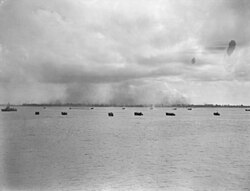
The invasion began at 8:15 am on 10 June with a heavy naval bombardment and anti-personnel bombing by Australian B-24s. The initial landing was largely unopposed, allowing the 2/43rd Battalion to advance rapidly and capture No. 1 Strip by that evening. The 2/28th Battalion captured the town of Victoria shortly after landing, though they met their first significant resistance at Flagstaff Hill at 10:45 am.
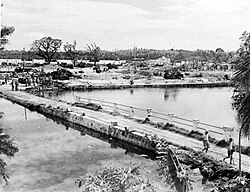
As the day progressed, the 2/28th Battalion faced increasing opposition west of Flagstaff Hill, utilizing tanks and mortars to clear Japanese positions. Meanwhile, the 2/11th Commando Squadron secured the Hamilton peninsula without opposition. The success of the beachhead was highlighted by an inspection tour conducted by General Douglas MacArthur, General George Kenney, Lieutenant General Leslie Morshead, and Air Vice Marshal William Bostock.
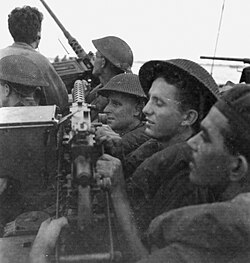
By 11 June, the 24th Brigade focused on securing the airfield. While the 2/43rd Battalion met light resistance, the 2/28th Battalion encountered the main body of the Japanese garrison in the interior. RAAF No. 62 Wing engineers landed on 11 June to begin the reconstruction of No. 1 Strip.
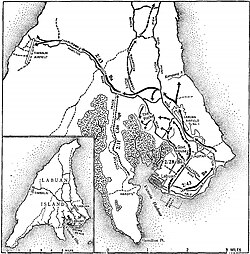
By 12 June, Australian intelligence identified a Japanese stronghold located north of Victoria and west of the airfield. This area, later dubbed "the Pocket," became the focal point of the remaining campaign. By the end of 14 June, the Australians had secured most of the island, leaving only the Pocket as a center of resistance.
The Battle for the Pocket
The Pocket was a formidable defensive position approximately 1,200 yards long and 600 yards wide, consisting of jungle-covered ridges (Lushington, Norman, and Lyon) bordered by swamps. It was defended by approximately 250 Japanese personnel. To minimize casualties, Brigadier Porter opted for a strategy of isolation and heavy bombardment rather than a direct infantry assault.
Between 15 and 20 June, the 2/12th Field Regiment fired 140 tons of shells into the position. An initial probe on 16 June by the 2/28th Battalion and tanks proved costly; the force was pinned down on Eastman Spur, resulting in five killed and 23 wounded. This setback led Porter to intensify the bombardment, bringing in the heavy cruiser HMAS Shropshire to shell the area on 18 and 19 June.
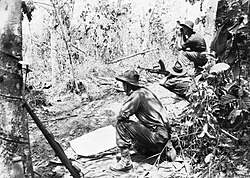
On 21 June, in a desperate attempt to break the siege, about 50 Japanese troops slipped out of the Pocket to attack the airfield, dock facilities, and a prisoner of war enclosure. These raids were defeated by logistics personnel and engineers, resulting in 43 Japanese deaths.
The final assault on the Pocket began at 10 am on 21 June. C Company advanced along Lushington Ridge, while D Company pushed south from Eastman Spur. D Company was supported by Matilda II tanks, including "Frog" flamethrower variants, which proved decisive in clearing the remaining defenders. The final assault killed 60 Japanese soldiers, while another 117 had been killed by the preceding artillery barrage.
Humanitarian Impact and Aftermath
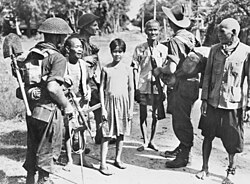
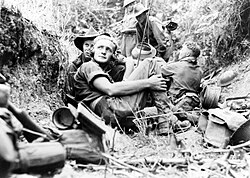
The campaign left a severe humanitarian crisis. Allied bombing and naval shelling had destroyed nearly all buildings in Victoria, leaving thousands homeless. Approximately 3,000 civilians were housed in a beachhead compound, where the 24th Brigade provided essential supplies and support. Former British colonial government employees were recruited to help establish a new administration.
Following the fall of the Pocket, the 2/12th Commando Squadron conducted mopping-up operations across the island through mid-July, killing 27 more Japanese soldiers and improving the island's topographic maps.
Key Facts
- Total Australian Casualties: 34 killed and 93 wounded.
- Total Japanese Casualties: 389 dead and 11 prisoners captured.
- Key Weaponry: Matilda II tanks, including "Frog" flamethrowers, and heavy artillery from the 2/12th Field Regiment.
- Strategic Goal: Capture of Labuan and the restoration of No. 1 Strip airfield.
- Major Units: Australian 24th Brigade (9th Division), US 727th Amphibious Tractor Battalion, and RAAF No. 62 Wing.
| Phase | Key Date(s) | Primary Objective | Outcome |
|---|---|---|---|
| Pre-Invasion | May - 9 June 1945 | Intelligence & Bombardment | Beaches cleared; airfields suppressed |
| Landing | 10 June 1945 | Beachhead & Victoria | Successful landing; Victoria captured |
| Securing Interior | 11 - 14 June 1945 | No. 1 Strip & Outskirts | Airfield captured; Japanese pushed to "the Pocket" |
| Final Assault | 15 - 21 June 1945 | Destruction of the Pocket | Japanese garrison eliminated |
Frequently Asked Questions
What was "the Pocket" on Labuan?
The Pocket was a Japanese stronghold consisting of three jungle-covered ridges (Lushington, Norman, and Lyon) bordered by swamps. It served as the final defensive position for the Japanese garrison on the island.
How did the Allied forces overcome the defenses of the Pocket?
The Allies used a strategy of isolation and attrition, firing 140 tons of artillery shells and utilizing naval bombardment from HMAS Shropshire. The final assault was successful due to the use of Matilda II "Frog" flamethrower tanks.
What role did the United States play in the invasion?
The US provided critical support through minesweeping operations, B-24 Liberator bombers for close air support, and the 727th Amphibious Tractor Battalion, which provided the LVTs necessary to cross the coral reefs.
What was the humanitarian situation following the landing?
The situation was dire, as Allied attacks had destroyed most buildings in Victoria. Approximately 3,000 homeless civilians were housed in a compound and supported by the 24th Brigade.
Who were the senior leaders present during the campaign?
Notable leaders included General Douglas MacArthur, General George Kenney, Lieutenant General Leslie Morshead, and Air Vice Marshal William Bostock, who visited the beachhead on 10 June.