Kyle of Lochalsh Railway Station
Nestled in the rugged beauty of Highland Scotland, Kyle of Lochalsh railway station serves as the scenic terminus of the Kyle of Lochalsh Line. Located in the village of Kyle of Lochalsh, this station provides a vital link for travelers journeying through the northern Highlands, situated approximately 102.7 km (63 miles 64 chains) from Dingwall.
Managed by ScotRail, the station is more than just a transport hub; it is a piece of living history that reflects the engineering ambition of the late 19th century and the evolving connectivity of the Scottish coast.
Key Facts
- Opening Date: 2 November 1897.
- Management: Currently operated by ScotRail.
- Heritage Status: Designated as a Category B Listed Building since 16 December 1986.
- Route: Terminus of the line from Dingwall.
- Infrastructure: Features two platforms and three intact sidings.
A History of Engineering Ambition
The station was opened by the Highland Railway following an extension of the Dingwall and Skye Railway from Stromeferry. The construction of this extension was a monumental task, taking over four years to complete due to the challenging terrain. Engineers had to excavate more than 30 cuttings through solid rock and construct 29 bridges.
These difficulties made it the most expensive rail route built in the UK at the time, costing approximately £20,000 per mile. The original design featured a chalet-style station building and a broad island platform situated on a pier at the water's edge, complemented by a signal box, a small locomotive shed, and several sidings.
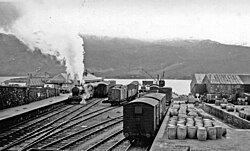
Between 1935 and 1939, the station also hosted LMS caravans, providing unique accommodation for visitors to the region.
Evolution of Transport and Connectivity
Historically, the station was a primary gateway for those traveling to the Outer Hebrides via ferry. However, the distance from Kyle of Lochalsh to Stornoway (71 miles) proved inefficient. In 1970, the Ross and Cromarty council invested £460,000 (roughly £6.3 million in 2025 values) to establish a new ferry terminal at Ullapool, which reduced the distance to Stornoway to 43 miles.
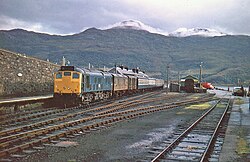
The station's relationship with the Isle of Skye also evolved. While the piers once offered sailings to the island, these were superseded on 16 October 1995 by the opening of the Skye Bridge, located conveniently close to the station.
Technological shifts also impacted the station's operations. In 1984, British Rail introduced Radio Electronic Token Block working—a system used to ensure only one train occupies a section of single-track line at a time—leading to the closure of the signal box. Today, the signal box has been repurposed as a holiday cottage.
Station Facilities and Layout
The station remains well-equipped for modern travelers, offering a ticket office, accessible toilets, benches, and a telephone. Visitors can also enjoy a small restaurant and gift shop located directly on the platform, with parking available on the access bridge.
The layout consists of two platforms capable of accommodating nine-coach trains. While platform 1 (the western face) handles the majority of passenger traffic, platform 2 is used less frequently.
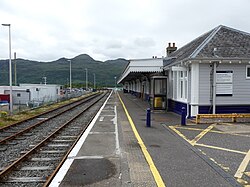
For operational purposes, three sidings remain intact, including a loading bank siding and a run-round loop for locomotive-hauled trains. Access to these sidings and platform 2 is managed via ground frames.
Passenger Traffic and Services
Passenger numbers at Kyle of Lochalsh have shown significant recovery and growth in recent years. Following a sharp dip in 2020/21, usage has climbed steadily, peaking at 53,584 entries and exits in the 2023/24 period.
| Financial Year | Passenger Volume |
|---|---|
| 2020/21 | 7,858 |
| 2021/22 | 40,702 |
| 2022/23 | 46,634 |
| 2023/24 | 53,584 |
| 2024/25 | 46,788 |
Current services include four daily departures to Dingwall and Inverness during the week. Sunday services are more limited, with either one departure in winter or two during the summer season.
Frequently Asked Questions
When did the Kyle of Lochalsh railway station open?
The station officially opened on 2 November 1897, following the completion of the Highland Railway's extension from Stromeferry.
Why was the construction of the line so expensive?
The route was the most expensive in the UK at the time because of the unforgiving terrain, which required the excavation of over 30 rock cuttings and the construction of 29 bridges.
Is the station still used for ferry connections?
No. Ferry services to the Outer Hebrides moved to Ullapool in 1970, and sailings to the Isle of Skye were replaced by the Skye Bridge in 1995.
What is the current status of the old signal box?
The signal box closed in 1984 after the introduction of Radio Electronic Token Block working and has since been converted into a holiday cottage.
How many platforms does the station have?
The station has two platforms, although passenger trains primarily use platform 1.