Inverness and Perth Junction Railway: The Engineering of the Highland Main Line
In the mid-19th century, the expansion of the railway network was seen as the primary driver of economic survival for Scottish towns. For Inverness, securing a reliable connection to the south was not merely a matter of convenience, but a necessity for growth. This ambition led to the creation of the Inverness and Perth Junction Railway, a bold engineering project that traversed some of the most challenging terrain in the Highlands.
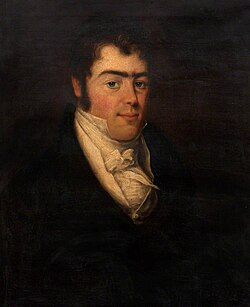
The journey toward a connected Highlands began with the vision of Joseph Mitchell, an Inverness-based engineer. Mitchell recognized that a phased approach was necessary, starting with a coastal line to Nairn before pushing further toward Aberdeen and eventually south to Perth.
Key Facts
- Operational Dates: 1 June 1863 – 1 February 1865 (as an independent company).
- Primary Route: Connected Forres to Perth via Aviemore.
- Highest Point: Druimuachdar Summit at 1,484 feet (452 m).
- Successor: Merged to form the Highland Railway in 1865.
- Legacy: The section from Aviemore to Stanley Junction remains part of the active Highland Main Line.
The Path to Connectivity
Connecting Inverness to Aberdeen
Before the southward push, Inverness first sought a link to Aberdeen. The Inverness and Nairn Railway opened in 1855, followed by the Inverness and Aberdeen Junction Railway (I&AJR), which completed the link to Keith by 1858. By 1861, these entities had merged, providing a stable foundation for the more ambitious project of heading south.
The Southward Expansion
The Inverness and Perth Junction Railway was formally established by an Act of Parliament on 22 July 1861. While the original plan suggested starting the southward route from Nairn, the line was instead shifted to Forres to better serve local fishing interests. This route, known as the Dava route, spanned 103 miles from Forres to Aviemore, crossing wild, sparsely populated landscapes.
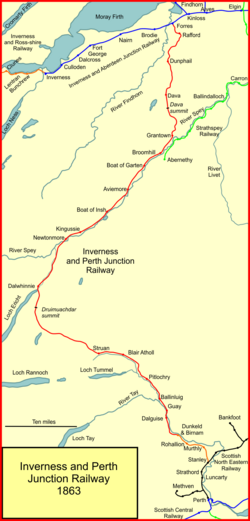
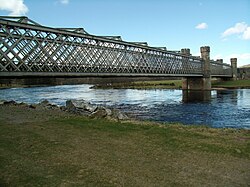
Construction was an immense undertaking, requiring 8 viaducts, 126 river bridges, and 119 road bridges. Despite the difficulty, the line opened in stages throughout 1863, finally linking Dunkeld to Pitlochry on 1 June, and completing the full connection from Forres to Pitlochry by 9 September.
Technical Challenges and Operations
The geography of the Highlands presented severe operational hurdles. The line featured two major summits: Dava (1,052 feet) and Druimuachdar (1,484 feet). These steep gradients required double-heading—the use of two locomotives to pull a single train—and the deployment of specialized 0-6-4T banking engines to assist trains up the slopes.
Safety was a paramount concern on the downhill sections. Until 1907, all goods trains were required to carry an additional brake van in the middle of the train. In extreme cases, "sprags" (wooden blocks used to jam wheels) were kept at intervals near the Slochd summit for emergency braking.
The Aberfeldy Branch
In 1865, the company opened a short branch line from Ballinluig to Aberfeldy. Spanning 8.75 miles, this section was the most expensive part of the Highland system to construct per mile, featuring 41 bridges. It served the region until its closure in May 1965.
Evolution of the Route
The Direct Line (Carrbridge Route)
By the late 19th century, the original Dava route was becoming a bottleneck. To increase efficiency, the Inverness and Aviemore Direct Railway (the Carrbridge route) was authorized in 1884. This 34.5-mile cut-off provided a shorter path between Inverness and Aviemore, opening fully in 1898 with a new summit at Slochd (1,315 feet).
Amalgamation and Modern Status
On 1 February 1865, the Inverness and Perth Junction Railway merged with the Inverness and Aberdeen Junction Railway to form the Highland Railway. Over time, the newer Direct Line absorbed most of the through traffic, leading to the closure of the original Dava section on 18 October 1965.
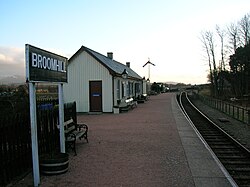
Today, the legacy of the line lives on. The stretch between Aviemore and Stanley Junction remains a vital part of the Highland Main Line operated by ScotRail. Additionally, the Strathspey Railway heritage line has preserved and reopened the section from Aviemore to Broomhill.
| Feature | Detail |
|---|---|
| Total Route Length (Forres to Aviemore) | 103 miles (166 km) |
| Highest Summit | Druimuachdar (1,484 ft) |
| Construction Cost | £798,111 |
| Key Infrastructure | 8 viaducts, 245 total bridges |
| Major Merger | Formed Highland Railway (1865) |
Frequently Asked Questions
Why was the Dava route replaced by the Carrbridge route?
The Carrbridge route was significantly shorter and more direct, reducing travel time and operational costs between Inverness and Aviemore compared to the original, more circuitous Dava route.
What were banking engines used for on this line?
Banking engines were powerful locomotives used to push heavy trains up the steep gradients of the Highland summits, particularly between Blair Atholl and Dalnaspidal, to ensure they could reach the top of the climbs.
Which parts of the original railway are still in use today?
The section from Aviemore to Stanley Junction remains active as part of the Highland Main Line. Additionally, the Strathspey Railway operates a heritage service between Aviemore and Broomhill.
Who was the primary engineer behind the railway's development?
Joseph Mitchell was the key engineer based in Inverness whose dynamic approach and planning were instrumental in establishing the connections to Nairn, Aberdeen, and eventually Perth.
What happened to the Aberfeldy branch?
The Aberfeldy branch, which was the most expensive section of the system to build per mile, operated from 1865 until it was closed on 3 May 1965.