Kirtland Egyptian Papers
The Kirtland Egyptian Papers are a collection of documents produced primarily between 1835 and 1842 in Kirtland, Ohio, and Nauvoo, Illinois. Currently housed in the Church History Library of the LDS Church, these manuscripts represent an early attempt by Joseph Smith and his associates to translate and systematize the Egyptian language. Because of ongoing debates regarding the order in which they were created, there is no universally accepted numbering system; instead, they are often identified by folder numbers assigned by Hugh Nibley around 1971.
Key Facts
- Origin: Produced in Kirtland, Ohio, and Nauvoo, Illinois, between approximately 1835 and 1842.
- Primary Figures: Joseph Smith, Oliver Cowdery, William W. Phelps, Warren Parrish, and Frederick G. Williams.
- Core Content: Copies of Egyptian characters, attempts at a grammar/alphabet, and early manuscripts of the Book of Abraham.
- Scientific View: Modern Egyptologists identify some characters as Hieratic (a cursive form of ancient Egyptian writing) from the Book of the Dead, though Smith's translations differ from these findings.
- Key Documents: Includes the "Valuable Discovery" notebook and the "Grammar and Alphabet of the Egyptian Language."
Notebooks and Copies of Egyptian Characters
In 1835, Michael Chandler brought Egyptian papyri to Kirtland. Oliver Cowdery copied several sentences from these papyri, which Joseph Smith then translated. This process is reflected in two primary notebooks.
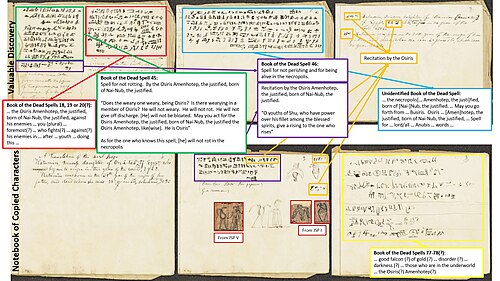
The "Valuable Discovery" notebook is a 24-page volume signed by Joseph Smith, containing characters from a now-lost version of the Book of the Dead for Amenhotep. A second notebook, the "Notebook of Copied Egyptian Characters," contains similar passages and illustrations. While most characters remained untranslated, some were identified as referring to "Katumin, Princess, daughter of On-i-tas King of Egypt." However, modern Egyptologists translate these specific Hieratic characters as "Recitation by the Osiris."
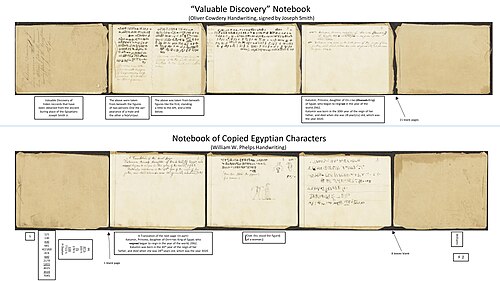
Beyond the notebooks, several other copies of characters exist. These include drawings of baboons and priests offering water, as well as the "Church Historian's Fragment," which contains both pasted papyri and copied characters. Another significant piece is the copy of the hypocephalus (a circular disk placed under the head of a mummy) of Sheshonq, which later informed Facsimile 2 in the Book of Abraham.
The Egyptian Alphabet and Grammar
Joseph Smith and his scribes attempted to create a systematic guide to the Egyptian language. This effort resulted in three "Egyptian Alphabet" documents and a comprehensive "Grammar and Alphabet of the Egyptian Language." These documents functioned like a dictionary, featuring columns for characters, their pronunciations, and their definitions.
Interestingly, not all characters in these documents originated from the papyri. Joseph Smith informed William W. Phelps that some were characters of the Adamic language (the original language spoken by Adam). This is supported by a May 1835 letter from Phelps to his wife, written before the papyri arrived, which included samples of this "pure language."
![Characters with translations taken from the Valuable Discovery notebook. Some of the characters are mirror images of the Egyptian characters.[7]](/images/78/6c/786cd38b77073c29554de80ee051313e34d6a1be8e5e9d851884cce319ecd4fa.jpg)
Summary of Primary Manuscripts
| Category | Key Examples | Primary Scribes | Estimated Date |
|---|---|---|---|
| Notebooks | Valuable Discovery, Notebook of Copied Characters | Cowdery, Phelps, Williams | Early July 1835 |
| Alphabet Docs | Egyptian Alphabet A, B, and C | Smith, Cowdery, Phelps | July–Nov 1835 |
| Grammar | Grammar and Alphabet of the Egyptian Language | Phelps, Parrish | July–Nov 1835 |
| Abraham MSS | Manuscripts A, B, and C; Nauvoo versions | Williams, Parrish, Phelps, Richards | 1835–1842 |
Authorship and Translation Controversy
The scientific and historical value of the Grammar and Alphabet is a subject of significant debate. Egyptologist I. E. S. Edwards described the work as a "piece of imagination" lacking scientific value, a sentiment echoed by Hugh Nibley, who stated it had no practical value.
Historians differ on how these documents relate to the Book of Abraham:
- The Scribe Theory: Jay Todd and Hugh Nibley suggested the Grammar was either reverse-engineered from the translation or produced independently by scribes who had turned against Smith. Samuel M. Brown suggests W. W. Phelps played a major role under Smith's general direction.
- The Modus Operandi Theory: Richard P. Howard and Edward H. Ashment argue that the Grammar was the actual method used to translate the Book of Abraham. Christopher C. Smith supports this, suggesting Joseph Smith was the primary author and that the Grammar's dictionary-like structure explains the "choppiness" of the first three verses of the Book of Abraham.
Book of Abraham Manuscripts
Several manuscripts of the Book of Abraham were produced between July and November 1835, including versions by Frederick G. Williams, Warren Parrish, and William W. Phelps. The most complete of these is Manuscript-C. Later, in 1842, Willard Richards produced further manuscripts in Nauvoo, including an explanation of Facsimile 2 that borrowed heavily from the earlier Grammar and Alphabet volume.
Frequently Asked Questions
What are the Kirtland Egyptian Papers?
They are a collection of notebooks, alphabet documents, and grammar attempts produced by Joseph Smith and his associates in the 1830s and 1840s to translate Egyptian papyri.
Who wrote the "Valuable Discovery" notebook?
The English text and likely the Egyptian characters were written by Oliver Cowdery, though the notebook was signed by Joseph Smith and redacted by Frederick G. Williams.
What is the "Adamic language" mentioned in the papers?
The Adamic language refers to what Joseph Smith described as the original language of humanity. Some characters in the alphabet documents were attributed to this language rather than the Egyptian papyri.
How do modern Egyptologists view the translations?
Modern Egyptologists have found that the characters Smith translated as referring to Princess Katumin and King Onitas actually read "Recitation by the Osiris" in Egyptian Hieratic.
What is the significance of the Grammar and Alphabet volume?
It represents an attempt to systematize the Egyptian language into a dictionary-like format. Scholars debate whether it was a tool used to create the Book of Abraham or an uninspired work created by Smith's scribes.