King's Service Order
The King's Service Order (KSO; Māori: Te Tohu Whakanui Ratonga a te Kīngi) is a prestigious honor awarded by the Monarch of New Zealand. It is designed to recognize individuals who have provided valuable voluntary service to the community or demonstrated meritorious and faithful service to the Crown and the public sector, whether in appointed or elected roles.
Established on March 13, 1975, by Queen Elizabeth II, the order was created following a comprehensive review of New Zealand's honors system in 1974. Its primary purpose was to replace the Imperial Service Order and provide a dedicated way to honor civilian contributions to society.
Key Facts
- Established: March 13, 1975, by Queen Elizabeth II.
- Purpose: Recognizes voluntary community service and meritorious public sector service.
- Eligibility: Civilians only; military service is not eligible.
- Sovereign Head: King Charles III.
- Post-nominals: KSO (current) and QSO (previous).
- Total Inductees: 220 (QSO) and 27 (KSO).
Evolution and History
For nearly five decades, the honor was known as the Queen's Service Order (QSO), reflecting the fact that Queen Elizabeth II was the first monarch officially titled Queen of New Zealand. Following the accession of King Charles III, the order was renamed the King's Service Order on May 3, 2024. This name change does not apply retrospectively to badges already awarded, nor does it change the post-nominals of previous recipients.
Originally, the order was divided into two distinct categories: "For Community Service" and "For Public Services." However, after the institution of the New Zealand Order of Merit in 1996, a review by the Prime Minister's Honours Advisory Committee recommended removing these sub-divisions. In April 2007, a new royal warrant officially reconstituted the Order and its associated medal without these divisions.
Composition and Membership
The Monarch of New Zealand serves as the Sovereign Head, and those appointed to the order are known as Companions. Membership is categorized into four types:
- Ordinary Companions: New Zealand citizens or citizens of Commonwealth realms (limited to 50 appointments per year).
- Extra Companions: Reserved for members of the Royal Family.
- Additional Companions: Appointed for significant royal, state, or national occasions.
- Honorary Companions: Citizens of countries that do not share the New Zealand monarch as their head of state.
The Governor-General of New Zealand holds a unique position as both the Principal Companion and an Additional Companion in their own right. The administrative duties are managed by the Secretary and Registrar of the Order.
Insignia and Symbolism
The insignia of the order features a stylized mānuka flower with five petals. At its center is the effigy of the reigning monarch, surrounded by a red circle inscribed with the words FOR SERVICE — MŌ NGA MAHI NUI, topped with a crown.
The ribbon is rich in cultural symbolism, featuring a traditional Māori Poutama motif. This design consists of black, white, and red ochre (kōkōwai) diagonal steps, which represent human growth and the act of striving ever upwards. The ribbon is edged with red ochre stripes.
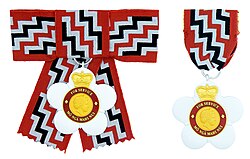
Men wear the insignia on the left lapel of their coat, while women typically wear it from a ribbon tied in a bow at the left shoulder. The Governor-General wears the badge on a thin gold chain.
The King's Service Medal
Closely related to the Order is the King's Service Medal (KSM). This is a silver circular medal featuring the monarch's effigy on the obverse and the Coat of Arms of New Zealand on the reverse. It utilizes the same ribbon and bow pattern as the Order but ranks as a sixth-level honor.
| Feature | King's Service Order (KSO/QSO) | King's Service Medal (KSM/QSM) |
|---|---|---|
| Rank | Fourth-level Order | Sixth-level Honor |
| Recipients | Companions | Medalists |
| Eligibility | Civilians only | Civilians only |
| Symbolism | Mānuka flower insignia | Silver circular medal |
| Ribbon | Māori Poutama motif | Māori Poutama motif |
Frequently Asked Questions
Who is eligible for the King's Service Order?
The order is available to civilians who have provided valuable voluntary service to the community or meritorious service to the Crown and public sector. Military service is not eligible for this specific honor.
What happened to the "Queen's Service Order" title?
Following the accession of King Charles III, the order was renamed the King's Service Order on May 3, 2024. However, this change was not retrospective, meaning previous recipients keep their original titles and post-nominals.
What do the post-nominals QSO and KSO mean?
These are letters placed after a person's name to indicate they are a Companion of the order. QSO refers to the Queen's Service Order, and KSO refers to the King's Service Order.
What is the meaning of the ribbon's design?
The ribbon features the Māori Poutama motif, which consists of diagonal steps symbolizing the growth of mankind and the continuous effort to strive upwards.
How many Ordinary Companions can be appointed each year?
Ordinary membership is limited to 50 appointments per annum.