Kickapoo Tribes and Communities of North America
The Kickapoo people maintain a resilient presence across North America, organized into three federally recognized communities within the United States: Kansas, Texas, and Oklahoma. These groups are not isolated; they are linked by deep familial and cultural ties, particularly the Texas and Mexican Kickapoo. Together, these two branches form a single cross-border nation known as the Kickapoo of Coahuila/Texas. To preserve their shared heritage and kinship, members of these communities migrate annually between their three primary locations.
Key Facts
- Three Federally Recognized Groups: Located in Kansas, Texas, and Oklahoma.
- Cross-Border Identity: The Texas and Mexican branches operate as one nation (Kickapoo of Coahuila/Texas).
- Kansas Leadership: The prophet Kenekuk was instrumental in preserving the tribe's identity and land in Kansas.
- Oklahoma Resilience: The Oklahoma tribe reorganized in 1936 following the dismantling of their government by the Curtis Act.
- Texas Recognition: The Texas Indian Commission officially recognized the Texas tribe in 1977.
Kickapoo Indian Reservation of Kansas
The community in Kansas was shaped significantly by the leadership of the prophet Kenekuk. A strategic leader, Kenekuk worked to maintain the tribe's reservation and preserve the distinct identity of the Kickapoo people following a series of forced relocations. His early leadership was rooted in the religious revivals of the 1820s and 1830s, where he blended elements of Protestantism and Catholicism to teach obedience to God.
However, upon relocating to Kansas, the Kickapoo people shifted their focus away from these Western religious ideologies. Instead, they prioritized farming to ensure the tribe's food security and successfully reclaimed portions of their original ancestral lands. This shift helped the community remain unified and self-sufficient.
The reservation is situated in the northeastern part of Kansas, spanning Brown, Jackson, and Atchison counties. Covering 612.203 square kilometers (236.373 sq mi), it had a resident population of 4,419 as of the 2000 census. While Horton is the largest community, the reservation also includes Muscotah, Netawaka, Powhattan, Whiting, and Willis.
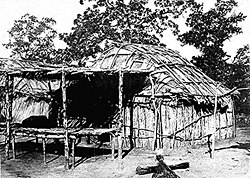
Kickapoo Indian Reservation of Texas
Located on the Rio Grande along the U.S.-Mexico border in western Maverick County, the Kickapoo Indian Reservation of Texas is part of the Rosita South community, just south of Eagle Pass. This reservation is relatively small, covering 0.4799 square kilometers (118.6 acres), and had a population of 420 persons according to the 2000 census. The tribe received official recognition from the Texas Indian Commission in 1977.
Additionally, Maverick County is home to the "South Texas Subgroup of the Kickapoo Tribe of Oklahoma." While this group previously owned 917.79 acres of non-reservation land north of Eagle Pass, most of this land has since been sold to developers, though they maintain an office in the city.
Kickapoo Tribe of Oklahoma
The origins of the Oklahoma community began after the Kickapoo were expelled from the Republic of Texas. While many moved into Mexico, two villages settled in Indian Territory—one within the Muscogee Creek Nation and the other within the Chickasaw Nation. In 1883, they were granted their own reservation and recognized as the Kickapoo Tribe of Oklahoma.
This autonomy was short-lived due to federal legislation. The Dawes Act of 1893 broke up communal tribal lands into individual household allotments, and the Curtis Act of 1898 dismantled the tribal government to encourage assimilation—the process of absorbing a minority group into the dominant culture. These policies created significant hardship for tribal members.
Recovery began in the 1930s when federal and state governments encouraged tribal reorganization. Under the Oklahoma Indian Welfare Act, the Kickapoo Tribe of Oklahoma was formally reorganized in 1936. Today, the tribe is headquartered in McLoud, Oklahoma, with a jurisdictional area covering Pottawatomie, Lincoln, and Oklahoma counties, and a membership of 2,719 enrolled tribal members.
Community Comparison Summary
| Community | Primary Location | Key Historical Event/Figure | Approx. Land Area/Population (2000) |
|---|---|---|---|
| Kansas Reservation | NE Kansas (Brown, Jackson, Atchison) | Leadership of Prophet Kenekuk | 612.203 sq km / 4,419 people |
| Texas Reservation | Maverick County (Rio Grande) | Recognized by Texas Indian Commission (1977) | 0.4799 sq km / 420 people |
| Oklahoma Tribe | McLoud, OK (Pottawatomie, Lincoln, OK) | Reorganized via Oklahoma Indian Welfare Act (1936) | 2,719 enrolled members |
Frequently Asked Questions
What is the relationship between the Texas and Mexican Kickapoo?
The Texas and Mexican Kickapoo are considered the same cross-border nation, known as the Kickapoo of Coahuila/Texas, and they maintain close ties through annual migrations.
Who was Kenekuk and why was he important to the Kansas Kickapoo?
Kenekuk was a prophet and leader who used his influence to help the Kansas Kickapoo maintain their reservation and preserve their cultural identity despite numerous relocations.
How did the Dawes Act and Curtis Act affect the Oklahoma Kickapoo?
The Dawes Act ended communal land ownership by dividing land into individual allotments, and the Curtis Act dismantled the tribal government to force assimilation into the majority culture.
When was the Kickapoo Tribe of Oklahoma reorganized?
The tribe reorganized its government in 1936 under the authority of the Oklahoma Indian Welfare Act.
Where is the largest community on the Kansas reservation located?
The largest community on the Kickapoo Indian Reservation of Kansas is the city of Horton.