KELT-9b: The Hottest Known Exoplanet in the Universe
In the vast expanse of our galaxy, few celestial bodies are as extreme as KELT-9b. This giant exoplanet pushes the boundaries of planetary science, existing in a state so volatile that it challenges our traditional understanding of what a planet can be. From temperatures that rival stars to an atmosphere that is literally evaporating into space, KELT-9b is a laboratory for extreme physics.

Physical Characteristics and Composition
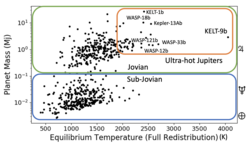
KELT-9b is classified as a hot Jupiter, a class of gas giants that orbit very close to their parent stars. While it is relatively massive—approximately 2.2 times the mass of Jupiter—it is also significantly larger in volume. With a radius nearly twice that of Jupiter, its overall density is less than half that of the largest planet in our solar system.
The planet is tidally locked, meaning one side permanently faces its host star while the other remains in eternal darkness. This configuration creates a stark temperature contrast and extreme atmospheric dynamics. Furthermore, the outer boundary of its atmosphere nearly reaches its Roche lobe—the region around a celestial body within which orbiting material is gravitationally bound to it. Because it is so close to this limit, the intense radiation from the host star drives a rapid process of atmospheric escape.
Data from 2020 indicates that this atmospheric loss is staggering, with an estimated loss rate between 18 and 68 Earth masses every billion years.
Extreme Temperatures and Atmospheric Chemistry
As of 2022, KELT-9b holds the title of the hottest known exoplanet. Its dayside temperatures reach approximately 4,600 K (4,327 °C; 7,820 °F), making it warmer than some K-type stars. These temperatures are so intense that molecules on the dayside are ripped apart into their component atoms.
This process allows refractory elements—materials with very high melting points—to exist as atomic species. Observations have identified neutral oxygen, neutral and singly ionized atomic iron (Fe and Fe+), and singly ionized titanium (Ti). These elements temporarily reform into molecules as they are carried to the cooler night side. This cycle is supported by a measured heat transfer efficiency of 0.3 between the two hemispheres, likely powered by the latent heat released during the dissociation and recombination of molecular hydrogen.
The Thermosphere and Upper Atmosphere
The planet's thermosphere—the outermost layer of the atmosphere—is expected to reach temperatures between 10,000 and 11,000 K (9,727–10,727 °C; 17,540–19,340 °F). This extreme heating is driven by the ionization of heavy metal atoms, such as iron.
Recent findings from June 2026 revealed a self-absorption phenomenon of Hα (hydrogen-alpha) in the upper atmosphere. This discovery suggests that KELT-9b is losing approximately 10 grams of material per second, with vertical outflow wind speeds reaching roughly 5 km/s.
Key Facts
- Temperature: Dayside reaches 4,600 K, hotter than some stars.
- Mass: Approximately 2.2 times the mass of Jupiter.
- Density: Less than half the density of Jupiter due to its large radius.
- Atmospheric Loss: Estimated at 18-68 Earth masses per billion years.
- Composition: Presence of atomic iron, titanium, and oxygen; suspected low carbon-to-oxygen ratio.
- Dynamics: Tidally locked with a vertical outflow wind speed of ~5 km/s.
Summary of Planetary Properties
| Property | KELT-9b Value | Comparison/Note |
|---|---|---|
| Mass | ~2.2 MJ | 2.2x Jupiter mass |
| Radius | ~2x Jupiter radius | Significantly inflated |
| Dayside Temp | 4,600 K | Warmer than some K-type stars |
| Thermosphere Temp | 10,000–11,000 K | Driven by metal ionization |
| Atmospheric Loss | 18-68 MEarth / billion years | Rapid escape via Roche lobe |
Frequently Asked Questions
Why is KELT-9b hotter than some stars?
KELT-9b is so hot because it orbits extremely close to its host star, absorbing an immense amount of radiation. Its dayside temperature of 4,600 K exceeds the surface temperature of some smaller, cooler K-type stars.
What happens to molecules on the dayside of KELT-9b?
The extreme heat causes molecules to break apart into their individual atoms. This allows elements like iron and titanium to exist in atomic or ionized forms, which only recombine into molecules when they migrate to the cooler night side.
What is atmospheric escape in the context of KELT-9b?
Atmospheric escape occurs when the planet's atmosphere is stripped away into space. Because KELT-9b's atmosphere nearly reaches its Roche lobe and is blasted by radiation, it loses mass at a rate of 18 to 68 Earth masses per billion years.
What is the significance of the Hα self-absorption discovery?
The discovery of Hα self-absorption in June 2026 provided evidence of the planet's mass loss in real-time, suggesting a loss of 10 grams per second and wind speeds of approximately 5 km/s in the upper atmosphere.