Keck Observatory Instruments: Tools for Deep Space Exploration
The Keck Observatory utilizes a sophisticated suite of instruments to peer into the farthest reaches of the universe. By combining massive light-gathering power with advanced technology, these tools allow astronomers to analyze the chemical composition, motion, and age of celestial objects. Central to this capability is spectroscopy—the process of breaking light into its component colors to measure intensity and wavelength—and adaptive optics, a system that compensates for the blurring effects of Earth's atmospheric turbulence to produce crystal-clear images.
From hunting for distant exoplanets to mapping the cosmic web, the observatory's instruments operate across various wavelengths, primarily in the optical and near-infrared spectrums.
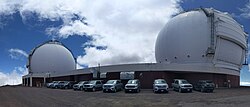
Key Facts
- Adaptive Optics: Keck was the first large telescope to operate a laser guide star adaptive optics system to counteract atmospheric blurring.
- Exoplanet Detection: Instruments like HIRES and the new Keck Planet Finder (KPF) use the radial velocity method to find planets orbiting other stars.
- Massive Scale: The DEIMOS instrument can capture spectra for over 1,200 objects simultaneously in "Mega Mask" mode.
- Precision: The HIRES instrument achieves a radial velocity precision of up to 1.0 meter per second.
- Infrared Specialization: Many instruments, such as MOSFIRE and NIRC-2, specialize in the near-infrared range (approximately 0.9 to 5 micrometers).
Current Scientific Instrumentation
Near-Infrared Specialists
The observatory employs several instruments designed to detect infrared light, which can penetrate cosmic dust and reveal distant, redshifted objects.
- MOSFIRE (Multi-Object Spectrometer for Infra-Red Exploration): Delivered in 2012, this third-generation instrument operates between 0.97 and 2.41 μm. Its standout feature is a cryogenic Configurable Slit Unit (CSU) that can be remotely reconfigured in under six minutes to form up to 46 slits, or used as a wide-field imager.
- NIRC-2 (Near Infrared Camera 2): Working with adaptive optics, NIRC-2 provides high-resolution imaging and spectroscopy in the 1–5 μm range, ideal for mapping Solar System bodies and analyzing remote galaxy morphology.
- NIRES (Near-Infrared Echellette Spectrometer): This spectrograph provides simultaneous wavelength coverage from 0.94 to 2.45 microns.
- NIRSPEC (Near Infrared Spectrometer): Used for studying brown dwarfs, the Galactic Center, and high redshift radio galaxies.
- OSIRIS (OH-Suppressing Infrared Imaging Spectrograph): This instrument filters out the bright emissions of hydroxyl (OH) molecules from Earth's atmosphere, allowing astronomers to detect objects 10 times fainter than previously possible.
Optical and High-Resolution Spectrographs
For precise measurements of light and chemical signatures, Keck relies on high-resolution optical tools.
- HIRES (High Resolution Echelle Spectrometer): The most mechanically complex main instrument, HIRES has provided evidence for the Big Bang theory and detected planets outside our Solar System. It has a detection limit of 0.2 MJ at 1 AU.
- KPF (Keck Planet Finder): Achieving first light in 2022, this extremely stable spectrograph is specifically designed to identify exoplanets via the radial velocity method.
- ESI (Echellette Spectrograph and Imager): A high-resolution spectrograph for optical wavelengths that also supports imaging.
Wide-Field and Cosmic Mapping Tools
To study the large-scale structure of the universe, Keck uses instruments capable of observing many objects at once.
- DEIMOS (Deep Extragalactic Imaging Multi-Object Spectrograph): Capable of gathering spectra from 130+ galaxies in one exposure, or over 1,200 objects using a narrow-band filter in "Mega Mask" mode.
- KCWI (Keck Cosmic Web Imager): An integral field spectrograph originally covering 350 to 560 nm, now extended to 1050 nm via the Keck Cosmic Reionization Mapper (KCRM).
- LRIS (Low Resolution Imaging Spectrograph): A faint-light instrument with red and blue arms used to explore quasars, galactic clusters, and active galactic nuclei.
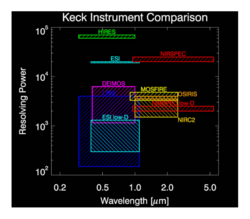
Instrument Summary Table
| Instrument | Primary Function | Wavelength/Specialty | Key Capability |
|---|---|---|---|
| MOSFIRE | Multi-Object Spectrograph | Near-Infrared (0.97-2.41 μm) | Rapidly reconfigurable cryogenic slits |
| HIRES | Echelle Spectrometer | High-Resolution Optical | 1.0 m/s radial velocity precision |
| DEIMOS | Multi-Object Spectrograph | Extragalactic Imaging | Up to 1,200 objects in Mega Mask mode |
| KPF | High-Res Spectrograph | Exoplanet Hunting | Extreme stability for radial velocity |
| NIRC-2 | Infrared Camera | Near-Infrared (1-5 μm) | Adaptive Optics integration |
| OSIRIS | Infrared Spectrograph | Near-Infrared | OH-emission suppression |
Retired Instrumentation
Over the decades, several pioneering instruments have paved the way for current technology. The NIRC (Near Infrared Camera) was once sensitive enough to detect a single candle flame on the Moon, contributing heavily to studies of the Galactic Center before its retirement in 2010. The LWS (Long Wavelength Spectrometer) operated in the 3-25 micron range for planetary and cometary research. Additionally, the Keck Interferometer, which combined light from both telescopes to create an effective 85-metre baseline with an angular resolution of 5 mas at 2.2 μm, was discontinued in mid-2012.
Frequently Asked Questions
What is the purpose of the Keck Planet Finder (KPF)?
The KPF is a high-resolution, extremely stable spectrograph designed to identify exoplanets using the radial velocity method, which detects the slight wobble of a star caused by an orbiting planet.
How does OSIRIS improve the detection of faint objects?
OSIRIS suppresses the bright emissions of hydroxyl (OH) molecules in Earth's atmosphere. By ignoring these bright wavelengths, it can detect objects 10 times fainter than previous instruments.
What makes MOSFIRE unique compared to other spectrographs?
MOSFIRE features a cryogenic Configurable Slit Unit (CSU) that can be remotely reconfigured in less than six minutes without requiring thermal cycling, allowing it to switch between multi-object spectroscopy and wide-field imaging.
What is the role of Adaptive Optics at Keck?
Adaptive Optics use laser guide stars to compensate for atmospheric turbulence, which normally blurs the light from distant stars. This allows ground-based telescopes to achieve image resolutions that rival space-based observatories.
What is the difference between DEIMOS and HIRES?
DEIMOS is designed for wide-field, multi-object surveys (capturing spectra for hundreds or thousands of galaxies at once), whereas HIRES is a high-resolution instrument designed for extreme precision on individual targets, such as measuring radial velocity to 1.0 m/s.