Spitzer Space Telescope: Mapping the Infrared Universe
The Spitzer Space Telescope revolutionized our view of the cosmos by capturing light in the infrared spectrum—wavelengths that are invisible to the human eye but essential for peering through cosmic dust. By detecting heat signatures, Spitzer allowed astronomers to observe the coldest reaches of space, from the birth of stars to the distant edges of the observable universe.
To maximize its scientific output, NASA implemented Legacy Projects. These were large, coherent investigations designed to ensure high-level data was gathered quickly, especially in the event of early technical failure or cryogen depletion. These teams provided high-level data products to the Spitzer Science Center and the NASA/IPAC Infrared Science Archive, fostering a community-driven approach to discovery that continued throughout the mission's lifespan.
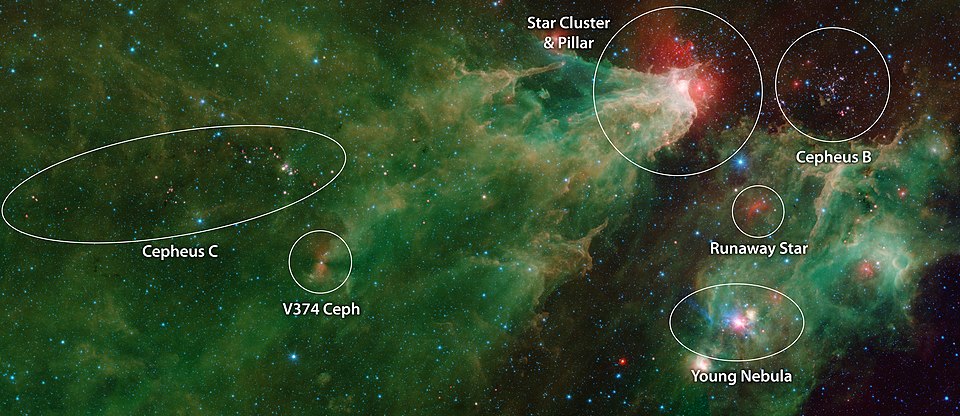
Key Facts
- Primary Focus: Observed young stellar objects (YSOs), exoplanets, and distant galaxies.
- Major Surveys: GLIMPSE and MIPSGAL provided the first large-scale infrared maps of the Milky Way.
- Exoplanet Milestones: Directly captured light from "hot Jupiters" and identified Earth-sized planets in the TRAPPIST-1 system.
- Deep Space: Helped identify GN-z11, one of the most distant known galaxies, seen as it was 13.4 billion years ago.
- Technical Adaptation: Modified hardware during its "warm" mission to enhance stability for exoplanet hunting.
Mapping the Milky Way and Beyond
One of Spitzer's most enduring contributions was the detailed mapping of our own galaxy. The GLIMPSE (Galactic Legacy Infrared Mid-Plane Survey Extraordinaire) survey captured over 2 million snapshots across four wavelengths over a decade. This was complemented by MIPSGAL, which used 24 and 70 μm channels to cover 248° of the galactic disk.
In 2008, these efforts culminated in the largest and most detailed infrared portrait of the Milky Way, created by stitching together 800,000 snapshots. Other galactic discoveries included the revelation that the Milky Way possesses a more substantial bar structure across its core than previously believed.
The Double Helix Nebula
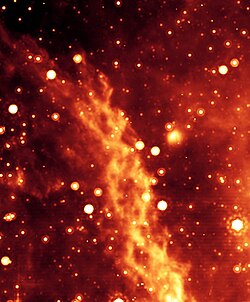
In 2006, Spitzer discovered the Double Helix Nebula, a twisted spiral of gas 80 light-years long. Located near the galactic center, this structure is believed to be the result of massive magnetic fields generated by the gas disc orbiting the supermassive black hole at the center of our galaxy.
The Life Cycle of Stars and Planets
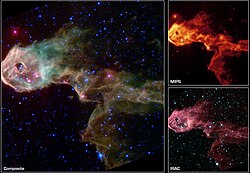
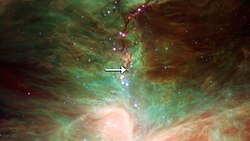
Spitzer provided critical insights into how stars and planetary systems form. In 2004, it detected a bright red hot spot within the gas and dust cloud L1014, identifying what may be one of the youngest stars ever seen. The telescope also observed the star EX Lupi, discovering that forsterite (a type of silicate crystal) could be formed by radiative heating during stellar outbursts.
This discovery helped solve a long-standing mystery regarding how high-temperature crystals end up in frozen comets. Scientists believe bipolar outflows—powerful streams of gas ejected from a protostar—transport these heated crystals from the inner disk to the colder outer regions of the accretion disk.
Exoplanet Discoveries
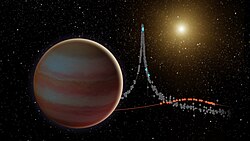
While not originally designed as a planet hunter, Spitzer was adapted to study exoplanets using transit photometry (measuring the dip in a star's brightness as a planet passes in front) and gravitational microlensing (observing how a planet's gravity bends light from a distant star).
- Direct Detection: In 2005, it was among the first to directly capture light from "hot Jupiters" HD 209458 b and TrES-1b.
- Atmospheric Mapping: In 2007, it mapped the atmospheric temperature of HD 189733 b.
- TRAPPIST-1: Spitzer discovered five of the seven planets in this system, three of which reside in the habitable zone, where liquid water could potentially exist.

Advanced Cosmic Observations
Spitzer's reach extended to the very beginning of time. Researchers reported that an image of a quasar in the Draco constellation contained an infrared glow that may represent the light of the first stars, formed just 100 million years after the Big Bang.
The telescope also explored the fringes of our solar system, discovering the Phoebe ring of Saturn—a tenuous disc of material extending 128 to 207 times the radius of the planet. In the realm of deep space, it collaborated with the Hubble Space Telescope to identify galaxy GN-z11, providing a glimpse of the universe 13.4 billion years ago.
The "Beyond" Mission
Starting in October 2016, the "Beyond" extended mission focused on identifying candidates for the James Webb Space Telescope. This phase presented engineering challenges; as Spitzer moved further from Earth, its antenna required higher angles for communication, which increased solar heating on the spacecraft while reducing the sunlight hitting its solar panels.
Summary of Major Spitzer Discoveries
| Target/Object | Discovery/Finding | Significance |
|---|---|---|
| TRAPPIST-1 | Seven Earth-sized planets | Three located in the habitable zone |
| GN-z11 | Distant galaxy | Seen as it appeared 13.4 billion years ago |
| Double Helix Nebula | Twisted spiral nebula | Evidence of massive magnetic fields at galactic center |
| EX Lupi / HOPS-68 | Forsterite crystals | Explains presence of crystals in cold comets |
| Saturn | Phoebe ring | Identified a massive, tenuous outer disc |
Frequently Asked Questions
How did Spitzer detect exoplanets if it wasn't originally designed for it?
Engineers tweaked the hardware by modifying the heating cycle to double stability, utilizing the "peak-up" camera in new ways, and analyzing sensors at a sub-pixel level. It primarily used transit photometry and gravitational microlensing.
What are Legacy Projects in the context of Spitzer?
Legacy Projects were large-scale investigations that required teams to provide high-level data products back to the scientific community, ensuring a rapid and wide-reaching scientific return on the mission's funding.
What is the significance of the forsterite crystals found by Spitzer?
Forsterite crystals require high temperatures to form. Finding them in cold molecular clouds suggests that bipolar outflows from young stars transport heated material from the inner disk to the outer, colder regions.
What was the purpose of the "Beyond" mission?
The Beyond mission was an extended phase designed to identify promising targets for the James Webb Space Telescope and to manage the engineering challenges of Spitzer's increasing distance from Earth.
What is the difference between GLIMPSE and MIPSGAL?
GLIMPSE provided a 360° large-scale map of the inner Milky Way using the Infrared Array Camera, while MIPSGAL complemented this by covering 248° of the galactic disk using the 24 and 70 μm channels of the MIPS instrument.