Kashubian Language: History, Status, and Linguistic Heritage
The Kashubian language (kaszëbsczi jãzëk) is a unique West Slavic tongue spoken primarily in the region of Kashubia, located within the Pomeranian Voivodeship of Poland. As a member of the Lechitic subgroup of the Pomeranian branch, it represents a vital link to the linguistic history of the Baltic coast. While it shares deep roots with Polish, it maintains distinct phonological and grammatical characteristics that define the identity of the Kashubian people.
Today, Kashubian exists in a delicate balance. While it is the only language in Poland to hold the legal status of a regional language, it is classified as Definitely Endangered by the UNESCO Atlas of the World's Languages in Danger.
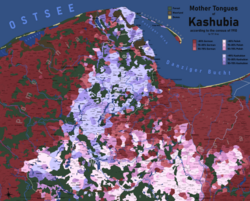
Key Facts
- Language Family: Indo-European → Balto-Slavic → Slavic → West Slavic → Lechitic → Pomeranian.
- Native Speakers: Approximately 87,600 people declared using it at home in the 2021 census.
- Official Status: Recognized as a regional language in Poland since 2005.
- Geographic Core: The Pomeranian Voivodeship, Poland.
- Writing System: Latin-based Kashubian alphabet.
Speakers and Geographic Distribution
Presence in Poland
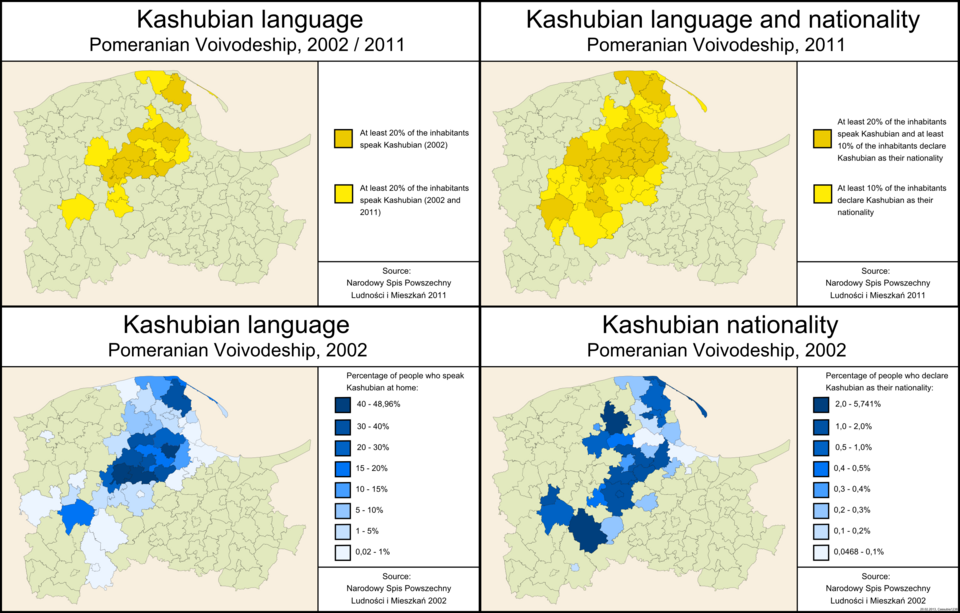
The number of Kashubian speakers has seen a decline in recent census data. In 2011, over 108,000 people reported using the language at home, a figure that dropped to roughly 87,600 by 2021. More strikingly, the number of exclusive Kashubian speakers fell from 3,800 to 1,700 in that same decade. However, linguists suggest these numbers may be influenced by changes in census methodology and the socio-political environment. A broader estimate suggests that around 366,000 people possess at least some proficiency in the language.
In practice, Kashubian is primarily used for informal communication among family and friends, while Polish remains the dominant language for formal settings. Despite this, it serves as an official alternative language for local administration in several communes, including Gmina Sierakowice, Gmina Linia, Gmina Parchowo, Gmina Luzino, and Gmina Żukowo.
The Diaspora in the Americas
Between 1855 and 1900, a significant diaspora occurred, with 115,700 Kashubians emigrating to North America, including approximately 15,000 to Brazil. In Renfrew County, Ontario, the language persists to this day. Conversely, in Winona, Minnesota—once dubbed the "Kashubian Capital of America"—the language struggled against Polonization. Often dismissed as "poor Polish" compared to the "good Polish" used by clergy, the language eventually died out after the mid-20th century.
Linguistic Characteristics and Dialects
Dialectal Diversity
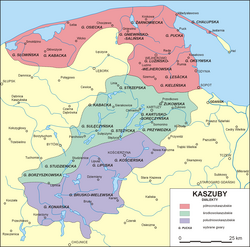
In the early 20th century, scholar Friedrich Lorentz identified three primary dialects: Northern, Middle, and Southern. Other recognized variations include the Bylacki, Slowinski, Kabatkow, and Zaborski dialects.
Phonology and Vocabulary
Kashubian is distinguished from Polish by several phonological processes. For example, it retains softness before -ar- (e.g., czwiôrtk vs. Polish czwartek) and exhibits a specific change where Proto-Slavic *-ъl- / *-ьl- becomes -ôł- (e.g., kôłbasa vs. Polish kiełbasa). Other notable features include the labialization of initial o- and the reduction of certain consonant clusters in common words.
The Kashubian Alphabet
The language uses a modified Latin script. Unique characters include Ë (the schwa [ə]), Ô (which varies in pronunciation from [ɞ] to [o] depending on the dialect), and Ą and à for nasal sounds. Digraphs such as cz, sz, and rz are also employed to represent specific phonemes.
Literature and Education
Literary Contributions
Kashubian literature has been shaped by several key figures. Florian Ceynowa's Xążeczka dlo Kaszebov was a pivotal work, and Aleksander Majkowski authored the national epic, The Life and Adventures of Remus. Other notable writers include Hieronim Derdowski, Jan Trepczyk, and Stanisław Pestka. The language has also seen significant religious translation, including the New Testament, largely through the work of Adam Ryszard Sikora.
Educational Evolution
During the communist era (1948–1989), Kashubian was marginalized and treated merely as folklore, with its teaching in schools prohibited. Since the fall of communism, its status has improved. While not a mandatory subject, it is offered as an optional language (typically 3 hours per week) at the request of parents. Since 1991, approximately 17,000 students across 400 schools have studied the language.
Legal Status and Protection
The Act of 6 January 2005 officially recognized Kashubian as a regional language in Poland. This legal protection allows for its use in official contexts in ten communes where speakers make up at least 20% of the population. This recognition has led to the installation of bilingual road signs and public amenities in heavily populated Kashubian areas.
| Category | Details |
|---|---|
| Classification | West Slavic (Lechitic/Pomeranian) |
| UNESCO Status | Definitely Endangered |
| Home Speakers (2021) | ~87,600 |
| Legal Status | Official Regional Language (since 2005) |
| Primary Region | Pomeranian Voivodeship, Poland |
Frequently Asked Questions
Is Kashubian a dialect of Polish?
No. While it is closely related to Polish and all Kashubian speakers are fluent in Polish, it is classified as a separate language within the West Slavic, Lechitic group.
Where is Kashubian officially spoken today?
It is spoken in the Kashubia region of Poland's Pomeranian Voivodeship and holds official regional status in specific communes where it is spoken by at least 20% of the population.
Why is Kashubian considered endangered?
The language has faced historical suppression, particularly during the communist period, and continues to struggle against the dominance of Polish in formal, educational, and administrative settings.
Can Kashubian be learned in schools?
Yes, it is included in the educational program in Kashubia. However, it is taught as an optional subject (similar to a foreign language) for three hours per week upon the explicit request of parents.
Did Kashubian survive in North America?
It survived in some areas, such as Renfrew County, Ontario. However, in other locations like Winona, Minnesota, it died out by the mid-20th century due to the process of Polonization.