Julio de Caro: The Visionary Architect of Argentine Tango
Julio de Caro (1899–1980) stands as one of the most influential figures in the history of Tango, the passionate musical genre and dance born in the Río de la Plata region. A prolific composer, musician, and conductor, de Caro transformed the sound of tango, elevating it from the streets of Buenos Aires to the world's most prestigious concert halls and opera houses.
Early Life and Musical Rebellion
Born on December 11, 1899, Julio grew up in a household steeped in formal music. His father operated a well-known conservatory in the San Telmo district of Buenos Aires, providing instruments and lessons to the city's aspiring musicians. While Julio and his brother Francisco were initially taught the piano and violin respectively, they eventually swapped instruments to suit their preferences.
Despite his father's disdain for popular music, Julio was drawn to the burgeoning tango scene. In 1915, he defied his father's wishes to perform as a second violinist in a zarzuela (a Spanish lyric-dramatic genre that alternates between spoken and sung scenes) at the Lorea Theatre. This rebellion continued as the brothers secretly attended recitals by legendary bandleaders such as Eduardo Arolas, Juan Carlos Cobián, and Roberto Firpo.
Julio's big break came in 1917 at the Palais de Glace. After a spontaneous performance that earned a standing ovation, Eduardo Arolas offered him a permanent position in his orchestra. To join, Julio had to use stealth to bypass his father's objections. It was during this tenure that he wrote his first tango, Mon beguin.
Rise to International Prominence
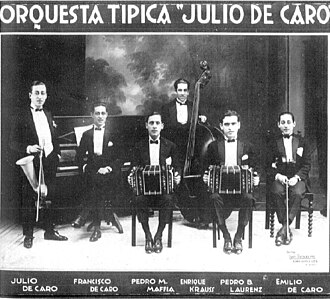
The tension at home eventually peaked when Julio's father forced him out of the house at age 18. Francisco joined his brother, and together they toured Argentina and Uruguay with Arolas' orchestra. During this period, they composed several tango standards, including Mala pinta, Mi encanto, and Bizcochito.
After a brief period of forming various quartets and touring the United States with Osvaldo Fresedo, Julio and Francisco reunited to lead their own ensemble at the end of 1923. Their success was immediate, securing lucrative contracts in downtown cafés and the emerging medium of radio. The Julio de Caro Orchestra soon signed with RCA Victor and performed for Edward, the Prince of Wales, in April 1925.
During this era, jazz legend Paul Whiteman introduced de Caro to the Stroh violin. This unique instrument featured a cornet horn attached to the body to project sound more effectively, making it an essential tool for radio broadcasts where the violin needed to be heard over the rest of the orchestra.
Global Reach and Artistic Legacy
By 1931, the orchestra's fame reached Europe. They toured France, performing for the Rothschilds and Prince Umberto di Savoia at the Palais de la Méditerranée in Nice. They also collaborated with Paramount Studios for the film Luces de Buenos Aires, starring the iconic Carlos Gardel.
Back in Argentina, de Caro reached the pinnacle of musical prestige, debuting at the Colón Theatre in 1935. In 1936, at the Teatro Opera, he presented a comprehensive production titled "Evolution of the Tango," which traced the genre's development from 1870. This period also marked a poignant family reconciliation when his aging parents attended one of his performances.
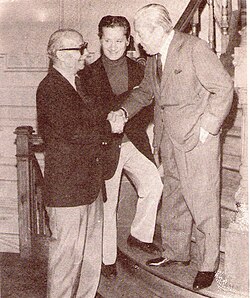
De Caro continued to mentor new talent, including the renowned vocalist Edmundo Rivero. Although he retired from his orchestra in 1954, he returned to the studio in 1975 for the project Los 14 de Julio de Caro, collaborating with figures such as author Ernesto Sábato and composer Ben Molar.
Key Facts
- Birth/Death: December 11, 1899 – March 11, 1980.
- Key Innovation: Adopted the Stroh violin to enhance sound projection for radio.
- Major Venues: Performed at the Colón Theatre, Teatro Opera, and Palais de la Méditerranée.
- Notable Works: Composed standards such as Mala pinta and Bizcochito.
- National Honor: His birthday, December 11, was declared "National Tango Day" in Argentina.
| Year | Milestone | Significance |
|---|---|---|
| 1917 | Joins Eduardo Arolas' Orchestra | Professional start and first composition (Mon beguin). |
| 1925 | Performance for Prince of Wales | Established high-society prestige and RCA Victor contract. |
| 1931 | European Tour | Expanded tango's reach to France and Paramount Studios. |
| 1935 | Colón Theatre Debut | Validation of tango in Argentina's premier opera house. |
| 1977 | Luna Park Ovation | Public celebration of his legacy on National Tango Day. |
Frequently Asked Questions
What was the Stroh violin and why did Julio de Caro use it?
The Stroh violin is a modified violin with a metal cornet horn instead of a wooden body. Julio de Caro used it because the horn projected sound more loudly and clearly, which was essential for radio performances to ensure the violin could be heard over the other instruments.
How did Julio de Caro's relationship with his father affect his career?
His father, a conservatory owner, initially opposed his interest in popular tango music. This conflict led Julio to join orchestras in secret and eventually resulted in him being forced out of the house at 18, which paradoxically pushed him and his brother Francisco to pursue their professional careers full-time.
What is the significance of December 11 in Argentine culture?
December 11 is recognized as "National Tango Day" in Argentina. This date coincides with the birthday of Julio de Caro (and also the legendary Carlos Gardel), honoring the contributions of these masters to the genre.
Which famous venues did the Julio de Caro Orchestra perform in?
The orchestra performed at some of the most prestigious venues of the era, including the Colón Theatre and Teatro Opera in Buenos Aires, the Palais de Glace, and the Palais de la Méditerranée in Nice, France.
Who were some of Julio de Caro's notable collaborators?
Throughout his career, he worked with his brother Francisco, bandleaders like Eduardo Arolas and Osvaldo Fresedo, vocalist Edmundo Rivero, and later in life, author Ernesto Sábato and composer Ben Molar.