Understanding Juche: The Core Ideology of North Korea
To understand the political, social, and economic landscape of North Korea, one must understand Juche (pronounced *joo-chay*). Often translated as the "subject idea," Juche serves as the guiding ideological framework for the Democratic People's Republic of Korea (DPRK). While it has roots in traditional Marxism–Leninism, it has evolved into a distinct system that emphasizes national independence and self-reliance.
Originally attributed to the country's founder, Kim Il Sung, the ideology was later refined and expanded by his son and successor, Kim Jong Il. Today, it influences everything from the nation's calendar to its industrial production and foreign policy.
Key Facts
- Core Concept: Emphasizes self-reliance and national independence.
- Origin: Attributed to Kim Il Sung; developed into a distinct ideology by Kim Jong Il in the 1970s.
- The Juche Calendar: Uses the birth year of Kim Il Sung (1912) as Year 1.
- Economic Impact: Driven by an autarkic (self-sufficient) model, including the use of "Juche fiber" (vinylon).
- Socialism of Our Style: A concept introduced by Kim Jong Il to distinguish North Korean socialism from the Soviet model.
The History and Evolution of Juche
The conceptualization of Juche is a subject of significant scholarly discussion. While North Korean sources credit Kim Il Sung with its creation, many Western scholars, such as Andrei Lankov, suggest the ideology emerged more formally through specific political milestones. Lankov notes that while the term was used in a 1955 speech, it was not adopted as the "basic ideological principle of North Korean politics" until after a 1965 speech delivered by Kim Il Sung in Indonesia.
Scholars generally agree that Hwang Jang-yop, a top adviser to Kim Il Sung, played a crucial role in the early development of the ideology. Hwang is credited with expanding the meaning of Juche and reshaping Korean communist history to solidify Kim Il Sung's leadership within the Workers' Party of Korea (WPK).
The Transition from Marxism–Leninism
Initially, Juche was viewed as a variant of Marxism–Leninism. However, during the 1970s, Kim Jong Il declared it a separate, distinct ideology. Throughout the 1980s and 1990s, he continued to distance the doctrine from traditional Marxism–Leninism, placing greater emphasis on his father's specific ideas and the unique historical context of Korea.
The Juche Calendar
In a unique application of this ideology, the North Korean government adopted the Juche calendar. Following a decree in 1997, the calendar marks years based on the birth of Kim Il Sung in 1912. Under this system, the year 1912 is Juche 1, and the year 2026 is designated as Juche 115.
In official usage, the Juche year is often presented alongside its Gregorian equivalent to ensure international clarity, such as "Juche 115 (2026)."
Juche in Practice: Economics and Self-Reliance
One of the most visible manifestations of Juche is in North Korea's pursuit of an autarkic economy—an economy designed to be as self-sufficient as possible. Following the devastation of the Korean War, the nation focused on building a heavy industry base to minimize dependence on foreign powers.
Industrial Self-Sufficiency
While North Korea received aid from the Soviet Union and China, it notably did not join Comecon (the communist common market). This isolationist economic approach led to several unique developments:
- Energy: To reduce petroleum dependence, the country relies heavily on coal and hydroelectric power.
- Textiles: The production of vinylon, known as "Juche fiber," is a point of national pride. Made from locally available coal and limestone, it is frequently used in propaganda to demonstrate technological self-reliance.
- Manufacturing: The nation has invested in domestic technology, including the development of homemade Computer Numerical Control (CNC) machines, which grew from the first domestic model in 1995 to approximately 15,000 machines by 2017.
"Socialism of Our Style"
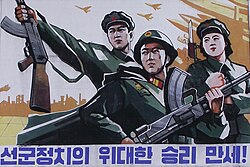
In December 1990, Kim Jong Il introduced the concept of "Socialism of Our Style" (also known as Korean-style socialism). This was a direct response to the collapse of the Eastern Bloc and the revolutions of 1989. Kim Jong Il argued that the socialist systems in Eastern Europe failed because they "imitated the Soviet experience in a mechanical manner" without accounting for their own specific historical and social circumstances.
By emphasizing "our style," the leadership asserted that North Korea could build a successful socialist state by applying the Juche idea rather than dogmatically following foreign models of Marxism–Leninism.
| Feature | Juche Application |
|---|---|
| Economic Goal | Autarky (Self-sufficiency) |
| Primary Energy Sources | Coal and Hydroelectric power |
| Key Textile Product | Vinylon ("Juche fiber") |
| Ideological Model | Socialism of Our Style |
Frequently Asked Questions
What is the meaning of the word "Juche"?
Juche is often translated as "subject idea" or "self-reliance." It represents the principle that the people are the masters of their own destiny and must maintain independence in politics, economy, and defense.
How does the Juche calendar work?
The Juche calendar counts years starting from 1912, the birth year of Kim Il Sung. To find the Juche year, you subtract 1911 from the current Gregorian year.
What is "Socialism of Our Style"?
Introduced by Kim Jong Il, this concept argues that socialism must be adapted to the specific historical and social conditions of a country rather than being a "mechanical" imitation of the Soviet Union or other foreign models.
How does Juche affect North Korea's economy?
Juche encourages an autarkic economy, meaning the country strives to produce its own essential goods—such as vinylon fiber from coal—to reduce reliance on imports and foreign aid.
Is Juche the same as Marxism–Leninism?
While it originated from Marxist–Leninist roots, Juche was developed into a distinct ideology that breaks from traditional Marxist–Leninist dogmas to focus on Korean national identity and the leadership of the Kim family.