Juan de Garay: The Conquistador Who Founded Buenos Aires
Juan de Garay was a prominent Spanish conquistador—a professional soldier and explorer—who played a pivotal role in the early colonization of South America. Serving under the Crown of Castile within the Viceroyalty of Peru, Garay is most remembered for his administrative leadership in Paraguay and his instrumental role in the second foundation of Buenos Aires.
His career was marked by a transition from military expeditionary work to political governance, where he sought to establish permanent settlements and structured governance in the Paraná River basin.
Key Facts
- Born: 1528 in Biscay, Spain (though some sources dispute the exact location).
- Major Achievement: Re-founded Buenos Aires on June 11, 1580.
- Political Roles: Governor of Asunción and Governor of the Río de la Plata and Paraguay.
- City Foundations: Founded Santa Fe de la Vera Cruz and the second iteration of Buenos Aires.
- Death: Killed in 1583 during an ambush by Querandíes natives.
Early Life and Military Beginnings
The exact birthplace of Juan de Garay remains a subject of historical debate. While some records suggest he was born in Junta de Villalba de Losa in Castile, others point to Orduña in the Basque Country. Regardless of the specific town, Garay identified himself as being from Biscay, a region in the Basque Country.
Garay's journey to the New World began in 1543 when he sailed to Peru as part of the first expedition of Viceroy Blasco Núñez Vela, accompanying his uncle, Pedro de Zárate. His early years in the Americas were defined by exploration and settlement, including his participation in the foundation of Santa Cruz de la Sierra in 1561.
Political Rise and the Foundation of Santa Fe
By 1568, Garay had moved to Asunción, where he began to gain significant political influence. In April 1573, the governor of Asunción commissioned him to lead an expedition of eighty men to the Paraná River. This mission resulted in the foundation of the city of Santa Fe de la Vera Cruz.
Garay's leadership capabilities led to his appointment as the governor of Asunción in 1576. During his tenure, he focused on introducing justice and civilization to the indigenous populations, aiming to foster peace through the establishment of Indian villages and the implementation of local governance systems.
The Second Foundation of Buenos Aires
In 1580, holding the rank of Capitan General of the Viceroyalty, Garay set out to re-establish a settlement on the banks of the Río de la Plata. A previous attempt by Pedro de Mendoza in 1536 had resulted in the creation of Nuestra Señora del Buen Ayre, but that settlement had been destroyed by native populations.
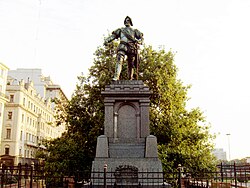
On June 11, 1580, Garay landed at the site now known as the Plaza de Mayo. He named the new settlement Ciudad de la Trinidad and designated its port as Santa Maria de Buenos Ayres. This second foundation ensured that Buenos Aires would grow into the primary port and most significant city of the Paraná basin.
Final Expeditions and Death
Following the establishment of Buenos Aires, Garay spent the years between 1581 and 1582 leading an expedition in search of the legendary City of the Caesars, a mythical city of gold and riches.
His life came to a violent end on March 20, 1583. While traveling from Buenos Aires to Santa Fe with a group consisting of 40 men, a Franciscan priest, and several women, the party camped on the banks of the Carcarañá River near the ancient Sancti Spíritus Fort. They were ambushed by Querandíes natives, resulting in the deaths of Garay, the priest, one woman, and twelve soldiers.
Family and Legacy
Garay came from a family of some economic and cultural standing; his uncle served as Judge and Alcalde Mayor of Segovia, and his cousin studied at the University of Salamanca. He was married twice, first to Isabel de Becerra and later to Juana de Espindola y Palomino. He had a son, Juan de Garay y Becerra, and a daughter, Jerónima de Contreras, who married the governor of Rio de la Plata, Hernando Arias de Saavedra.
In his ancestral home in Biscay, the palace-baserri (a traditional Basque farmhouse) known as Garatikua—later called "Garay-Goitia" in the 19th century—stands as a testament to his family's origins.
| Period/Date | Role/Event | Location |
|---|---|---|
| 1543 | First expedition to Peru | Peru |
| 1561 | Foundation of Santa Cruz de la Sierra | Bolivia (Modern) |
| 1573 | Foundation of Santa Fe de la Vera Cruz | Argentina (Modern) |
| 1576-1578 | Governor of Asunción | Paraguay (Modern) |
| June 11, 1580 | Second foundation of Buenos Aires | Argentina (Modern) |
| 1581-1582 | Search for the City of the Caesars | South America |
| March 20, 1583 | Death by ambush | Carcarañá River |
Frequently Asked Questions
Where was Juan de Garay born?
His exact birthplace is disputed; some sources cite Junta de Villalba de Losa in Castile, while others suggest Orduña in the Basque Country. However, Garay himself identified as being from Biscay.
Why is Buenos Aires said to have been founded twice?
The first settlement, Nuestra Señora del Buen Ayre, was established by Pedro de Mendoza in 1536 but was destroyed by native inhabitants. Juan de Garay successfully re-founded the city on June 11, 1580.
What was Garay's goal as Governor of Asunción?
His primary objective was to foster peace and harmony among indigenous populations by introducing justice, civilization, and local governance systems through the creation of Indian villages.
How did Juan de Garay die?
He was killed on March 20, 1583, during an ambush by Querandíes natives while camping on the banks of the Carcarañá River during a journey from Buenos Aires to Santa Fe.
What was the original name of Buenos Aires under Garay?
When Garay founded the city in 1580, he called the settlement Ciudad de la Trinidad and named its port Santa Maria de Buenos Ayres.