Juan Carlos Onganía: The Dictatorship of the Argentine Revolution
Juan Carlos Onganía Carballo was a high-ranking military officer who served as the 35th President of Argentina from June 29, 1966, to June 8, 1970. Rising to power through a coup d'état known as the Argentine Revolution, Onganía overthrew President Arturo Umberto Illia to establish a de facto regime. Unlike previous military interventions that served as temporary transitions, Onganía sought to implement a permanent, paternalistic social and political order modeled after Francoist Spain.
Key Facts
- Term: June 29, 1966 – June 8, 1970.
- Rise to Power: Toppled Arturo Illia via a military coup.
- Political Ideology: Opposed both liberal democracy and communism.
- Key Event: Orchestrated the "Night of the Long Police Batons," leading to a massive academic brain drain.
- Downfall: Removed by a military junta following popular uprisings and internal military dissent.
The Authoritarian-Bureaucratic State
Onganía's administration aimed to redefine the role of the Armed Forces, positioning them as the primary leaders in Argentina's political and economic operations. Political scientist Guillermo O'Donnell categorized this regime as an authoritarian-bureaucratic state, a term also applied to similar military regimes in Brazil, Chile, and Uruguay during the mid-to-late 20th century.
Economic and Social Policies
To manage the state, Onganía suspended political parties and introduced Participacionismo (Participationism). This system created committees of industry, labor, and agriculture representatives to advise the government, though these members were largely appointed by Onganía himself. He further consolidated power by suspending the right to strike through Law 16,936.
Under Minister of Economy Adalbert Krieger Vasena, the government implemented a 40% devaluation and a wage freeze to combat 30% inflation. These measures favored foreign capital but negatively impacted the domestic economy, particularly agriculture. Additionally, the government reformed the Fossil Fuels Law, reducing the monopoly of the state enterprise Yacimientos Petrolíferos Fiscales (YPF).
Cultural Repression and Education
Onganía's rule was marked by a rigid campaign against "immoralism" and a total end to university autonomy, which had been established by the University Reform of 1918. He prohibited miniskirts, long hair for boys, and public kissing, while censoring avant-garde art and "obscene" literature, including books like Lolita and Nexus.
One of the most infamous episodes of his presidency occurred just one month into his term. Onganía ordered police to invade the Faculty of Sciences at the University of Buenos Aires, resulting in the beating and arrest of numerous students and professors.
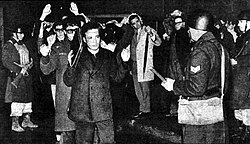
This event, known as La Noche de los Bastones Largos (The Night of the Long Police Batons), triggered a significant "brain drain," as many intellectuals were forced into exile, an event that continues to affect Argentine academia.
The Path to Downfall
The regime's stability began to erode due to both internal military friction and public unrest. In May 1968, General Julio Alsogaray emerged as a leader of the conservative opposition within the military. Although Onganía attempted to neutralize this by replacing top military leaders—including appointing Alejandro Agustín Lanusse—the government remained fragile.
Public anger culminated in massive worker and student uprisings, most notably the Cordobazo in Córdoba (1969) and the Rosariazo in Rosario. The assassination of Pedro Eugenio Aramburu in June 1970 served as the final catalyst. General Lanusse and the dominant military faction demanded Onganía's resignation; when he refused, he was removed by a military junta.
Summary of Presidency
| Category | Details |
|---|---|
| Period in Office | 1966–1970 |
| Preceded by | Arturo Umberto Illia |
| Succeeded by | Roberto Marcelo Levingston |
| Economic Strategy | Wage freezes, 40% devaluation, and foreign capital promotion |
| Cultural Policy | Strict censorship and suppression of university autonomy |
Later Life and Death
Following his removal from power, Onganía retired to an estate in Buenos Aires. Interestingly, he became a critic of the human rights violations committed during the National Reorganization Process (the 1976–1983 dictatorship under Jorge Videla). Despite his retirement, he attempted a political comeback in 1995 as a presidential candidate for the Front for Patriotic Solidarity, criticizing President Carlos Menem for government corruption.
In May 1995, a stroke left Onganía paralyzed and unable to speak, forcing his withdrawal from the campaign. He died of a heart attack on June 8, 1995, at the Military Hospital of Buenos Aires at the age of 81.
Frequently Asked Questions
How did Juan Carlos Onganía come to power?
Onganía rose to power on June 29, 1966, after leading a military coup d'état called the "Argentine Revolution," which overthrew the democratically elected president, Arturo Umberto Illia.
What was the "Night of the Long Police Batons"?
It was a violent police raid on the University of Buenos Aires' Faculty of Sciences ordered by Onganía. The event ended university autonomy and led to a massive exodus of professors and students from Argentina.
What was the "Cordobazo"?
The Cordobazo was a major popular uprising of workers and students in the city of Córdoba in 1969, which significantly weakened Onganía's government and contributed to his eventual downfall.
What was the "authoritarian-bureaucratic state"?
This is a term coined by political scientist Guillermo O'Donnell to describe regimes like Onganía's, which were characterized by a leading role for the military in political and economic operations, opposing both liberal democracy and communism.
Did Onganía support later military dictatorships in Argentina?
No, in his later years, Onganía was critical of the human rights violations that occurred during the National Reorganization Process (1976–1983).