Jordan River: Geography, History, and Religious Significance
The Jordan River is one of the most culturally and spiritually significant waterways in the world. Flowing through a complex geopolitical landscape, it serves as a border between Jordan, Israel, the Palestinian West Bank, and southwestern Syria. From its headwaters in the north to its terminal end in the Dead Sea, the river is a lifeline for the region and a central symbol in multiple faiths.
Historically, the river has been a source of fertility and a boundary for ancient civilizations. Today, it is a focal point of environmental concern and international water diplomacy, reflecting the delicate balance between human necessity and ecological preservation.
![1871 map of the Jordan River.[17] Note in particular Lake Hula, which was later drained.](/images/01/af/01af732606de1dbc62eb924802d532be9284d0b08fdf02233ee4a1c625308c96.jpg)
Key Facts
- Total Length: 251 km (156 mi).
- Source: Confluence of the Hasbani and Dan Rivers.
- Mouth: The Dead Sea, located approximately 416 meters below sea level.
- Major Tributaries: The Dan, Banias, Yarmouk, and Zarqa rivers.
- Environmental Status: Identified as one of the world's 100 most endangered ecological sites.
- Water Flow: Modern flow is less than 10% of its historical average.
Geography and Physical Characteristics
The Upper Course and Sources
The river begins at the Sde Nehemia kibbutz in northern Israel at an elevation of 70 meters (230 ft). Its primary sources include the Dan River, the largest upper tributary contributing roughly 240-252 million cubic meters annually, and the Banias, which arises from a spring at the foot of Mount Hermon.
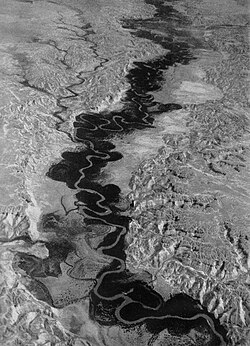
The Lower Course and the Jordan Valley
After passing through the Sea of Galilee, the river descends to about 210 meters below sea level. The final 120-kilometer stretch is known as the Jordan Valley. In this section, the river meanders significantly due to a lower gradient before emptying into the Dead Sea, a terminal lake with no outlet.
The lower course is fed by several tributaries, most notably the Yarmouk River, which forms the border between Syria, Jordan, and Israel, and the Zarqa River. Numerous smaller "side wadis" (seasonal stream beds) also contribute to the flow from both the east and west banks.
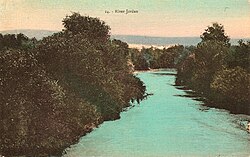
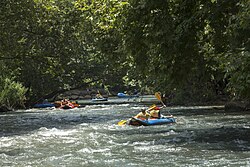
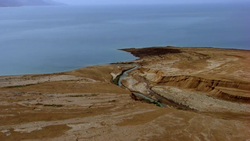
Environmental Challenges and Water Management
The Jordan River ecosystem is currently in a state of crisis. In modern times, up to 95% of the river's water is diverted for human use. The historical flow of 1.3 billion cubic meters per year has plummeted to just 20 to 30 million cubic meters reaching the Dead Sea as of 2010.
Human Impact and Pollution
Extensive damage has been caused by the construction of pumping stations and diversion channels, such as Israel's National Water Carrier and Jordan's East Ghor Canal. These diversions, combined with high evaporation rates and industrial salt extraction, have caused the Dead Sea to shrink rapidly.
Pollution is another critical issue. While a small 3-kilometer section below the Sea of Galilee is kept pristine for tourism and baptism, much of the remaining 100-kilometer downstream stretch is heavily polluted by untreated wastewater and agricultural fertilizers.
Religious and Cultural Importance
The Hebrew Bible
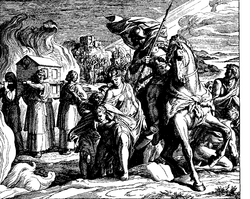
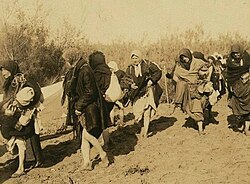
In the Hebrew Bible, the Jordan is associated with fertility and serves as a demarcation line between the tribes of Israel. It is the site of several biblical miracles, including the crossing of the Israelites under Joshua and the crossing of Elijah and Elisha on dry ground. Elisha is also credited with healing Naaman's leprosy through the river's waters.
The New Testament
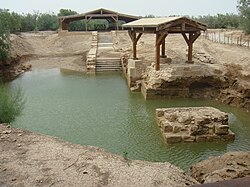
The river holds immense significance in Christianity as the site where John the Baptist preached and performed baptisms. Most notably, the New Testament records the baptism of Jesus in the Jordan, an event that marks the beginning of his public ministry.
Global Symbolism
Beyond scripture, the Jordan River is a recurring symbol in gospel and spiritual music, as well as in the works of composers like Johann Sebastian Bach. It remains a primary destination for pilgrims from around the world.
Summary of River Characteristics
| Feature | Detail |
|---|---|
| Source Elevation | 70 m (230 ft) |
| Mouth Elevation | −416 m (−1,365 ft) |
| Total Length | 251 km (156 mi) |
| Historic Flow | 1.3 billion m³/year |
| Current Flow (to Dead Sea) | 20–30 million m³/year |
| Primary Mouth | Dead Sea |
Frequently Asked Questions
Where does the Jordan River start and end?
The Jordan River begins at the confluence of the Hasbani and Dan Rivers in northern Israel and ends by flowing into the Dead Sea.
Why is the Jordan River considered ecologically endangered?
The river is endangered due to the diversion of up to 95% of its water for human use, high levels of pollution from sewage and fertilizers, and a lack of regional cooperation in ecosystem management.
What is the significance of Al-Maghtas?
Al-Maghtas is a site on the Jordanian side of the river believed to be the location where John the Baptist baptized Jesus.
How has the water flow changed over time?
The flow has decreased drastically from a historical average of 1.3 billion cubic meters per year to as little as 2% of that volume in the Lower Jordan River.
Which countries share the Jordan River basin?
The river basin is shared by Israel, Jordan, Syria, and the Palestinian West Bank.