John Tradescant the Elder: The Pioneer of English Botany and Museums
In the early 17th century, the intersection of exploration, art, and science gave rise to a unique fascination with the natural world. At the heart of this movement in England was John Tradescant the Elder, a man whose life spanned the roles of naturalist, gardener, collector, and intrepid traveler. From the royal courts of London to the frozen reaches of Arctic Russia, Tradescant dedicated his life to gathering the wonders of the earth, ultimately laying the groundwork for the modern public museum.
Key Facts
- Profession: Naturalist, gardener, collector, and traveler.
- Major Achievement: Created "The Ark," England's first museum open to the public.
- Royal Service: Served as keeper of the Gardens, Vines, and Silkworms at Oatlands Palace for King Charles I.
- Scientific Legacy: The plant genus Tradescantia is named in honor of him and his son.
- Museum Connection: His collections formed a core part of the Ashmolean Museum in Oxford.
Early Life and Professional Ascent
Born in the 1570s in Suffolk, John Tradescant began his career in the service of the nobility. His professional journey took a significant turn when he became the head gardener to Robert Cecil, the 1st Earl of Salisbury, at Hatfield House. It was Cecil who first introduced Tradescant to the world of international travel, dispatching him to the Low Countries in 1610/11 to source fruit trees.
Tradescant's talent for horticulture led him to continue working for Robert's son, William, at Salisbury House in London. Between 1615 and 1623, he further established his reputation by designing gardens for Lord Wotton on the site of St Augustine's Abbey.
A Life of Adventure and Royal Patronage
By 1623, Tradescant had entered the service of George Villiers, the 1st Duke of Buckingham, the royal favorite. In this capacity, he remodeled gardens at Burley-on-the-Hill and New Hall in Essex. However, Tradescant was more than a gardener; he was an adventurer and an engineer. His travels were vast and varied:
- Arctic Russia: He visited the Nikolo-Korelsky Monastery in 1618.
- The Levant and Algiers: He joined an expedition against the Barbary pirates in 1620.
- France: He traveled to Paris and the Île de Ré, where he served as an engineer during the siege of La Rochelle.
Following the assassination of the Duke of Buckingham in 1628, King Charles I appointed Tradescant in 1630 as the keeper of His Majesty's Gardens, Vines, and Silkworms at Oatlands Palace in Surrey.
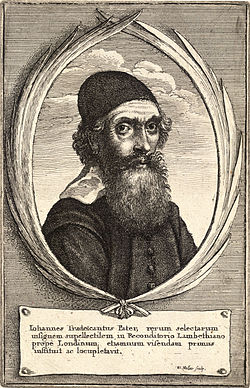
The Ark and the Birth of the Public Museum
Throughout his travels, Tradescant obsessively collected seeds, bulbs, and ethnographic artifacts. He housed these treasures in a large residence in Lambeth, London, which he named "The Ark." This site became a prototypical Cabinet of Curiosity—a private collection of rare, strange, and scientifically interesting objects intended to represent the diversity of the world.
The Ark eventually evolved into the Musaeum Tradescantianum, recognized as the first museum in England to be open to the general public. Tradescant expanded his collection through a network of contacts, including his friend John Smith, an American colonist who bequeathed a quarter of his library to him. Alongside his son, John Tradescant the Younger, he introduced numerous exotic plants into English gardens that remain staples of horticulture today.
Legacy and Lasting Influence
John Tradescant the Elder passed away between April 15 and 16, 1638. He is buried in the churchyard of St-Mary-at-Lambeth, a site that now houses the Garden Museum. His influence extended far beyond his lifetime through the preservation of his collections.
The vast collection assembled by the Tradescants was eventually given to the University of Oxford by Elias Ashmole. When combined with the university's existing holdings, it became the foundation of the Ashmolean Museum, which opened its doors in 1683. In 1752, Carl Linnaeus honored the father and son by naming the flowering plant genus Tradescantia after them.
| Period/Date | Role/Event | Location/Patron |
|---|---|---|
| 1610/11 | Sourcing fruit trees | Low Countries / Robert Cecil |
| 1615–1623 | Garden Design | St Augustine's Abbey / Lord Wotton |
| 1623 | Gardener to the Duke | New Hall & Burley-on-the-Hill / George Villiers |
| 1630 | Keeper of Gardens & Silkworms | Oatlands Palace / King Charles I |
| Post-1638 | Collection Legacy | Ashmolean Museum, Oxford |
Frequently Asked Questions
What was "The Ark" in Lambeth?
The Ark was the home of John Tradescant the Elder where he stored his extensive collection of natural history specimens and ethnographic curiosities. It served as the first public museum in England, known as the Musaeum Tradescantianum.
How did John Tradescant contribute to the Ashmolean Museum?
The collections gathered by John Tradescant the Elder and his son were later donated to the University of Oxford by Elias Ashmole, forming a primary part of the Ashmolean Museum when it opened in 1683.
What is a Cabinet of Curiosity?
A Cabinet of Curiosity is a diverse collection of rare, exotic, and strange objects—ranging from biological specimens to man-made artifacts—that served as a precursor to the modern museum.
Which plant is named after the Tradescants?
The genus of flowering plants known as Tradescantia was named by Carl Linnaeus in 1752 to honor both John Tradescant the Elder and his son.
Where can you find traces of Tradescant's life today?
He is buried at St-Mary-at-Lambeth (now the Garden Museum), and Tradescant Road in Vauxhall marks the former boundary of his estate.