John o' Groats: Scotland's Iconic Northeastern Tip
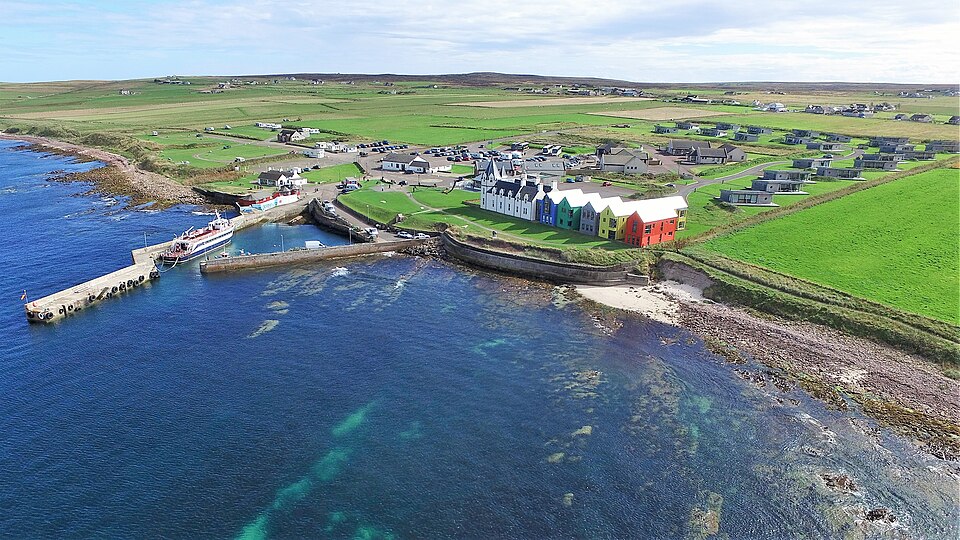
Perched on the northeastern edge of mainland Scotland, John o' Groats (Scottish Gaelic: Taigh Iain Ghròta) is more than just a village; it is a symbol of endurance and achievement. Located in the historic county of Caithness, this settlement serves as a bucket-list destination for travelers, adventurers, and those seeking the rugged beauty of the Highland coast.
The village is situated approximately 2.5 miles (4 kilometers) northeast of Canisbay. While it is often associated with the furthest reaches of the UK, the absolute northernmost point of mainland Scotland is actually the nearby Dunnet Head, while the northeastern corner is marked by Duncansby Head.
Key Facts
- Location: Northeastern tip of mainland Scotland, Caithness, Highland council area.
- Population: Approximately 300 (as of 2007).
- Famous Route: The endpoint or starting point of the "Land's End to John o' Groats" journey.
- Distance to London: 690 miles (1,110 km).
- Distance to North Pole: 2,200 miles (3,500 km).
- Local Identity: Residents are known as "Groaters."
The History and Name of the Village
The village takes its name from Jan de Groot, a 15th-century Dutchman who operated a ferry service between the Scottish mainland and Orkney. This service became vital after King James IV acquired Orkney from Norway. While local legend suggests the "o' Groats" refers to the one groat (a small coin) Jan charged for the ferry, the name actually derives from the Dutch de groot, meaning "the large."
Historically, the area was home to John o' Groat's House, an ancient octagonal building. According to Haydn's Dictionary of Dates, the house featured eight windows and eight doors to allow eight family members to enter separately, thereby avoiding quarrels over precedence at the dining table.
Tourism and Landmarks
John o' Groats is globally recognized as the terminus for long-distance cycles, walks, and charitable events. The phrase "Land's End to John o' Groats" describes the journey from the southwestern tip of Cornwall to this northern outpost. Although the A9 trunk road previously ended here, it now terminates at Scrabster.
The John o' Groats House Hotel
Established in 1875 on or near the site of Jan de Groot's original home, the John o' Groats House Hotel is one of the UK's most famous landmarks. After a period of disrepair, the hotel underwent a radical transformation by GLM architects for Natural Retreats and reopened in August 2013.
The Journey's End Signpost
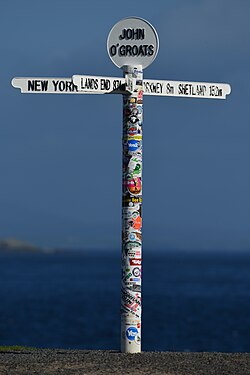
A major draw for visitors is the Journey's End signpost. Installed in 1964, it originally allowed visitors to pay for a photograph featuring a custom message or distance to a specific location. Following the 2013 hotel redevelopment, the original signpost was moved to a nearby caravan park, and a new, publicly accessible signpost was erected at the original site.
Local Life and Culture
Despite its small population of around 300, the village maintains a linear center featuring council housing, a sports park, and a local shop. The community is active in sports, with John o' Groats FC competing in the Caithness Amateur Football Association.
Culturally, the village hosts the annual John o' Groats Book Festival every April. Since its inception in 2018, the festival has attracted notable authors such as Christopher Brookmyre and Theresa Breslin, alongside local writers.
Transport and Accessibility
Visitors can reach the village via local bus services operated by Stagecoach Highlands and Aaron's of Wick, which connect to Thurso, Dounreay, and Wick. The nearest rail link is the Wick National Rail Station, where ScotRail provides four weekday trains per day to Inverness.
For those traveling to the Orkney Isles, a seasonal summer ferry operates between John o' Groats and Burwick on South Ronaldsay.
Climate and Geography
The village experiences a typical northern maritime climate. Precipitation is highest in the autumn and winter months, peaking in November. Summer temperatures are mild, with mean daily maximums reaching around 16°C (61°F) in July.
| Metric | Winter (Jan) | Spring (Apr) | Summer (Jul) | Autumn (Oct) | Annual Total |
|---|---|---|---|---|---|
| Mean Max Temp (°C) | 6 | 10 | 16 | 9 | - |
| Mean Min Temp (°C) | 1 | 6 | 8 | 2 | - |
| Precipitation (mm) | 96.0 | 57.3 | 62.4 | 116.4 | 989.6 |
| Sunshine Hours | 28.5 | 164.7 | 159.7 | 83.0 | 1,307.4 |
Frequently Asked Questions
Is John o' Groats the northernmost point of Scotland?
No. While it is the most famous northeastern point, the northernmost point of mainland Scotland is actually Dunnet Head, and the northeastern corner is Duncansby Head.
Who was Jan de Groot?
Jan de Groot was a 15th-century Dutchman who operated a ferry service from the Scottish mainland to the Orkney Isles.
What is the "Land's End to John o' Groats" route?
It is a famous long-distance journey spanning the length of the UK, starting at Land's End in Cornwall, England, and ending at John o' Groats in Scotland.
How do I get to John o' Groats by train?
The nearest railway station is in Wick. From there, you can take local bus services to reach the village.
When is the best time to visit for the Book Festival?
The John o' Groats Book Festival is held annually in April.