Jaw Anatomy and Evolution Across the Animal Kingdom
Jaws are paired, opposable articulated structures located at the entrance of the mouth. While most commonly associated with grasping and manipulating food, the term also encompasses the entire structural vault of the mouth that allows an organism to open and close its oral cavity. These structures are fundamental to the body plans of humans and a vast majority of the animal kingdom.
Key Facts
- Vertebrate jaws evolved from the anterior pharyngeal arches (gill supports).
- Arthropod jaws are made of chitin and typically move laterally.
- Mammalian jaws are simplified, with the lower jaw consisting of a single bone called the mandible.
- Cranial kinesis refers to the mobility of skull bones, which is highest in snakes.
- Aristotle's lantern is the unique five-part symmetrical jaw system found in sea urchins.
Jaws in Arthropods
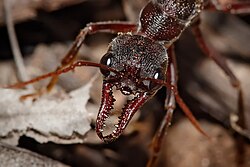
In arthropods, jaws are composed of chitin—a tough, semi-transparent polysaccharide. Unlike vertebrates, these jaws oppose laterally (side-to-side) and may take the form of mandibles or chelicerae. These systems often integrate numerous mouthparts, some of which are modified legs, such as pedipalps.
The primary functions of arthropod jaws include food acquisition, transporting food to the mouth, and initial processing through mastication, or chewing.
The Evolution of Vertebrate Jaws
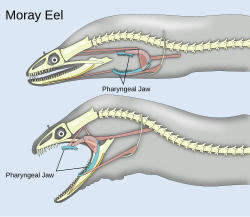
Vertebrate jaws are constructed from bone or cartilage and oppose vertically, consisting of an upper and lower jaw. These structures are derived from the two most anterior pharyngeal arches (the skeletal supports for gills). In jawed vertebrates, known as Gnathostomes, seven arches are present, whereas primitive jawless vertebrates (Agnatha) possess nine.
Origins in Fish
The vertebrate jaw likely evolved during the Silurian period, appearing first in Placoderm fish before diversifying in the Devonian. The first pharyngeal arch became the jaw itself, while the second became the hyoid arch, which suspends the jaw from the braincase to allow for significant mobility.
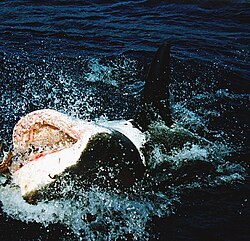
Interestingly, the original evolutionary advantage of the jaw may have been respiratory rather than dietary. Jaws likely powered the buccal pump—a mechanism used by modern fish and amphibians to pump water across gills or air into lungs. Over time, natural selection favored the use of jaws for feeding.
Amphibians, Reptiles, and Birds
In tetrapods (four-limbed vertebrates), the jaw structure is more simplified than in fish. Most upper jaw bones—including the premaxilla, maxilla, jugal, quadratojugal, and quadrate—have fused to the braincase. The lower jaw bones (dentary, splenial, angular, surangular, and articular) have fused into a single unit called the mandible.
These animals exhibit varying levels of cranial kinesis (the ability of skull bones to move independently). Snakes exhibit the highest degree of this mobility, allowing them to consume prey much larger than their own heads.
Mammalian Jaw Specialization
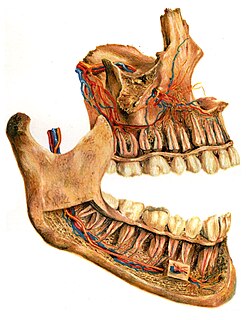
Mammalian jaws consist of the maxilla (upper) and the mandible (lower). During evolution, the articular and quadrate bones of the ancestral jaw were reduced in size and repurposed as part of the middle ear. Consequently, mammals have very little cranial kinesis.
The mandible is attached to the temporal bone via the temporomandibular joints. Dysfunction in these joints can lead to pain, clicking, and limited movement. In apes, the lower jaw is further reinforced by a structure called the simian shelf. Additionally, in therian mammals, the premaxilla has reduced, and the ancestral upper jaw tip has evolved into the protruding mammalian nose.
Unique Case: Sea Urchins
Sea urchins possess a highly specialized jaw apparatus known as Aristotle's lantern. This system displays five-part symmetry and features five perpetually growing teeth made of crystalline calcium carbonate.
| Group | Composition | Movement/Orientation | Key Feature |
|---|---|---|---|
| Arthropods | Chitin | Lateral | Mandibles/Chelicerae |
| Fish | Bone/Cartilage | Vertical | Hyoid arch suspension |
| Tetrapods | Bone | Vertical | Fused mandible |
| Mammals | Bone | Vertical | Temporomandibular joint |
| Sea Urchins | Calcium Carbonate | Five-part symmetry | Aristotle's lantern |
Frequently Asked Questions
What are pharyngeal arches?
Pharyngeal arches are skeletal structures that originally supported the gills in early vertebrates. In jawed vertebrates, the most anterior arches evolved into the jaws and the hyoid system.
What is the difference between the maxilla and the mandible?
The maxilla refers to the upper jaw, while the mandible refers to the lower jaw.
What is cranial kinesis?
Cranial kinesis is the ability of certain animals to move parts of their skull independently of one another. This is most prominent in snakes, enabling them to swallow large prey.
How did the mammalian ear relate to the jaw?
During mammalian evolution, two bones that previously formed the jaw joint (the articular and quadrate) were reduced in size and incorporated into the ear structure.
What is the function of the buccal pump?
The buccal pump is a mechanism using the jaws to push water across the gills in fish or air into the lungs in amphibians to facilitate respiration.