Italian Social Republic: The Final Years of Mussolini's Fascist Regime
The Italian Social Republic (Italian: Repubblica Sociale Italiana, or RSI), more commonly known as the Republic of Salò, was a collaborationist puppet state established by Nazi Germany in northern and central Italy during the closing stages of World War II. Operating from September 1943 to April 1945, the RSI represented the final, desperate attempt of Benito Mussolini to maintain power after being ousted from the Kingdom of Italy.
The regime emerged during a period of extreme instability, as Italy was split between the German-occupied north and the Allied-liberated south, the latter informally known as the Kingdom of the South. This division sparked not only a foreign conflict but a brutal Italian civil war, pitting fascist loyalists against national resistance partisans.
Key Facts
- Duration: September 23, 1943 – April 25, 1945.
- Leader: Benito Mussolini (Duce).
- Status: German puppet state with limited diplomatic recognition.
- Capitals: Salò, Verona, and Milan (de facto); Rome (de jure).
- End: Collapsed following a general partisan uprising and Allied offensives.
The Fall of the Kingdom and the Rise of Salò
The origins of the RSI lie in the military failures of the Fascist regime. By July 1943, following the Allied invasion of Sicily and the loss of North African colonies, the Grand Council of Fascism passed a motion of no confidence in Mussolini. With the support of King Victor Emmanuel III, Mussolini was overthrown and arrested.
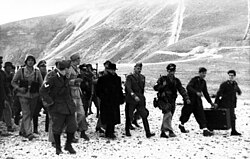
While the new Italian government attempted to negotiate a secret peace with the Allies, the announcement of the Armistice of Cassibile on September 8, 1943, prompted an immediate German response. Nazi forces launched Operation Achse, seizing control of northern Italy and rescuing Mussolini from prison in Campo Imperatore. On September 23, 1943, the Italian Social Republic was proclaimed.
Governance and Diplomatic Isolation
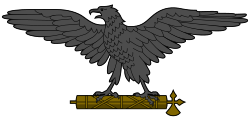
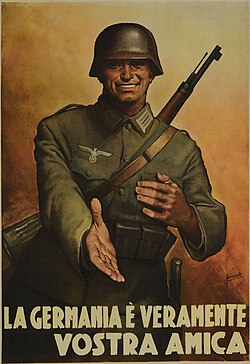
Although the RSI claimed sovereignty over all of Italy and its former colonies, its actual jurisdiction was limited to a fraction of the country. The state was heavily dependent on German military and political support, with Rudolf Rahn serving as the German plenipotentiary.
Diplomatically, the RSI was largely isolated. It was recognized only by the Axis powers and their satellites. Notably, Vichy France and Finland did not recognize the regime, nor did Vatican City. While unofficial relations existed with Spain, Portugal, and Argentina, the RSI remained a pariah in the eyes of the international community.
Military Efforts and the Gothic Line
The RSI military was established under the Rastenburg Protocol of October 1943, allowing the creation of division-sized formations. Under Minister of National Defence Rodolfo Graziani, four divisions totaling 52,000 men were raised. These forces were primarily deployed to the Gothic Line—a defensive line in the Apennine Mountains designed to halt the Allied advance.
One notable engagement was Operation Winter Storm in December 1944, a combined German-Italian offensive against the U.S. 92nd Infantry Division. While the RSI achieved limited success in this battle, the overall strategic situation remained dire.
Air and Naval Forces
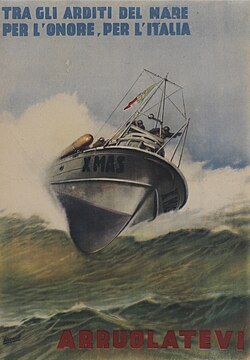
The Aviazione Nazionale Repubblicana (ANR), the RSI air force, faced overwhelming Allied superiority. Despite this, they shot down 262 Allied aircraft, losing 158 of their own. The navy, the Marina Nazionale Repubblicana (MNR), was significantly smaller than the Royal Navy that had defected to the Allies, consisting mainly of motor torpedo boats and midget submarines.
The Collapse of the Regime
By early 1945, the RSI was disintegrating. Mussolini’s rhetoric grew more extreme, claiming he would "fight to the last Italian" and envisioning Milan as the "Stalingrad of Italy." However, behind the scenes, many fascist and German officials were secretly negotiating truces with the Allies.
The end came on April 25, 1945, known today as Liberation Day. A general uprising by Italian partisans, coordinated with the final Allied offensive, ousted the remaining Axis forces. Mussolini was captured and executed by partisans on April 28, 1945. The RSI officially surrendered on May 1, following the general German capitulation in Italy.
Summary of the Italian Social Republic
| Feature | Details |
|---|---|
| Official Name | Repubblica Sociale Italiana (RSI) |
| Ideology | Unitary Fascist State |
| Key Figures | Benito Mussolini, Rodolfo Graziani |
| Primary Adversaries | Allied Forces, Italian Partisans |
| Currency | Italian lira |
| Outcome | Dissolution and execution of Mussolini |
Frequently Asked Questions
What was the Republic of Salò?
The Republic of Salò was the popular name for the Italian Social Republic, a German puppet state led by Benito Mussolini from 1943 to 1945 after he was rescued from imprisonment by Nazi forces.
How did the RSI differ from the Kingdom of Italy?
Unlike the Kingdom of Italy, which was a monarchy, the RSI was a fascist republic. It had significantly less territory, lacked broad international recognition, and was entirely dependent on Nazi Germany for its existence.
What was the Gothic Line?
The Gothic Line was a series of defensive fortifications in the Apennine Mountains where RSI and German forces attempted to stop the Allied advance into northern Italy during the final years of the war.
Who were the partisans?
The partisans were members of the Italian national resistance who fought against the German occupation and the RSI collaborationist regime during the Italian civil war.
How did Benito Mussolini die?
Mussolini was captured by Italian partisans on April 28, 1945, while attempting to flee to Switzerland, and was subsequently executed.