Exploring the Genus Isopyrum: A Botanical Overview
The genus Isopyrum represents a specialized group of flowering plants within the Ranunculaceae family, commonly known as the buttercup family. These perennial herbs are native to the diverse landscapes of Eurasia, offering unique morphological characteristics that have fascinated botanists for centuries. From their delicate white flowers to their complex leaf structures, members of this genus play a specific role in their native ecosystems.
Key Facts
- Family: Ranunculaceae
- Number of Species: Four accepted species
- Native Range: Eurasia (including Europe and Asia)
- Flower Color: White
- Growth Habit: Perennial herbs
Botanical Description
Stems and Foliage
Isopyrum plants are characterized by their perennial growth habit, meaning they live for more than two years. The stems are typically erect and glabrous, a botanical term meaning they are smooth and free from hairs. The leaves of the genus are biternate, which describes a leaf structure where the leaf is divided into three main parts, and those parts are further divided into three leaflets.
The foliage displays distinct coloration depending on its position on the plant. Leaves attached to the base of the stem are pale green on their underside and green on the top. Those attached higher up the stem feature short petioles (leaf stalks) accompanied by white sheathes.
Flowers and Reproductive Organs
The flowers of Isopyrum exhibit radial symmetry, meaning they are shaped equally around a central axis. Each flower is composed of five sepals (leaf-like structures that protect the flower bud) and five petals. In this genus, the sepals are white and petaloid, meaning they look and function much like petals. The actual petals are notably smaller than the sepals.
For reproduction, each flower contains between 20 and 30 stamens (the male reproductive organs) topped with yellow anthers. The female reproductive parts, known as pistils, range from one to five per flower.
Fruit and Seed Development
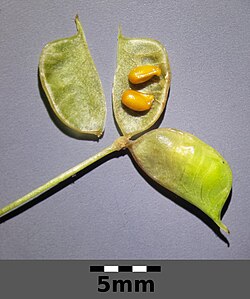
Following pollination, the plant produces fruit in the form of follicles. These are dry fruits that split open along a single seam to release seeds. Isopyrum plants typically produce groups of one to five follicles per flower. Each follicle contains numerous seeds that are smooth in texture and range in shape from ovoid (egg-shaped) to ellipsoid. These seeds can appear in various shades of black.
Taxonomic History
The genus was first formally described in 1753 by the renowned Swedish biologist Carl Linnaeus. Over the years, the classification of Isopyrum has undergone significant revision to better reflect the evolutionary relationships between species.
A major turning point occurred in 1920, when British botanists James Ramsay Drummond and John Hutchinson published a revision of the genus. They identified that certain species within Isopyrum were more closely related to the genus Aquilegia (columbines) than to other members of Isopyrum. To resolve this, they segregated the genus Paraquilegia and expanded the genus Semiaquilegia. Additionally, several species formerly classified under Isopyrum in North America and eastern Asia were moved to the genera Dichocarpum and Enemion.
Geographic Distribution
According to the Plants of the World Online (POWO) database, Isopyrum is a strictly Eurasian genus. Its native range is extensive, covering:
- Spain and France
- Much of Eastern Europe
- Asia, stretching from Kazakhstan and Pakistan through northern China to Korea and the far east of Russia
The genus has also been introduced to Denmark and Germany.
Accepted Species
While many plants were historically linked to this genus, current botanical consensus recognizes only four accepted species:
- Isopyrum anemonoides Kar. & Kir
- Isopyrum ludlowii Tamura & Lauener
- Isopyrum manshuricum (Komarov) Komarov ex W.T.Wang & Hsiao
- Isopyrum thalictroides L.
Summary of Isopyrum Characteristics
| Feature | Description |
|---|---|
| Stem Texture | Glabrous (smooth) |
| Leaf Type | Biternate |
| Flower Symmetry | Radial |
| Sepal Count | Five (white and petaloid) |
| Fruit Type | Follicles |
| Seed Shape | Ovoid to ellipsoid |
Frequently Asked Questions
What is the type species of Isopyrum?
The type species for the genus is Isopyrum thalictroides L.
How many species are currently recognized in the Isopyrum genus?
There are currently four accepted species within the genus.
What does it mean that the stems are glabrous?
In botany, a glabrous stem is one that is smooth and lacks any hairs or trichomes.
Where can Isopyrum be found in the wild?
Isopyrum is native to Eurasia, with a range spanning from Western Europe (Spain and France) through Eastern Europe and across Asia to Russia and Korea.
What is the difference between the sepals and petals in Isopyrum flowers?
In Isopyrum, the five sepals are white and petal-like (petaloid), while the five actual petals are significantly smaller than the sepals.
What kind of fruit does this plant produce?
The plant produces follicles, which are dry fruits that contain numerous smooth, black, egg-shaped or ellipsoid seeds.