Islamic State: Evolution of Governance from Medina to the Modern Era
An Islamic state is a form of government based on sharia (Islamic law). While the term is often used today to describe modern political movements, it has a deep history encompassing various polities and theories of governance across the Islamic world. In a modern context, the Arabic term dawlah islāmiyyah refers to notions associated with political Islam, or Islamism.
The concept has evolved from the early community in Medina to expansive imperial caliphates and, eventually, to the diverse nation-states of the 20th and 21st centuries. While classical theories focused on the implementation of divine law, modern interpretations often blend traditional sharia with contemporary political structures.
Key Facts
- Foundation: The first Islamic state was established by the Prophet Muhammad in Medina in 622 CE.
- Core Principle: Governance is based on sharia, with consultation (shura) playing a central role.
- Evolution: The concept transitioned from city-states and empires to modern nation-states after 1918.
- Modern Terminology: The specific term "Islamic state" is considered by some scholars to be a 20th-century neologism.
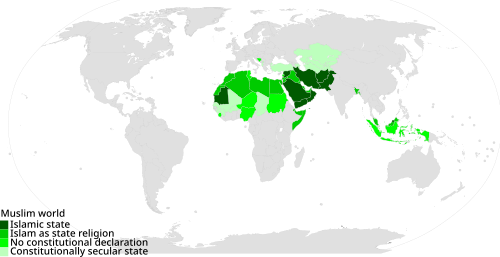
- Diverse Forms: Modern examples range from absolute monarchies (Brunei) to Islamic republics (Iran, Pakistan, Mauritania).
Historical Evolution of Islamic Governance
Historian Majid Khadduri identifies six distinct stages in the history of the Islamic state, tracing its growth from a local entity to a global influence:
- City-state (622–632): The formative period in Medina.
- Imperial (632– c. 750): The era of rapid expansion.
- Universal (c. 750– c. 900): A period of peak cultural and political reach.
- Decentralization (c. 900– c. 1500): The shift toward regional power centers.
- Fragmentation (c. 1500–1918): The breakdown of centralized authority.
- Nation states (1918–present): The emergence of modern borders and sovereignty.
Early Caliphates
The first Islamic state began in 622 CE under the Constitution of Medina, creating political unity for the Muslim Ummah (nation). Following Muhammad, the Rashidun (Rightly Guided) Caliphs led from 632 to 661 CE. This was followed by the Umayyad Caliphate (661–750) and the Abbasid Caliphate (750–1258), both of which significantly expanded the state's territorial reach.
The Ottoman Caliphate and its Abolition
The Ottoman Sultan Selim I reclaimed the title of caliph between 1512 and 1520. However, this office was abolished in 1924 by Mustafa Kemal Atatürk as part of his sweeping reforms. This abolition sparked the Khilafat Movement in India, where Mahatma Gandhi and Indian Muslims sought to reinstate the caliphate, linking the cause to Indian nationalism and independence from British rule.
The Modern Conception of the Islamic State
The Evolution of "Dawla"
The term dawla originally derived from a root meaning "to turn" or "come around in a cyclical fashion," referring to the alternating fortunes of victory and defeat. Over time, it came to describe the succession of dynasties. By the 19th century, influenced by exchanges with Europe, dawla (Arabic) and devlet (Turkish) evolved to mean "state" in the modern political sense.
Ideological Foundations
Scholars like Qamaruddin Khan suggest that the specific term "Islamic state" was not used in Muslim political science before the 20th century. The modern notion emerged largely as a reaction to the 1924 abolition of the Ottoman caliphate, popularizing the idea that Islam is both a religion and a state (al-Islam din wa dawla).
Key ideologues who shaped this modern vision include:
- Rashid Rida: Argued for a "caliphate of necessity" combining spiritual and temporal authority.
- Abul A'la Maududi: Envisioned the Islamic state as a "third way" between capitalism and socialism, blending electoral democracy with social welfare.
- Other Influencers: Ruhollah Khomeini, Sayyid Qutb, and Hassan al-Banna.
Contemporary Islamic States and Republics
Today, the application of Islamic governance varies widely. Some countries designate Islam as the state religion without applying sharia in courts, while others integrate it fully into their legal systems.
| Country | Form of Government | Key Characteristic |
|---|---|---|
| Brunei | Absolute Monarchy | Islam is the official religion. |
| Iran | Islamic Republic | Governed by the Guardianship of the Islamic Jurists. |
| Pakistan | Islamic Republic | Parliamentary democracy with Islam as the official religion. |
| Mauritania | Islamic Republic | Sharia is the law of the land. |
| Afghanistan | Islamic Emirate | Totalitarian Islamic state under the Taliban. |
| Yemen | Republic | Sharia is the source of all legislation. |
Regional Variations
In Iran, the 1979 Revolution established a unique system, though some theologians later advocated for secularization to preserve the purity of the faith. In Syria, following the collapse of the Ba'athist regime in 2024, the group Hay'at Tahrir al-Sham (HTS) declared an Islamic state starting in 2025, governed by a temporary constitution.
Frequently Asked Questions
What is the difference between a Muslim country and an Islamic state?
A Muslim country is a nation with a majority Muslim population, whereas an Islamic state is a political entity that specifically bases its government and legal system on sharia.
When was the first Islamic state established?
The first Islamic state was established by the Prophet Muhammad in Medina in 622 CE under the Constitution of Medina.
What is the role of "shura" in Islamic governance?
Shura refers to consultation. In Islamic governance, the voices of the majority are generally accepted, provided the decisions do not violate the teachings of the Quran or Sunnah.
Why was the Ottoman Caliphate abolished?
The Ottoman Caliphate was abolished in 1924 by Mustafa Kemal Atatürk as part of a series of reforms intended to modernize Turkey and move away from the traditional caliphate system.
Who were the Rashidun Caliphs?
The Rashidun, or "Rightly Guided" Caliphs, were the immediate successors to the Prophet Muhammad who led the Muslim community from 632 to 661 CE.