Investiture: The Traditions and Ceremonies of Formal Installation
Derived from the Latin in and vestire (meaning "to dress" or "robe"), investiture is a formal installation ceremony. It serves as a public marker for an individual taking up membership or leadership within a Christian religious institute, an order of chivalry, or a high-ranking governmental office. At its core, an investiture is about the transition of status, often symbolized by the donning of specific clothing or the receipt of a physical emblem of authority.
During these ceremonies, the participant is "invested with" outward symbols of their new role. These can range from religious habits and ecclesiastical decorations to medals, badges, or specific colored veils. In political or clerical contexts, such as the appointment of a bishop, the individual may receive historical regalia—traditional ornaments or dress—that represent the office itself and are passed from one successor to the next. These events often occur in significant spaces, such as parliaments or churches, and may involve the use of thrones, scepters, or swords.
Key Facts
- Definition: A formal ceremony marking the assumption of a role, membership, or honor.
- Symbols: Common items include robes, crowns, medals, scapulars, and habits.
- Scope: Practiced across religious, chivalric, governmental, and academic institutions.
- UK Scale: Approximately 2,600 people receive state honours annually in the United Kingdom.
- Variety: Can range from the appointment of a Supreme Court Justice to the enrollment of a youth in Scouting.
Religious and Spiritual Investitures
Christian Religious Institutes
In religious orders, investiture typically refers to the ceremonial handing over of the religious habit (the distinctive clothing of a religious order) to a new novice. This usually occurs upon admission to the novitiate, though it may happen later during simple or solemn profession. The ceremony often takes place in a church choir or a community's chapter house.
The type of garment often denotes the member's rank. For example, a novice might wear a shorter or white habit, which is exchanged for a full, regular habit upon their profession. Similarly, in some women's orders, a white veil is replaced by a black veil during temporary or solemn vows.
Bishops and Confraternities
For bishops, investiture occurs alongside their consecration, granting them jurisdiction over a specific part of the church. In confraternities, such as the Confraternity of the Immaculate Conception, new members are invested with a scapular (a garment consisting of two rectangular pieces of cloth) as an outward symbol of their membership and devotion.
Chivalry and State Honours
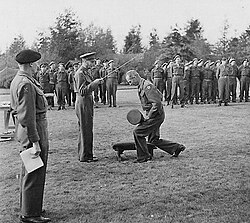
Investiture is the primary method by which individuals are made knights or dames within orders of chivalry, such as the Order of Saint John. In the United Kingdom, these honours are published twice yearly in the New Year and Birthday Honours lists. These ceremonies are typically conducted by the reigning monarch or a senior royal family member at locations such as Buckingham Palace, Windsor Castle, or the Palace of Holyroodhouse.
Similar practices exist across other Commonwealth realms, where governors-general or lieutenant-governors bestow honours on behalf of the monarch.
Governmental and Academic Installation
Many institutions with feudal origins use investiture to install heads of state or officials in ceremonial roles. In the United States, justices of the Supreme Court undergo investiture, which typically involves taking two oaths: one to uphold the Constitution and another to apply justice equally. Academic leaders, including university chancellors, rectors, and presidents, are also invested into their offices.
In Spain, the term "parliamentary investiture" refers to a specific electoral procedure. A candidate for prime minister defends their political program before the legislative chamber; if supported, the monarch formally appoints them to the role.
Other Applications of Investiture
The term is also utilized in the Scouting movement, where a ceremony marks a youth's enrollment or their transition between sections (e.g., moving from Cubs to Scouts), signifying their commitment to scouting traditions. Additionally, the concept appears in literature, such as in the poem "The Investiture" by Siegfried Sassoon, which reflects on a young man killed during World War I.
| Context | Common Symbols/Regalia | Typical Setting |
|---|---|---|
| Religious Orders | Habits, Veils, Scapulars | Church or Chapter House |
| Chivalry/Honours | Medals, Badges, Knighthood | Palaces or Royal Residences |
| Government/Law | Oaths, Robes of State | Parliament or Court |
| Academic | Official Regalia | University Campus |
Frequently Asked Questions
What is the difference between investiture and coronation?
While similar, a coronation is a specific rite for a monarch that includes anointing, whereas investiture is a broader term for the formal installation into various roles, including religious, chivalric, or governmental offices.
How often do investitures occur in the UK?
There are approximately 25 investiture ceremonies held annually in the United Kingdom, with around 2,600 people receiving honours each year.
What does a novice wear during a religious investiture?
Depending on the order, a novice may be invested with a white or shorter habit, which is later exchanged for a full habit or a black veil upon taking solemn profession.
Is investiture used in non-religious contexts?
Yes. It is used for the installation of Supreme Court justices in the US, the appointment of the Spanish prime minister, university leadership installations, and youth enrollment in Scouting.
What is a scapular in the context of investiture?
A scapular is a garment or outward totem given to members of certain confraternities as a symbol of their membership and a sign of their commitment to specific prayers or acts of charity.