International Monetary Fund: Global Governance and Financial Stability
The International Monetary Fund (IMF) is a premier international financial institution headquartered in Washington, D.C. Established to foster global monetary cooperation and secure financial stability, the IMF serves as a central pillar of the global economic architecture. With a membership spanning 191 countries—including 190 United Nations member states and Kosovo—it operates as a specialized agency of the United Nations.
From its inception, the IMF has evolved to address the complexities of a globalized economy, managing a budget of $1,295 million as of 2023 and employing a professional staff of 3,100 experts to monitor economic trends and provide critical financial assistance to member nations.
Key Facts
- Founded: July 22, 1944, during the Bretton Woods Conference.
- Membership: 191 countries.
- Leadership: Led by Managing Director Kristalina Georgieva.
- Primary Organs: The Board of Governors and the Executive Board.
- Core Functions: Economic surveillance, financial assistance, and capacity development.
- Official Language: English.
History and Foundation
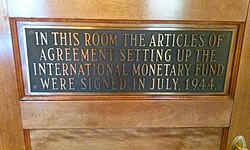
The IMF was conceived during the Bretton Woods Conference in July 1944, a landmark gathering aimed at rebuilding the international economic system following World War II. The agreements signed at the Mount Washington Hotel laid the groundwork for both the IMF and the World Bank.

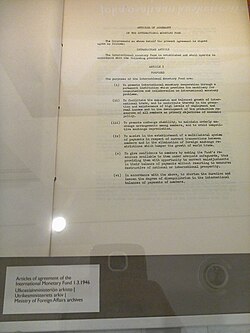
The formal legal framework was established through the Articles of Agreement, which came into effect on March 1, 1946. Over the subsequent eight decades, the institution has transitioned from managing fixed exchange rates to navigating the challenges of the 21st century, including sovereign debt crises and the rise of digital currencies.
Governance and Voting Power
Governance within the IMF is structured around a quota system. A quota is a subscription of funds that each member country pays to the IMF, which determines its voting power, the amount of financing it can access, and its liability.
Unlike many international organizations where each member has one vote, the IMF uses a weighted voting system. This means countries with larger economies typically hold more influence. The United States currently holds the highest voting share at 16.49%.
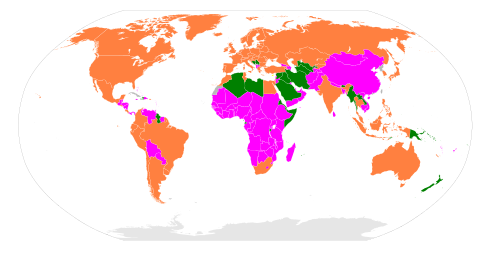
![IMF member states IMF member states not accepting the obligations of Article VIII, Sections 2, 3, and 4[60] Former IMF states/non-participants/no data available](/images/6b/1a/6b1a8a6175f2dd5c91866c0e8dd72a6a4212a9c4a462cce36a3777bb2bde7cad.webp)
Top Member Countries by Voting Power
| Rank | Country | Quota (Millions of XDR) | Votes | % of Total Votes |
|---|---|---|---|---|
| 1 | United States | 82,994.2 | 831,394 | 16.49% |
| 2 | Japan | 30,820.5 | 309,657 | 6.14% |
| 3 | China | 30,482.9 | 306,281 | 6.08% |
| 4 | Germany | 26,634.4 | 267,796 | 5.31% |
| 5 | France | 20,155.1 | 203,003 | 4.03% |

Core Operations and Functions
The IMF operates through three primary mechanisms designed to maintain global financial health:
Economic Surveillance
The IMF monitors the economic and financial policies of its member countries and the global economy at large. This process, known as surveillance, helps identify risks and provide policy recommendations. To support this, the IMF utilizes Data Dissemination Systems, such as the SDDS (Special Data Dissemination Standard) and GDDS (General Data Dissemination System), to ensure transparency in economic reporting.
Financial Assistance and Conditionality
The IMF provides loans to member countries experiencing actual or potential balance-of-payments problems. These loans are often subject to conditionality—specific policy changes the borrowing country must implement to correct the problems that led to the financial crisis.
These requirements often take the form of structural adjustment, which may include:
- Trade liberalization and the removal of import/export restrictions.
- Privatization of state-owned enterprises.
- Currency devaluation to improve export competitiveness.
- Budget balancing and the removal of state subsidies.
- Improving governance and anti-corruption measures.
Leadership and Administration
The IMF is led by a Managing Director, a position traditionally held by a European. The current Managing Director is Kristalina Georgieva. The leadership team also includes a First Deputy Managing Director and a Chief Economist who guide the institution's strategic and research directions.
Recent Leadership History
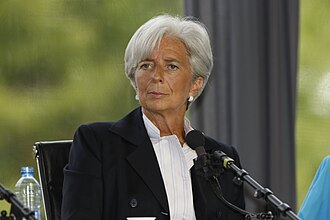
The role of Managing Director has seen various leaders, including Christine Lagarde (2011–2019) and Dominique Strauss-Kahn (2007–2011). The First Deputy Managing Director role is currently held by Dan Katz, while Pierre-Olivier Gourinchas serves as the Chief Economist.
Criticisms and Controversies
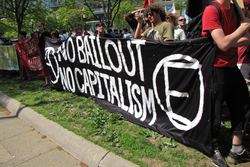
Despite its role in stability, the IMF has faced significant criticism. Opponents often argue that the conditionality attached to loans can be overly harsh, potentially impacting public health, food access, and social welfare in developing nations. Some critics also point to the disproportionate influence of the United States and other wealthy nations in the voting structure.
Frequently Asked Questions
What is the primary purpose of the IMF?
The IMF's primary purpose is to ensure the stability of the international monetary system—the system of exchange rates and international payments that enables countries to transact with each other.
How does the IMF determine voting power?
Voting power is based on a quota system. Each member is assigned a quota based on its relative size in the world economy, which determines its financial commitment to the fund and its voting weight.
What is structural adjustment?
Structural adjustment refers to a set of economic policy reforms—such as privatization, trade liberalization, and budget cuts—that the IMF requires borrowing countries to implement to stabilize their economies.
Who leads the IMF?
The IMF is led by a Managing Director, currently Kristalina Georgieva, who oversees the daily operations of the fund and its staff.
What is the difference between the IMF and the World Bank?
While both were created at Bretton Woods, the IMF focuses on macroeconomic stability and short-term balance-of-payments support, whereas the World Bank focuses on long-term economic development and poverty reduction through project lending.