Intercalated Games: The Forgotten Chapter of Olympic History
In the early years of the modern Olympic movement, the path to the global phenomenon we know today was fraught with organizational chaos and political tension. Amidst this instability emerged the Intercalated Games—a proposed series of international competitions designed to be held halfway between the traditional four-year Olympic cycle. While intended to be a recurring fixture, only one such event ever took place: the 1906 Games in Athens.
The Vision for a Two-Year Cycle
Following the resounding success of the first modern Games in Athens in 1896, Greek organizers proposed that Athens become the permanent home of the Olympics, hosting the event every four years. This proposal created a rift within the International Olympic Committee (IOC). Pierre de Coubertin, the founder of the IOC, opposed a permanent location because he envisioned a rotating international host system, as he had intended for the 1900 Games to be held in Paris.
To resolve this conflict, the IOC reached a compromise in 1901. They established a new schedule featuring two distinct series of quadrennial Games. One series would follow De Coubertin's model of international rotation, while the other—the Intercalated Games—would be held permanently in Athens. Both series were granted equal status as International Olympic Games.
A Movement in Crisis: Paris 1900 and St. Louis 1904
The necessity for the Intercalated Games became apparent as the first two rotating Olympics struggled. The 1900 Games in Paris were overshadowed by the Exposition Universelle (a world's fair), leading to haphazard organization and poor attendance for many events. The friction was so great that De Coubertin eventually resigned from the organizing committee.
The situation worsened with the 1904 Summer Olympics in St. Louis, Missouri. These Games were overshadowed by the Louisiana Purchase Exposition and suffered from even poorer organization. Due to extreme travel difficulties, only 20% of the athletes were non-American, and half of those few internationals were Canadian.
By this point, the Olympic Movement was in a dire state. With the next scheduled Games not until 1908, there was a fear that public goodwill would vanish entirely. Furthermore, Rome—the proposed host for 1908—was planning another exhibition alongside the Games, threatening to repeat the failures of Paris and St. Louis.
The 1906 Lifeline in Athens
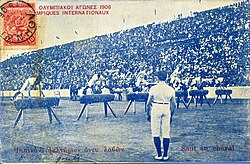
The 1906 Intercalated Games served as a critical lifeline for the movement. Although De Coubertin remained opposed to the idea, the IOC provided full support to the Greek organizing committee. The event served a dual purpose: celebrating the tenth anniversary of the 1896 Games and recapturing the original spirit of the Olympic movement.
For Greece, the 1906 Games were more than a sporting event; they were a grand project to demonstrate the nation's relevance to both the past and present of Europe. This ambition led to the construction of new infrastructure and the restoration of the ancient stadium in Athens.
Key Facts
- Purpose: To provide a permanent home for the Games in Athens every four years, alternating with rotating international hosts.
- The Only Event: Despite the plan for a series, only the 1906 Games were ever held.
- Catalyst: The failure of the 1900 (Paris) and 1904 (St. Louis) Games, which were both overshadowed by world's fairs.
- Significance: The 1906 Games helped save the Olympic Movement from collapse before the 1908 Games.
- Legacy: Resulted in the restoration of the ancient stadium in Athens.
Summary of Early Olympic Challenges
| Year | Location | Status/Type | Primary Challenge |
|---|---|---|---|
| 1896 | Athens | Olympiad | N/A (Highly successful) |
| 1900 | Paris | Olympiad | Overshadowed by Exposition Universelle |
| 1904 | St. Louis | Olympiad | Poor organization; low international participation |
| 1906 | Athens | Intercalated | Opposition from Pierre de Coubertin |
Frequently Asked Questions
What were the Intercalated Games?
The Intercalated Games were intended to be a series of International Olympic Games held every four years in Athens, positioned halfway between the rotating international Games of the Olympiad.
Why was only one Intercalated Games held?
While the IOC initially supported the compromise to satisfy Greek organizers and stabilize the movement, only the 1906 event took place before the system was abandoned.
How did the 1900 and 1904 Games affect the movement?
Both events were overshadowed by large exhibitions (world's fairs), resulting in poor organization and low attendance, which left the Olympic Movement in a precarious position.
Who was Pierre de Coubertin and what was his role?
Pierre de Coubertin was the founder of the International Olympic Committee. He advocated for the Games to rotate between different international cities rather than remaining permanently in Greece.
What was the significance of the 1906 Games for Greece?
The 1906 Games allowed Greece to showcase its importance to Europe and led to significant infrastructure projects, including the restoration of the ancient stadium.