Indochinese Communist Party: Origins, Evolution, and the Path to Power
The formation of the Indochinese Communist Party (ICP) marked a pivotal shift in the struggle for Vietnamese independence. Emerging from a fragmented landscape of Marxist groups and nationalist fervor, the party navigated complex relationships with the Comintern—the international organization that advocated for world communism—and fought a brutal colonial administration to establish a foothold in Southeast Asia.
The Unification and Comintern Influence
The party's roots trace back to a "Unification Conference" held in Hong Kong from February 3 to 7, 1930. Brokered by Hồ Chí Minh, this meeting brought together warring factions of the Thanh Niên organization and members of a Marxist group founded by Phan Bội Châu. The resulting entity was initially named the Communist Party of Vietnam (CPV).
The new party established a nine-member Provisional Central Committee, ensuring regional representation from Tonkin (North), Annam (Central), Cochinchina (South), and the Vietnamese émigré community in China. However, this initial structure drew sharp criticism from the Comintern, which viewed the party's focus on national liberation—summarized by the slogan "An Independent Viet Nam"—as overly nationalistic.
Under pressure from Moscow to eliminate "heterogeneous elements" and prioritize the international communist movement, a second conference was held in October 1930. This session renamed the organization the Indochinese Communist Party (ICP), signaling its alignment with Comintern mandates.
Early Struggles and Social Radicalization
At its inception, the ICP faced a daunting demographic challenge. In a nation of 17 million, the working class—the party's theoretical vanguard—consisted of only 221,000 people. Many of these workers were semi-peasants, particularly in the North, who frequently left industrial jobs during the Tết festival. A significant portion of the workforce was employed on rubber plantations under poor conditions.
Despite its small size, the ICP grew to approximately 1,500 members within five years. The party capitalized on social instability caused by bad harvests in 1929 and 1930 and heavy debt, which radicalized the peasantry. In the city of Vinh, ICP-led May Day demonstrations became a focal point for public dissatisfaction.
Suppression and the Popular Front
The French colonial authorities responded to the May Day rallies with violence, killing dozens of participants. This sparked widespread peasant revolts and the creation of local self-governing councils. The subsequent French crackdown was severe: roughly 1,300 people were killed, and many others were imprisoned or deported, including General Secretary Trần Phú.
The movement was later restored under the guidance of Lê Hồng Phong. By 1935, the Comintern shifted its global strategy toward a "Popular Front" against Fascism, urging communist parties to collaborate with any anti-fascist forces. This led the ICP to seek alliances with nationalist parties in Indochina.
This era saw a brief, unique cooperation between ICP cadres and left-oppositionists (Trotskyists). In Saigon, leaders like Nguyễn Văn Tạo and Tạ Thu Thâu collaborated on the newspaper La Lutte (The Struggle) and ran joint slates in municipal elections. However, this alliance collapsed by 1937 due to pressure from Moscow to denounce Trotskyists as "brothers of fascism."
World War II and the Rise of the Viet Minh
The outbreak of World War II and the fall of France to Nazi Germany in 1940 delegitimized French colonial rule. As Imperial Japan occupied Indochina, the ICP moved underground. The transition was costly; over 2,000 members were imprisoned, and key leaders like Nguyễn Văn Cừ and Hà Huy Tập were executed.
From this vacuum emerged a new leadership core consisting of Trường Chinh, Phạm Văn Đồng, and Võ Nguyên Giáp, working alongside Hồ Chí Minh. In February 1941, Hồ established the Viet Minh (League for the Independence of Vietnam). To maximize public support, the Viet Minh initially downplayed its communist goals, presenting itself as a broad patriotic front against Japanese occupation.
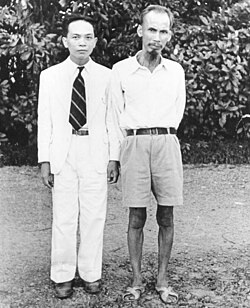
Despite Hồ's imprisonment by the Chinese Nationalist government from 1942 to 1944, the organization prospered. By 1944, the ICP membership was estimated at 2,000 to 3,000. In 1945, the party launched the August Revolution, seizing power and eliminating rival political groups, including the VNQDĐ and various Trotskyist factions.
Evolution into the Communist Party of Vietnam
To mask its communist identity, the ICP formally dissolved in 1945, folding its activities into the Viet Minh and the Marxism Research Association. Membership surged during this period, growing from 50,000 in 1946 to 400,000 by 1950.
In 1951, the party was re-founded as the Workers' Party of Vietnam, splitting into three separate parties for Vietnam, Laos, and Cambodia. Following the 1976 merger of the Workers' Party of North Vietnam and the People's Revolutionary Party of South Vietnam, the organization finally became the Communist Party of Vietnam (CPV).
| Year/Period | Organization Name | Key Focus/Event | Approx. Membership |
|---|---|---|---|
| Feb 1930 | Communist Party of Vietnam (CPV) | Initial Unification | Small/Initial |
| Oct 1930 | Indochinese Communist Party (ICP) | Comintern Alignment | ~1,500 (first 5 years) |
| 1941 | Viet Minh (Front) | Anti-Japanese Resistance | 2,000–3,000 (ICP core) |
| 1951 | Workers' Party of Vietnam | Regional Split (VN, Laos, Cambodia) | 766,349 |
| 1976 | Communist Party of Vietnam (CPV) | North-South Merger | 1,550,000 |
Key Facts
- Founding: Established in February 1930 in Hong Kong through the unification of Marxist groups.
- Comintern Role: The Comintern forced the name change to the Indochinese Communist Party to reduce nationalist emphasis.
- Viet Minh: A patriotic front created in 1941 to fight Japanese occupation while hiding communist objectives.
- August Revolution: The 1945 uprising that allowed the party to seize power and eliminate political rivals.
- Leadership: Key figures included Hồ Chí Minh, Võ Nguyên Giáp, and later, the influential First Secretary Lê Duẩn.
Frequently Asked Questions
Why was the party renamed from the CPV to the ICP in 1930?
The Comintern criticized the original Communist Party of Vietnam for being too nationalistic. They demanded a new conference to ensure the party focused more on the international communist movement and less on the specific slogan of an "Independent Viet Nam."
What was the purpose of the Viet Minh?
The Viet Minh was established as a broad patriotic league to gather maximum public support against Japanese occupation. By downplaying its social and communist objectives, it could attract a wider range of allies in the fight for national independence.
How did the party handle the Trotskyist opposition?
The relationship fluctuated from a brief period of cooperation during the Popular Front era (producing the newspaper La Lutte) to violent suppression. By 1945, the party executed leading cadres of rival Trotskyist groups during the August Revolution.
Who became the de facto leader after Hồ Chí Minh's health declined?
Lê Duẩn became the de facto leader of the party. While Hồ Chí Minh remained the chairman, Lê Duẩn exerted primary control over day-to-day decision-making and the planning of the offensive in the south.
How did the party's membership grow over time?
The party started very small, with only about 1,500 members in its first five years. It grew to roughly 400,000 by 1950, reached 766,349 by 1951, and eventually grew to 1,550,000 members by the time of the 1976 merger.