Stalinism and the Rise of European Fascism (1930–1939)
The 1930s were a decade of intense political volatility, marked by the consolidation of power within the Soviet Union and the aggressive ascent of fascism across Europe. As Joseph Stalin tightened his grip on the Communist movement, a deep schism emerged between the official Stalinist line and a growing anti-Stalinist left. This period was defined not only by the struggle against right-wing totalitarianism but also by a fierce internal battle for the soul of the revolutionary left.
The Consolidation of Stalin's Rule
During this era, the Soviet party launched heavy attacks against critics both domestically and abroad. Historian Bernhard H. Bayerlein describes this as a repressive transformation of the Communist movement, which inadvertently strengthened oppositionist and anti-Stalinist currents. In response, the International Revolutionary Marxist Centre was established in 1932, serving as an association for left-wing parties that rejected both the moderate mainstream of social democracy and the Stalinist Third International (the global organization of communist parties led by Moscow).
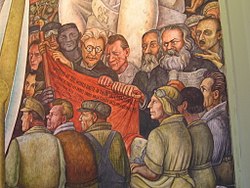
Leon Trotsky emerged as a primary critic of the regime. While Trotsky remained committed to defending the Russian Revolution from foreign aggression, he advocated for an anti-bureaucratic political revolution to be led by the Soviet working class. By 1936, Trotsky called for the restoration of the right to criticize economic matters, the revitalization of trade unions, and the implementation of free elections for Soviet parties.
Trotsky also challenged Stalin's policy of forced collectivisation—the state-led consolidation of individual peasant farms into collective ones—favoring instead a gradual, voluntary approach with greater tolerance for the rights of Soviet Ukrainians. Along with American supporter James P. Cannon, Trotsky characterized the Soviet Union as a degenerated workers' state, arguing that while its revolutionary gains must be protected from imperialists, it was currently ruled by a "gangster-like" party bureaucracy.
The Great Purge
Between 1936 and 1938, internal tensions culminated in the Great Purge. What began as a crackdown on Stalin's critics evolved into a systemic cleansing of perceived "anti-Soviet elements." While the majority of victims were peasants and ethnic minorities, anarchists and democratic socialists were also targeted for opposing Stalin's repressive political methods. Many victims were executed or sent to Gulag prison camps without legal trial. Estimates suggest the casualties of the Great Purge ranged from 600,000 to over 1 million people.
Responding to the Rise of Fascism
As fascism gained momentum in Europe, the Soviet leadership's strategy shifted. Initially, during the Comintern's "third period," Communist parties viewed the democratic left as social fascists, considering them a greater enemy than actual fascism. However, in 1933, the Soviet leadership pivoted to a popular front policy. This new strategy encouraged Communists to collaborate with liberal and even conservative allies to build a united defense against fascist assaults.
Despite the dominance of Stalinist front organizations, historians like Enzo Traverso emphasize that the anti-Stalinist left played a crucial role in the anti-fascist movement. They argue that it was entirely possible for intellectuals and activists to be both anti-fascist and anti-Stalinist, resisting the allure of Stalinism while fighting the right.
The Spanish Civil War
The Spanish Civil War became a focal point for these ideological conflicts. While the entire left supported the Republican faction, violent internal clashes broke out between the Communists and other left-wing groups, including anarchists, Trotskyists, and the POUM (the Spanish affiliate of the International Revolutionary Marxist Centre). Support for the POUM became a rallying cry for the international anti-Stalinist left, highlighted in George Orwell's Homage to Catalonia and the writings of Emma Goldman and Rudolf Rocker.
Other notable examples of this non-Stalinist resistance include the "Antwerp Group" of former Communist activists led by Hermann Knüfken. After being expelled from a Communist-led militia in Spain due to political differences, they joined the anarchist Durruti Column. Similarly, Italian socialists Gaetano Salvemini, who founded the clandestine newspaper Non mollare, and Carlo Rosselli, leader of the Giustizia e Libertà group, fought against fascism while maintaining their independence from Stalinism.
Key Facts
- The Great Purge (1936–1938): Resulted in an estimated 600,000 to 1 million deaths through executions and Gulag imprisonments.
- Degenerated Workers' State: The term used by Trotsky and James P. Cannon to describe the USSR under the party bureaucracy.
- Popular Front: A 1933 policy shift by the Soviet leadership to ally with liberals and conservatives against fascism.
- Social Fascism: An early Comintern theory that viewed the democratic left as a primary enemy.
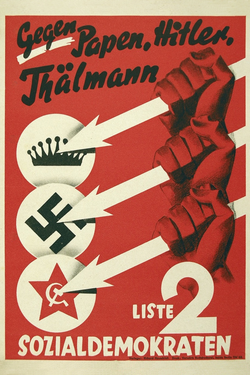
- Three Arrows: A symbol used by German Social Democrats to represent resistance against reactionary conservatism, Nazism, and Stalinism.
| Group | View on Stalinism | View on Fascism | Key Strategy/Action |
|---|---|---|---|
| Stalinists | Absolute Authority | Primary Enemy (post-1933) | Popular Front alliances |
| Trotskyists | Degenerated Bureaucracy | Mortal Enemy | Anti-bureaucratic revolution |
| Anti-Stalinist Left | Repressive/Totalitarian | Mortal Enemy | Independent anti-fascist action |
Frequently Asked Questions
What was the 'third period' in Comintern policy?
The 'third period' was a phase where Communist parties, under Soviet direction, viewed moderate social democrats as 'social fascists,' arguing they were a more immediate threat to the revolution than actual fascist movements.
How did Leon Trotsky's view of the Soviet Union differ from Stalin's?
While Stalin consolidated absolute power and forced collectivisation, Trotsky advocated for a return to workers' democracy, the right to criticize economic policy, and a voluntary approach to agricultural production.
What was the significance of the POUM in the Spanish Civil War?
The POUM represented a non-Stalinist Marxist alternative in Spain. Its conflict with the Communist-led factions within the Republican side highlighted the deep divide between Stalinism and the broader anti-fascist left.
Who were the primary targets of the Great Purge?
Although it targeted political opponents like anarchists and democratic socialists, the majority of those affected by the Great Purge were peasants and ethnic minorities.
What did the 'Three Arrows' symbol represent?
Adopted by the German Social Democratic Party, the Three Arrows symbolized a triple resistance against reactionary conservatism, Nazism, and Stalinism.