Indian Army Corps of Engineers
The Indian Army Corps of Engineers is a vital combat support arm of the Indian Army, dedicated to ensuring the mobility of friendly forces while restricting the movement of adversaries. From constructing critical infrastructure in the most inhospitable terrains to providing life-saving assistance during natural disasters, the Corps serves as the backbone of India's military logistics and border connectivity.
Operating under the motto Sarvatra (meaning "Everywhere"), the Corps is characterized by its maroon and blue colors and a legacy of technical excellence. Its operations are managed by the Engineer-in-Chief, currently Lieutenant General Vikas Rohella, SM.
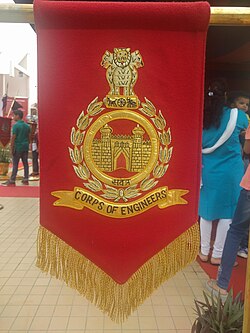
Key Facts
- Founded: Officially recognized in 1780.
- Primary Groups: Madras Sappers, Bengal Sappers, and Bombay Sappers.
- Core Motto: Sarvatra (Ubique / Everywhere).
- Key Organizations: Military Engineer Services (MES) and Border Roads Organisation (BRO).
- Training Hub: College of Military Engineering (CME), Pune.
- Historic Milestone: General Manoj Pande became the first Chief of the Army Staff from the Corps on May 1, 2022.
Historical Evolution
The origins of the Corps date back to the mid-18th century, with the earliest subunit, the 18 Field Company, established in 1777. The Corps officially traces its birth to 1780 with the raising of the Madras Sappers. Over time, similar groups were formed in the Bengal and Bombay Presidencies. These entities were unified following the events of 1857 and formally merged on November 18, 1932, to create the Corps of Indian Engineers.
Historically, the Sappers' responsibilities were diverse. Until 1911, they were responsible for passing battlefield messages—a duty that eventually led to the creation of the Corps of Signals. In 1932, the Corps also provided the initial batch of airmen for the newly formed Indian Air Force. During the Burma Campaign (1942–1945), the Corps integrated officers from the Indian Railways to enhance logistical capabilities.
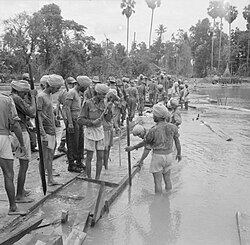
Following the Partition in 1947, leadership transitioned from British and Ceylonese officers to Indian command in 1960 under Major General Harkirat Singh. His tenure saw a massive expansion of the Corps and the establishment of the Border Roads Organisation.
Combat Engineering and Tactical Operations
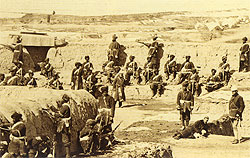
Combat engineers focus on two primary objectives: providing mobility for their own forces and counter-mobility for the enemy. This involves constructing bridges, tracks, and helipads, while simultaneously creating obstacles through mine-fields and the demolition of enemy bridges.
The Art of Sapping and Mining
The term "Sapping" refers to the technical process of digging zigzag or covered trenches to safely approach an enemy assault point. This skill was historically critical for overcoming the numerous forts across the Indian subcontinent.
Role in the Kargil War (OP Vijay)
The Corps played a pivotal role during the Kargil War. Several regiments were recognized for their bravery and technical skill:
- 108 Engineer Regiment: Operated in the Drass sector; awarded a Battle Honour, theatre Honour, and the COAS Unit Citation for War.
- 02 Engineer Regiment: Operated in Drass, Chor Batala, and Siachin sectors; awarded theatre honour.
- 106 Engineer Regiment: Operated in Drass and Kargil sectors; awarded the COAS Unit Citation of War.
- 112 Engineer Regiment: Operated in Daha and Ganasak sectors; awarded the COAS Unit Citation of War.
Major Engineering Organizations
Beyond direct combat, the Corps manages massive infrastructure projects through specialized organizations.
Military Engineer Services (MES)
The MES is one of India's largest construction and maintenance agencies, with an annual budget of approximately ₹13,000 crores. It is an inter-services organization responsible for the design and upkeep of airfields, dock installations, buildings, and essential utilities (water, electricity, and drainage) for the Army, Navy, Air Force, and Coast Guard.
Border Roads Organisation (BRO)
Established on May 7, 1960, the BRO consists of the Border Roads Development Board (BRDB) and the General Reserve Engineer Force (GREF). The BRO is instrumental in developing national highways and bridges in the Himalayas, Rajasthan, and Northeast India. In January 2024, the Defence Minister inaugurated 35 BRO projects across states including Ladakh, Arunachal Pradesh, and Sikkim to improve connectivity in inhospitable terrains.
Decorations and Honors
The bravery of the Corps is reflected in its extensive list of awards. Notable individual achievements include:
- Lt Gen PS Bhagat: The first Indian officer to win the Victoria Cross (WWII).
- Subedar Subramaniam: Awarded the George Cross (WWII).
- Major Rama Raghoba Rane: Awarded the Param Vir Chakra for clearing minefields under fire.
Collectively, the Corps has earned one Param Vir Chakra, two Maha Vir Chakras, 25 Vir Chakras, and numerous other distinguished service medals. The 9 Engineer Regiment is particularly noted for receiving 12 decorations during the 1971 Battle of Basantar.
| Category | Details |
|---|---|
| Established | 1780 |
| Motto | Sarvatra (Everywhere) |
| Primary Groups | Madras, Bengal, and Bombay Sappers |
| Key Infrastructure Arms | MES and BRO |
| Training Institution | College of Military Engineering (CME), Pune |
| Highest Gallantry Award | Param Vir Chakra (Major Rama Raghoba Rane) |
Frequently Asked Questions
What is the primary role of the Indian Army Corps of Engineers?
The Corps provides combat engineering support to ensure the mobility of Indian forces and the restriction of enemy movement. They also develop military infrastructure and assist civil authorities during natural disasters.
What are the three main groups of combat engineers in the Corps?
The Corps consists of the Madras Sappers, the Bengal Sappers, and the Bombay Sappers.
What is the difference between the MES and the BRO?
The Military Engineer Services (MES) focuses on the design and maintenance of military buildings, airfields, and utilities. The Border Roads Organisation (BRO) focuses on constructing roads, bridges, and highways in remote border areas and inhospitable terrains.
What does "Sapping" mean in a military context?
Sapping is the technique of digging precise, often zigzag or covered trenches to allow soldiers to approach an enemy position or fort safely.
Who was the first Chief of the Army Staff from the Corps of Engineers?
General Manoj Pande became the first Chief of the Army Staff from the Corps of Engineers on May 1, 2022.