Imperial Crowns: History, Design, and Symbolic Power
An imperial crown is a specialized piece of regalia worn by an emperor. Beyond its physical presence, it serves as a potent symbol of an empire's power, particularly in heraldic depictions. While the craftsmanship of imperial crowns often mirrors that of royal crowns—utilizing precious metals, pearls, and gemstones—their external forms frequently differ to emphasize the divine right and supreme authority of the wearer.
Key Facts
- Closed vs. Open: In Europe, closed crowns (with arches) typically symbolize imperial authority, while open crowns (circlets) were traditionally royal.
- Divine Symbolism: Christian symbols are often integrated into European imperial crowns to emphasize divine rule.
- East Asian Design: Chinese mianguan and Japanese benkan are characterized by chains that partially obscure the emperor's face.
- Legal Status: The English Crown is legally defined as an imperial crown following the Act in Restraint of Appeals (1533) and the Act of Supremacy (1534).
- Holy Roman Empire: The unique imperial style often featured a single crest running from front to back.
European Crown Design and Evolution
During the Middle Ages, European crowns were categorized primarily by their structure. An open crown consists of a golden circlet, often decorated with enamel or precious stones. This style was characteristic of the medieval French monarchy.
In contrast, a closed crown features metal bands, or arches, that cross from side to side and front to back, meeting at the top. These arches served three primary purposes: they strengthened the structure, provided a support for a central jewel or cross, and echoed the design of early Germanic helmets intended to protect the skull.
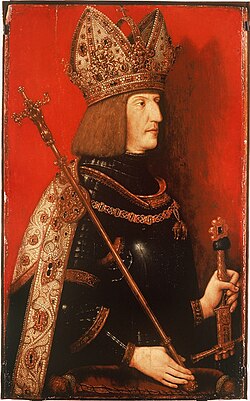
The Holy Roman Empire developed a distinct variation. Originally an open crown of eight jeweled sections, Emperor Conrad II (1024–39) added a jeweled crest running from front to back, inscribed with his name and title. This single-crest design became the hallmark of imperial office. Later, the Habsburgs incorporated mitre-like cusps into their 15th-century designs while maintaining the central crest.
The English Transition to the Closed Crown
The use of the closed crown in England was a point of political and symbolic evolution. While French kings adhered to open crowns, English monarchs began adopting closed designs to distinguish themselves. Henry IV's coronation on October 13, 1399, marked the first unequivocal use of a closed crown, though his tomb effigy still shows an open one.
By the reign of Henry VIII, the closed crown became the definitive symbolic representation of the English Crown as an imperial entity. This shift was influenced by Continental trends, such as the coinage of Holy Roman Emperor Maximilian I, which depicted a closed crown and was familiar to English traders.
Global Variations of Imperial Regalia
Imperial crowns vary significantly across different cultures and eras, reflecting local traditions and political structures.
East Asian Imperial Crowns
In East Asia, emperors wore different crowns depending on the specific ritual or ceremony. Notable examples include the Chinese mianguan and the Japanese benkan. Unlike European styles, these are distinguished by hanging chains that hide the emperor's face during formal proceedings.
Other Notable Imperial Styles
- Roman and Byzantine: Early Roman styles included the corona radiata (radiant crown) associated with Sol Invictus, while Byzantine emperors wore the stemma.
- Napoleonic: Napoleon Bonaparte utilized both a laurel crown and the "Crown of Charlemagne."
- Persian: The Qajar dynasty used the Kiani Crown, while the Pahlavi dynasty utilized the Pahlavi Crown.
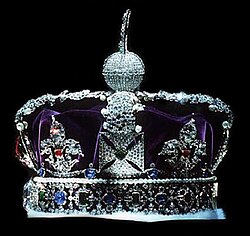
- Modern British: The Imperial Crown of India was specifically created for King George V for the 1911 Delhi Durbar.
Summary of Imperial Crown Types
| Region/Empire | Primary Design Feature | Symbolic Meaning |
|---|---|---|
| Holy Roman Empire | Single front-to-back crest / Mitre | Imperial Office & Divine Rule |
| England (Post-1533) | Closed/Arched design | Imperial sovereignty & independence |
| China/Japan | Face-obscuring chains | Ritual purity and ceremonial dignity |
| Ancient Rome | Laurel wreaths / Radiant spikes | Victory and Solar divinity |
Legal Usage and the English Empire
The designation of the English crown as "imperial" was a strategic legal move during the reign of Henry VIII. When Pope Clement VII refused to annul Henry's marriage to Catherine of Aragon, the English Parliament passed the Act in Restraint of Appeals (1533), declaring England an empire governed by one supreme head.
This was reinforced by the Act of Supremacy (1534), which united the headship of the Church of England with the imperial crown. Despite temporary annulments during the reign of Mary I, the status was restored under Elizabeth I and remained through the English Restoration, establishing the British crown as an imperial crown by law.
Frequently Asked Questions
What is the main difference between an open and a closed crown?
An open crown is a simple decorated circlet, whereas a closed crown features arches that meet at the top. In European tradition, the closed design typically symbolizes imperial authority, while the open design is associated with royalty.
Why did the English monarchy adopt the closed crown?
The closed crown was adopted partly to distinguish the English monarchy from the French (who wore open crowns) and to symbolically represent England as an empire, independent of foreign (specifically Papal) authority.
What are the characteristics of East Asian imperial crowns?
Imperial crowns in China (mianguan) and Japan (benkan) are characterized by the use of chains or beads that hang down to partially hide the emperor's face during ceremonies.
How did the Holy Roman Empire's crown differ from others?
The Holy Roman Empire's crown was uniquely identified by a single jeweled crest running from the front to the back of the head, a design element introduced by Emperor Conrad II.
What legal acts made the British crown "imperial"?
The Act in Restraint of Appeals (1533) and the Act of Supremacy (1534) explicitly defined the realm of England as an empire and tied the headship of the church to the imperial crown.