British Colonial Settlements in Wales and Ireland
The expansion of the English Crown across the British Isles was characterized by strategic settlement policies and the construction of formidable fortifications. From the rugged landscapes of Wales to the fertile plains of Ireland, the Crown employed distinct methods of control, ranging from the creation of fortified towns to the large-scale redistribution of land through plantations.
The English Conquest of Wales
During the reign of King Edward I, the English Crown implemented a rigorous policy of castle and settlement building to maintain control over the Welsh population. A primary objective was to strategically surround the newly conquered Kingdom of Gwynedd, ensuring the Crown's dominance over the region.
Many of these fortifications were designed as integrated fortified towns. These settlements were based on the concept of bastides—fortified towns originally developed by the Normans in Gascony—which were designed to be provisioned from safer territories to withstand local attacks. Some of these stone fortifications were designed by James of St. George d'Esperanche.
These towns were exclusively populated by English or Flemish settlers who relied on the Crown for survival. The native Welsh population faced severe restrictions: they were forbidden from entering the towns after dark, denied trading rights, and prohibited from carrying arms.
In modern times, this era remains a point of contention. In 2017, a restoration project at Flint Castle proposed an iron sculpture of a giant ring to represent the "Iron Ring" of castles. However, the project was cancelled following a social media campaign and petition, as critics argued it commemorated the Edwardian conquest of Wales.
The Plantations of Ireland
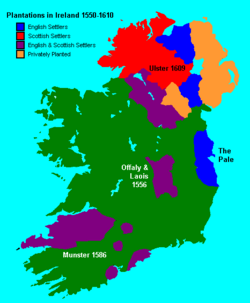
The Plantations of Ireland were a series of colonial ventures in the 16th and 17th centuries involving the confiscation of land from the Irish people. While immigration from Great Britain had occurred since the Anglo-Norman invasion, most earlier immigrants had either assimilated or been driven off by the 15th century, leaving the Crown's direct control limited to an area known as the Pale.
The Tudor conquest of Ireland began in the 1540s, followed by the first plantations in the 1550s under the Catholic Queen Mary I in the counties of Laois and Offaly. These early attempts largely failed due to resistance and attacks from local Irish clans.
A second wave of plantations occurred under Queen Elizabeth I, led by the West Country Men. Elizabeth's strategic goal was to grant land to planters to prevent the Irish from providing Spain with a base for attacking England.
The Plantation of Ulster
The most significant and successful effort began in the 1610s during the reign of James I. Following the defeat of rebel Ulster lords in the Nine Years' War, their lands were confiscated. This plantation covered most of the province of Ulster.
Unlike the existing population, which was primarily Catholic and Irish-speaking, the new settlers were required to be Protestant and English-speaking. Most of these settlers arrived from Scotland and England, establishing a distinct Ulster Protestant community.
Key Facts
- The Iron Ring: A network of castles and fortified towns built by Edward I to control Wales and the Kingdom of Gwynedd.
- Bastides: Fortified town designs adapted from Gascony to ensure settlers could hold out against attacks.
- The Pale: The small area of Ireland that remained under direct English Crown control prior to the Tudor conquests.
- Ulster Plantation: The largest and most successful Irish plantation, occurring in the 1610s under James I.
- Settler Requirements: In Ulster, settlers were mandated to be Protestant and English-speaking.
Summary of Colonial Efforts
| Region | Primary Method | Key Figures/Eras | Primary Goal |
|---|---|---|---|
| Wales | Castle and Bastide towns | King Edward I | Population control and strategic encirclement |
| Ireland (Early) | Land confiscation (Laois/Offaly) | Queen Mary I | Initial settlement (largely failed) |
| Ireland (Tudor) | Land grants to planters | Queen Elizabeth I | Preventing Spanish influence |
| Ireland (Ulster) | Mass redistribution of land | James I | Establishing a Protestant, English-speaking community |
Frequently Asked Questions
What were bastides in the context of Welsh settlements?
Bastides were fortified towns, a concept developed by the Normans in Gascony, designed to be self-sufficient and defensible against local attacks.
Why was the 2017 Flint Castle sculpture project cancelled?
The project was cancelled after a petition and social media campaign because the public viewed the sculpture as a commemoration of the Edwardian conquest of Wales.
What was the "Pale" in Ireland?
The Pale was the specific area of Ireland that remained under the direct control of the English Crown before the wider Tudor conquests began.
How did the Plantation of Ulster differ from earlier Irish plantations?
The Plantation of Ulster was the largest and most successful, specifically requiring settlers to be Protestant and English-speaking, which created a distinct community in the province.
Who were the West Country Men?
The West Country Men were the individuals who spearheaded the wave of plantations in Ireland during the reign of Queen Elizabeth I.