Iguazu Falls: The World's Largest Waterfall System
Spanning the border between the Argentine province of Misiones and the Brazilian state of Paraná, Iguazu Falls (known as Cataratas del Iguazú in Spanish and Cataratas do Iguaçu in Portuguese) represent the most extensive waterfall system on Earth. The name originates from the Guarani and Tupi words y (water) and ûasú (big), aptly describing the sheer scale of this natural wonder.
The falls divide the Iguazu River into upper and lower sections. While the river rises near Curitiba and flows primarily through Brazil, the majority of the falls are located on the Argentine side. This breathtaking site was first recorded by Spanish Conquistador Álvar Núñez Cabeza de Vaca in 1541 and was inscribed as a UNESCO World Heritage site in 2013.
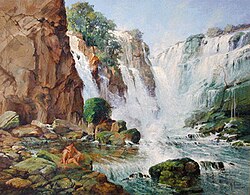
Key Facts
- Total Drops: Approximately 275 individual waterfalls.
- Maximum Height: The longest drop reaches 82 metres (269 ft).
- Total Width: The edge of the falls extends for 2.7 kilometres (1.7 mi).
- Average Flow: 1,756 cubic metres per second (m³/s).
- UNESCO Status: Both the Argentine and Brazilian parks are World Heritage Sites.
Geology and Geography
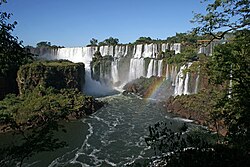
The falls are characterized by a distinct staircase structure, consisting of a two-step waterfall formed by three layers of basalt (a dark, fine-grained volcanic rock). These steps measure 35 and 40 metres in height and are part of the 1,000-metre-thick Serra Geral formation within the Paleozoic-Mesozoic Paraná Basin.
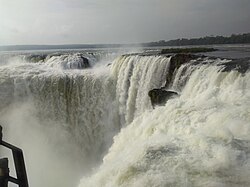
The 2.7-kilometre edge is divided by numerous islands, creating a fluctuating number of cataracts—between 150 and 300—depending on the water level. The most dramatic feature is the Devil's Throat (Garganta del Diablo), a narrow chasm 80–90 metres wide and 70–80 metres deep that absorbs roughly half of the river's total flow.
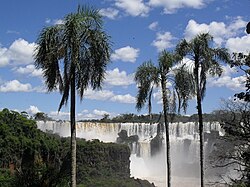
Geographically, the falls resemble a reversed letter "J". While Brazil contains over 95% of the Iguazu River basin, Argentina hosts nearly 80% of the actual falls. The river eventually drains into the Paraná River, marking the tri-border junction between Brazil, Argentina, and Paraguay.
Visiting the Falls
Visitors typically access the site via three main cities: Foz do Iguaçu (Brazil), Puerto Iguazú (Argentina), and Ciudad del Este (Paraguay). The falls are managed by two separate national parks: the Iguazú National Park in Argentina and the Iguaçu National Park in Brazil.

The Brazilian Experience
The Brazilian side is renowned for its panoramic views. A long walkway allows visitors to see the vast expanse of the falls, including an extension that leads to the base of the Devil's Throat. To minimize environmental impact while accommodating crowds, Brazil utilizes high-capacity, double-deck panoramic buses. Helicopter tours are also available here for aerial perspectives.
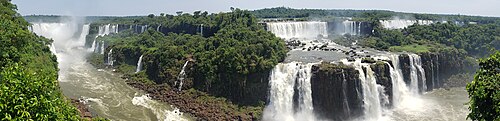
The Argentine Experience
The Argentine side offers a more immersive forest experience. Visitors use the Rainforest Ecological Train to reach various trails, including the 1 km-long Paseo Garganta del Diablo, which takes guests directly over the highest and deepest section of the falls. Inflatable boat services are also available to bring visitors close to the cascading water.
Comparative Scale and Climate
Iguazu is frequently compared to Niagara Falls and Victoria Falls. While Victoria Falls possesses the world's largest single curtain of water, Iguazu is wider and more fragmented. In terms of flow, Iguazu ranks as the sixth-greatest average annual flow globally.
| Parameter | Victoria Falls | Niagara Falls | Iguazu Falls |
|---|---|---|---|
| Height | 108 m | 51 m | 64–82 m |
| Width | 1,708 m | 1,203 m | 2,700 m |
| Mean Annual Flow | 1,088 m³/s | 2,407 m³/s | 1,746 m³/s |
| Highest Recorded Flow | 12,800 m³/s | 6,800 m³/s | 45,700 m³/s |
The region experiences a humid subtropical climate, characterized by high temperatures and abundant rainfall. The peak water volume typically occurs between December and February. However, extreme weather can cause fluctuations; for instance, a severe drought in 2006 reduced the flow to just 300 m³/s.
Frequently Asked Questions
Which country has more of the falls?
While Brazil holds the vast majority of the river basin, Argentina contains approximately 80% of the actual waterfall drops.
What is the Devil's Throat?
The Devil's Throat is a long, narrow canyon that is the highest and deepest part of the system, handling about half of the Iguazu River's total flow.
How does Iguazu compare to Niagara Falls?
Iguazu is significantly wider and taller than Niagara Falls, which is about a third shorter than the highest drops at Iguazu.
When is the best time to see the falls at maximum volume?
The period of greatest water volume is usually from December to February, which coincides with the season of heaviest rainfall.
Can you visit the falls from three different countries?
Yes, the falls are accessible via Foz do Iguaçu (Brazil) and Puerto Iguazú (Argentina), and the nearby city of Ciudad del Este (Paraguay) also provides access to the river where the three national borders meet.