Ichthyornis: The Toothy Seabird of the Late Cretaceous
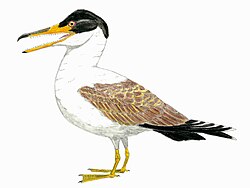
In the vast ecosystems of the Late Cretaceous, the skies were home to a fascinating creature that blurred the lines between ancient reptiles and modern birds. Ichthyornis (meaning "fish bird") was a genus of toothy, seabird-like ornithurans—a group of birds closely related to modern avian lineages—that thrived in North America millions of years ago.
Known primarily from the chalks of the Western Interior Seaway, Ichthyornis provides a critical evolutionary link. It was the first prehistoric bird relative discovered with teeth, a finding that once sparked intense scientific debate and provided early, tangible support for the theory of evolution.
Key Facts
- Temporal Range: Late Cretaceous (Cenomanian to Campanian ages).
- Habitat: The Western Interior Seaway of North America.
- Defining Feature: Possessed teeth in the middle of the jaws and fish-like vertebrae.
- Size: Roughly the size of a modern pigeon.
- Evolutionary Role: One of the closest non-avian relatives to modern birds.
Physical Characteristics and Anatomy
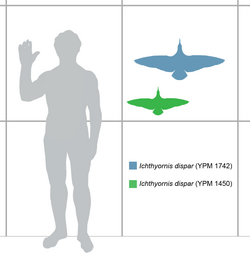
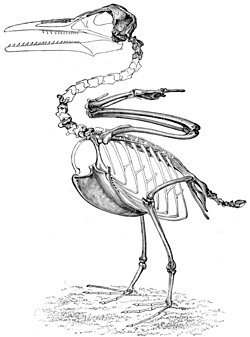
Ichthyornis occupied an ecological niche similar to modern gulls, petrels, and skimmers. An average specimen measured approximately 24 centimeters (9.4 inches) in length, with a skeletal wingspan of about 43 centimeters (17 inches). However, fossils show significant size variation across different specimens.
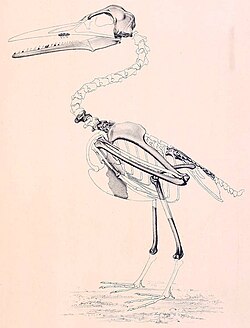
The most striking feature of Ichthyornis was its dentition. Unlike modern birds, it had teeth located in the middle portions of both the upper and lower jaws. These teeth were flattened, curved backward, and lacked serrations, arranged in a groove reminiscent of marine reptiles. Interestingly, the tips of the jaws were toothless and covered by a compound beak made of several distinct plates, similar to that of a modern albatross.
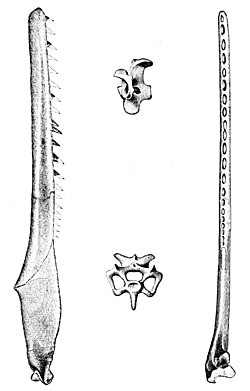
The genus also earns its name from its unique vertebrae, which are concave on both the front and back—a trait similar to some fish. While its palate was remarkably similar to modern neognaths (modern birds), studies of its endocast (a cast of the brain cavity) reveal a more basal brain structure, similar to that of Archaeopteryx and other non-avian theropods.
Evolution and Growth Over Time
Fossils of Ichthyornis are abundant in the Niobrara Formation, spanning from the late Coniacian (about 89 million years ago) to the Campanian (about 83.5 million years ago), with some remains dating as far back as the early Turonian (93 million years ago).
Evidence suggests that the species Ichthyornis dispar increased in size over several million years. For example, the holotype specimen YPM 1450 has a humerus (upper arm bone) of 58 millimeters, while geologically younger specimens, such as YPM 1742, possess a humerus measuring 71.5 millimeters. Because both sets of specimens show signs of skeletal maturity, scientists believe the species itself evolved to be larger over time.
The History of Discovery and the "Bone Wars"
The discovery of Ichthyornis is intertwined with one of the most famous rivalries in science: the "Bone Wars" between paleontologists Edward Drinker Cope and Othniel Charles Marsh. The fossils were first recovered in 1870 by Benjamin Franklin Mudge in Kansas. In a dramatic turn of events, Mudge redirected a shipment of fossils originally intended for Cope to Marsh, granting Marsh the prestige of naming the find.
Initially, Marsh misidentified the fossils, believing the toothed jaws belonged to a small marine reptile he named Colonosaurus mudgei. By 1873, he realized the jaws and the bird skeleton were part of the same animal. He subsequently created a new sub-class, Odontornithes ("toothed birds"), to accommodate this discovery.
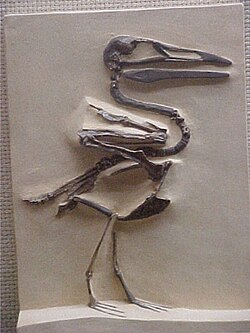
This discovery was highly controversial. Some critics accused Marsh of creating a hoax by attaching reptile jaws to a bird. However, the find was a goldmine for evolutionary biology. Charles Darwin noted in 1880 that Ichthyornis and its relative Hesperornis provided the "best support" for his theory of evolution since the publication of On the Origin of Species.
Classification and Taxonomy
While many species were originally named, modern reviews—most notably by Julia Clarke in 2004—recognize only one valid species: Ichthyornis dispar. Other previously named species are now considered synonyms or belong to different genera entirely.
| Category | Details |
|---|---|
| Scientific Name | Ichthyornis dispar |
| Clade | Ornithurae / Ichthyornithes |
| Temporal Range | Late Cretaceous (Cenomanian–Campanian) |
| Key Anatomy | Toothed jaws, compound beak, amphicoelous (double-concave) vertebrae |
| Primary Locations | Kansas, Alberta, Saskatchewan, Texas, Alabama, New Mexico |
Frequently Asked Questions
Did Ichthyornis have a beak?
Yes. While it had teeth in the middle of its jaws, the tips of the jaws were toothless and covered by a compound beak made of several plates, similar to the beak of an albatross.
Why is Ichthyornis called the "fish bird"?
The name comes from its vertebrae, which are concave on both the front and back, a skeletal characteristic similar to that found in some fish.
How did Ichthyornis contribute to the theory of evolution?
As a bird with teeth, it served as a "transitional" form that linked modern toothless birds to their reptilian ancestors, providing strong evidence for Darwin's theory of evolution.
Was Ichthyornis a direct ancestor of modern birds?
No. While it is very close to the ancestry of modern birds (Aves), it represents an independent lineage within the Ornithurae.
Where were Ichthyornis fossils primarily found?
They are most commonly found in the Niobrara Formation and other strata of the Western Interior Seaway across North America, including Kansas, Alberta, and Texas.