IAB Standard Ad Sizes and Digital Advertising Guidelines
In the early days of the internet, digital advertising was a fragmented landscape where banner ads appeared in over 250 different sizes. To bring order to this chaos, the Interactive Advertising Bureau (IAB) introduced standardized ad sizes. These standards ensure that advertisers and publishers can exchange creative assets seamlessly across different platforms and networks.
While IAB standards are widely adopted, particularly in North America and Europe, some global websites and advertising networks may utilize different dimensions or non-standard formats. These standards continue to evolve to combat banner blindness—a phenomenon where users consciously or unconsciously ignore banner-like information—and creative fatigue.
Key Facts
- The IAB standardized ad sizes to replace a system that previously had over 250 variations.
- Guidelines are updated bi-annually to maintain performance and relevance.
- Major ad serving companies like Adform, AppNexus, and SpotXchange support the IAB Universal Package.
- Modern guidelines now include HTML5, augmented reality (AR), virtual reality (VR), and 360-degree video.
- Native advertising is growing, with eMarketer reporting spending exceeding $4.3 billion by the end of 2015.
Evolution of IAB Guidelines
The IAB has consistently updated its framework to keep pace with technological shifts. In 2015, the organization announced creative guidelines for display and mobile that integrated HTML5 (the standard markup language for designing web pages and web applications).
By 2017, the IAB expanded its scope further, introducing adjustable ad formats and guidelines for emerging digital experiences. These include:
- Social media and mobile video
- Emoji ad messaging
- Augmented Reality (AR) and Virtual Reality (VR)
- 360-degree video ads
Standard Ad Unit Dimensions
Ad units are generally categorized by their shape and placement on a page. These range from small buttons to massive billboards and mobile-specific interstitials (full-screen ads that cover the interface of their host app).
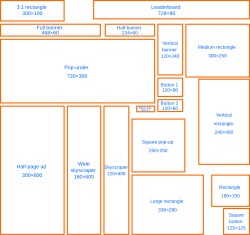
The following table summarizes common IAB ad units, their dimensions in pixels, and their aspect ratios.
| Ad Unit Name | Size (px) | Aspect Ratio | Total Pixels |
|---|---|---|---|
| Billboard | 970 × 250 | 97:25 | 242,500 |
| Leaderboard | 728 × 90 | 364:45 | 65,520 |
| Medium Rectangle | 300 × 250 | 6:5 | 75,000 |
| Wide Skyscraper | 160 × 600 | 4:15 | 96,000 |
| Smartphone Banner | 320 × 50 | 32:5 | 16,000 |
| Mobile Phone Interstitial (L) | 1080 × 1920 | 9:16 | 2,073,600 |
| Half Page Ad | 300 × 600 | 1:2 | 180,000 |
Legacy and Specialized Formats
Beyond the primary units, the IAB has defined various specialized sizes over the years. These include Rectangles and Pop-Ups (such as the 300x250 Medium Rectangle), Banners and Buttons (such as the 468x60 Full Banner), and Skyscrapers (such as the 120x600 Skyscraper). Additionally, specific sizes exist for feature phones, including small (120x20), medium (168x28), and large (216x36) banners.
Custom Executions and Native Advertising
Despite the utility of standards, many high-profile publishers opt for custom executions to increase engagement. Companies such as BuzzFeed, Vice Media, Inc., Quartz, and Elite Daily often move beyond standard IAB units to create unique user experiences.
This shift is closely tied to the rise of native advertising—ads that match the look, feel, and function of the media format in which they appear. As advertisers seek to bypass banner blindness, direct buys for custom, native content have become a significant revenue stream for digital publishers.
Frequently Asked Questions
Why are IAB standard ad sizes important?
They provide a universal language for advertisers and publishers, ensuring that ad creatives fit perfectly into designated website slots without breaking the layout or requiring custom coding for every single ad.
What is banner blindness?
Banner blindness is a psychological phenomenon where users ignore banner-like information on a webpage because they have been conditioned to recognize it as an advertisement rather than useful content.
How often does the IAB update its guidelines?
The IAB typically updates its guidelines bi-annually to adapt to new device types, screen resolutions, and changes in user behavior.
Do all ad networks use IAB standards?
While most major ad serving companies (such as AppNexus and Adform) support IAB standards, some networks—particularly those outside North America and Europe—may use non-standard sizes or proprietary formats.
What are the newest formats introduced by the IAB?
Recent updates have introduced guidelines for adjustable formats and immersive digital experiences, including augmented reality (AR), virtual reality (VR), 360-degree video, and emoji-based messaging.