Digital Advertising Operations and Display Ad Strategy
Launching a successful digital advertising campaign requires a synchronized effort between multiple specialized roles and a deep understanding of the technology that delivers content to users. From the initial client meeting to the final click, the process involves a complex pipeline of strategy, creativity, and technical execution.
The Advertising Agency Workflow
A professional ad campaign moves through several distinct departments, each ensuring that the final product is both strategically sound and visually compelling.
Accounts Department
The process begins with the accounts department. Their primary role is to meet with the client to define specific campaign goals. Once these objectives are clear, they translate them into a creative brief—a foundational document that guides the creative team on what needs to be achieved.
Creative Department
The creative team, typically composed of copywriters and graphic designers, is responsible for conceptualizing and producing the actual advertisement. Their goal is to develop a creative execution compelling enough to drive a customer to purchase a product or service, utilizing a blend of persuasive copy and striking visuals.
Media Planning and Buying
A media planner determines the optimal advertising channels and the timing for ad delivery. By analyzing audience data and media options, they align the campaign with the client's budget and objectives. Once the strategy is set, recommendations are handed off to media buyers, who manage the actual purchase of airtime and ad space.
Ad Operations (Ad Ops)
Ad Operations, or "Ad Ops," handle the technical delivery of the ad. They upload the creative assets into the advertiser's ad server to ensure the ad appears on the correct website at the correct time. Ad Ops teams are also responsible for budget management, tracking performance, and optimizing campaigns to meet the advertiser's KPIs (Key Performance Indicators).
The Role of the Ad Server
An ad server is a piece of advertising technology (ad tech) that administrates the distribution of digital display advertisements. It acts as a central hub that receives ad files and allocates them across various websites based on specific parameters.
Ad servers manage critical delivery details, including:
- Campaign Scheduling: Setting the specific dates a campaign should run.
- Targeting: Controlling delivery based on geographic location, language, and past user behavior.
- Frequency Capping: Limiting the number of times a user sees an ad to prevent overexposure.
- Pacing: Managing the speed at which an ad is spread across the web.
There are three primary types of ad servers:
- Publisher Ad Servers: Help website owners launch ads, list the highest prices, and track reach.
- Advertiser Ad Servers: Send ads as HTML codes to publishers, allowing for real-time changes to frequency and creative.
- Ad Network Ad Servers: Provide data on daily revenue and which networks are generating income for the publisher.
Display Ad Formats and Standards
Choosing the right format is essential for maximizing the impact of a medium. Research from the Amsterdam School of Communication Research (ASCor) indicates that audiences perceive different formats—such as sponsored content versus banner ads—in vastly different ways.
Common display formats include:
- Video: Motion-based advertisements.
- Rich Media Ads (Expandables): Flash files that expand via mouseover (polite) or automatically (non-polite).
- Overlays: Ads that appear over content and can be closed by the user.
- Interstitials: Full-page ads that appear before the target content is displayed.
- Sponsorship and Native Advertising: Including a brand logo in a website's design or creating "In-Feed" ads that mimic editorial content.
To standardize these experiences, the Interactive Advertising Bureau (IAB) provides a Display Standard Ad Unit Portfolio. These guidelines have evolved from the 2007 standards to include HTML5 in 2015 and adjustable formats for AR (Augmented Reality), VR (Virtual Reality), and 360-degree video in 2017.
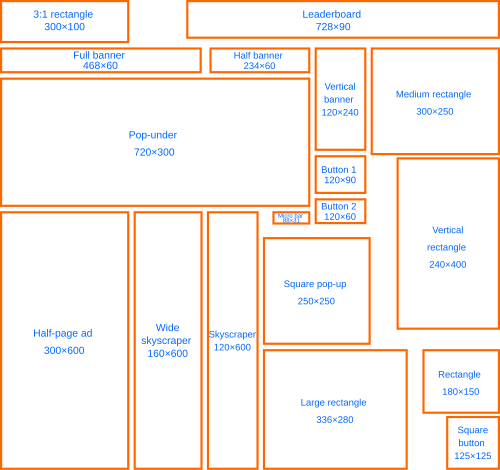
Standard Ad Unit Dimensions
| Ad Unit Name | Fixed Size (px) |
|---|---|
| Billboard | 970 x 250 |
| Leaderboard | 728 x 90 |
| Medium Rectangle | 300 x 250 |
| Skyscraper | 160 x 600 |
| Smartphone Banner | 300 x 50, 320 x 50 |
| Mobile Phone Interstitial | 640 x 1136, 750 x 1334, 1080 x 1920 |
Managing Ad Fatigue
Ad Fatigue (or ad boredom) occurs when consumers lose sensitivity to advertisements due to prolonged exposure. This typically results in lower engagement rates and a decline in CTR (Click-Through Rate). This is frequently seen in repetitive strategies like re-targeting, with YouTube ads being a common example.
Primary Causes of Fatigue
- Overexposure: Seeing the same ad too often leads to irritation or the user simply ignoring the ad.
- Lack of Variety: Repetitive messaging, creatives, and formats cause user disinterest.
- Inadequate Targeting: Ads that are not relevant to the user lead to rapid disengagement.
Key Facts
- Ad Ops are responsible for the physical delivery and budget optimization of campaigns.
- Ad Servers can be tailored for publishers, advertisers, or ad networks.
- IAB updates ad guidelines bi-annually to combat "banner blindness" and creative fatigue.
- Native Advertising is designed to blend in with editorial or "In-Feed" content.
- Ad Fatigue is often exacerbated by aggressive re-targeting strategies.
Frequently Asked Questions
What is the difference between a media planner and a media buyer?
A media planner analyzes data to decide which channels and timings are best for a campaign's goals, while the media buyer handles the actual financial transaction to purchase that ad space.
What is the purpose of an ad server?
An ad server is an ad tech tool used to manage, distribute, and track digital ads across various websites, controlling factors like targeting, frequency, and scheduling.
What are "polite" vs "non-polite" rich media ads?
Polite expandables only expand when a user interacts with them (such as a mouseover), whereas non-polite ads are auto-initiated.
How does the IAB help creative teams?
The IAB provides a Display Standard Ad Unit Portfolio, which serves as a guideline for standard ad sizes to ensure consistency and performance across different platforms.
What is banner blindness?
Banner blindness is a phenomenon where users consciously or subconsciously ignore banner-like information, leading ad companies to constantly test and evolve ad unit performance.