Hwaseong Fortress: A Masterpiece of Joseon Dynasty Military Architecture
Located in Suwon, Gyeonggi Province, Hwaseong Fortress stands as one of South Korea's most significant cultural and historical landmarks. Designated as a UNESCO World Heritage Site in 1997, this massive fortification represents a pinnacle of military engineering from the Joseon Dynasty. The fortress is not merely a defensive wall but a complex system of gates, towers, and pavilions designed with both strategic utility and aesthetic elegance in mind.
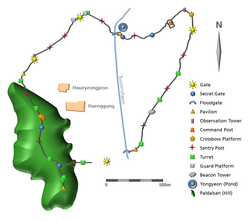
Key Facts
- Location: Suwon, Gyeonggi Province, South Korea
- UNESCO Designation: 1997 (Criteria ii, iii)
- Official Name: Hwaseong Fortress, Suwon
- Primary Function: Military defense and administrative center
- Key Historical Figure: King Jeongjo
Historical Context and Construction
The construction of Hwaseong Fortress was a monumental undertaking that utilized detailed records known as the Hwaseong seongyeok uigwe. These records provided precise drawings and instructions, ensuring the accuracy of the build. The fortress was designed to serve as a robust defensive structure while also acting as a center for regional administration.
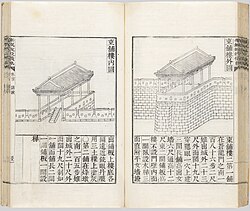
The architectural planning was so meticulous that many of the original designs are preserved through historical sketches and official documents, such as those published in the 1801 Hwaseong Seongyeok Uigwe.
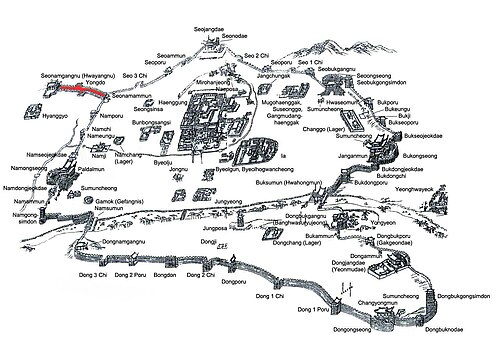
Architectural Features and Defensive Structures
The fortress is characterized by a sophisticated array of defensive elements. These include Main Gates, Floodgates, Beacon Towers, and various specialized combat structures like GunTowers and Crossbow Platforms.
The Defensive Wall and Turrets
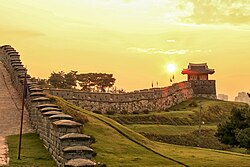
The wall itself is reinforced by numerous Turrets (chi), which are small bulges extending perpendicularly from the wall. These allow guards to attack assailants who have reached the base of the fortress from multiple angles. For example, Dongsam Chi (East Turret No. 3) provides this tactical advantage along the eastern stretch.
Specialized Combat Posts
To manage different combat scenarios, the fortress employs various types of posts:
- Poru (砲樓) vs. Poru (鋪樓): These terms distinguish between different types of artillery and sentry structures.
- GunTowers: Such as the North-East GunTower, which was completed in 1794 to protect the Hwahongmun area.
- Observation Towers: The North-West Observation Tower (Seobuk Gongsimdon) is a notable example. Built with bricks on three sides, it features three storeys that allowed soldiers to fire cannons and firearms from an elevated position.
Gates and Secret Passages
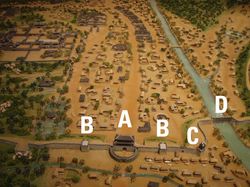
The fortress features four main gates: South (Paldalmun), East (Changnyongmun), North (Janganmun), and West (Hwaseomun). Janganmun, the North Gate, is recognized as the largest in Korea. To facilitate the movement of people, animals, and munitions without exposing the main entrances, several Secret Gates (ammun) were constructed, such as the East Secret Gate (Dongammun).
Summary of Fortress Components
| Structure Type | Quantity | Examples |
|---|---|---|
| Main Gates | 4 | South, East, North, West |
| Floodgates | 2 | South, North |
| Secret Gates | 5 | South, East, North, West, South-West |
| Observation Towers | 3 | South, North-East, North-West |
| Turrets | 10 | Various locations along the wall |
The Haenggung Palace
Adjacent to the fortress is the Haenggung, a detached palace. The palace features various halls, including Sinpungnu, the main gate of the palace, which was named to reflect King Jeongjo's affection for the city of Suwon. The palace served as a residence for the King during his visits to the area.
Frequently Asked Questions
What makes the North Gate (Janganmun) unique?
Janganmun is the largest gate of its kind in Korea. It features a stone base topped with a two-storey wooden pavilion and is protected by a semi-circular wall known as an ongseong.
What is a Gongsimdon?
A Gongsimdon is a hollow observation tower. The North-West Observation Tower (Seobuk Gongsimdon) is a prime example, featuring an internal structure that allowed soldiers to defend the gate using firearms from multiple levels.
How were the structures reconstructed?
Many parts of the fortress were destroyed during the Korean War. Significant reconstruction efforts took place between 1975 and 1978 to restore the gates and command posts to their historical state.
What is the purpose of the floodgates?
The floodgates, such as Namsumun (South Floodgate) and Hwahongmun, are striking architectural features designed to manage water flow near the fortress walls.
Why is the South-West Spur (Yongdo) important?
The Yongdo is a spur that branches from the main ring to control the ridge of Mount Paldal. It provides a strategic vantage point and currently offers expansive views over the town of Suwon.