Historical Markers: Preserving Global Heritage Through Commemorative Plaques
Historical markers serve as permanent physical links between the present and the past. These plaques, tablets, and signs are installed on buildings, monuments, or in public spaces to commemorate noteworthy people, significant events, or architectural landmarks. By transforming ordinary streetscapes into open-air museums, these markers ensure that the narrative of human achievement and cultural evolution remains visible to the general public.
While many are managed by national agencies dedicated to historic preservation—the practice of protecting and maintaining buildings or sites of historical importance—others are the result of grassroots efforts by local municipalities, non-profit organizations, or private individuals.

Key Facts
- The world's first historical plaque scheme was established by the Royal Society of Arts in 1866.
- The Philippines' National Historical Commission (NHCP) has installed over 1,690 markers since 1933.
- London's famous blue plaques were originally blue, then changed to chocolate brown to reduce costs, before returning to blue.
- In the United States, markers are managed through a mix of federal, state, and local programs.
- Some regions use color-coding to categorize markers, such as Manchester's occupation-based colors or Wales' purple plaques for women.
The Origins of Commemorative Plaques
The tradition of formal historical commemoration began in the United Kingdom. In 1866, the Royal Society of Arts established the first scheme of its kind, influenced by civil servant Henry Cole and politician William Ewart. The first plaque was unveiled in 1867 to mark the birthplace of Lord Byron at 24 Holles Street, Cavendish Square.
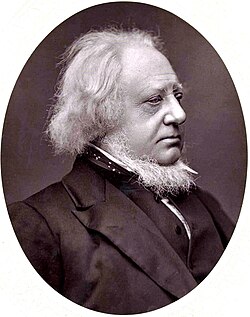
One of the earliest surviving markers from this era commemorates Napoleon III in King Street, St James's. Interestingly, the iconic blue color was briefly replaced with chocolate brown by the manufacturer Minton, Hollins & Co to save money. By 1901, the London County Council took over the administration of the scheme, which eventually evolved into the program now run by English Heritage.

Global Implementations of Historical Marking
United Kingdom and Europe
In the UK, blue plaques remain the most prominent marker type, though variety exists. The Dead Comics' Society installs plaques for comedians, while the London Borough of Southwark includes living people in its awards. In Wales, the Purple Plaques (Placiau Porffor) specifically honor significant women. Other European nations maintain rigorous systems, such as France's Monument historique and Germany's Kulturdenkmal.
The Philippines
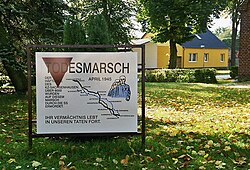
The National Historical Commission of the Philippines (NHCP) manages a vast network of cast-iron plaques. Starting in 1933, the program initially focused on Manila but has since expanded nationwide to include over 1,690 markers. These plaques are written primarily in Filipino, though English is used for markers from the American colonial era, and regional languages like Cebuano and Ilocano are also employed.
The NHCP has recently focused on the "Philippine Nationhood Trail" and quincentennial markers to ensure a more inclusive national narrative across the Visayas and Mindanao regions.
Australia
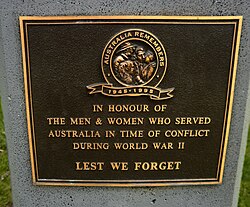
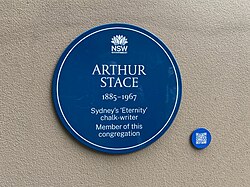
Australia has adopted similar blue plaque programs in South Australia, Victoria, and New South Wales. In New South Wales, the government has launched multiple rounds of plaques to recognize figures such as Aboriginal midwife Emma Jane Callaghan and the godmother of the Sydney Harbour Bridge, Kathleen Butler. In 2025, a plaque was unveiled in Walgett to mark the 60th anniversary of the 1965 Freedom Ride.
United States
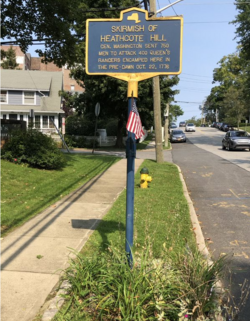
In the U.S., historical status is often bestowed by the National Register of Historic Places or the National Trust for Historic Preservation. However, much of the marking is handled at the state level. For example, New York began its state program in 1926, and Ohio produces its markers in a specialized workshop in Marietta.
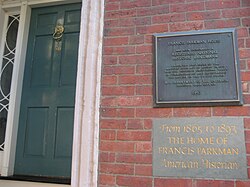
Some local programs allow homeowners to apply for markers. In Worcester, Massachusetts, residents can pay a fee (between $185 and $225) to mark structures at least 50 years old that retain their original character.
Maintenance and Evolution
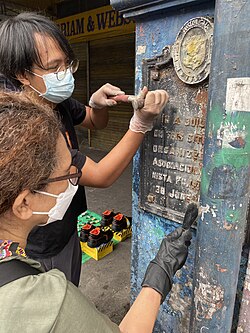
Historical markers are not static; they require ongoing care and occasional updates. Restoration is necessary to combat weathering, and some markers are replaced when historical information is rectified or after being lost to war and natural disasters.
In some cases, markers become points of controversy, such as those commemorating former political leaders or sensitive historical events, reflecting the evolving nature of public memory.
![A commemorative plaque[32] honoring those who protected the United States Capitol on January 6, 2021 was placed on a wall inside the building five years later.[33]](/images/3f/06/3f0643c687653b5a13156dd904a2d987728e7f65e478395c90a3c3ab9fb5f74f.jpg)
Summary of Global Marker Systems
| Country/Region | Primary Authority | Notable Characteristics |
|---|---|---|
| United Kingdom | English Heritage / Local Councils | Oldest system (1866); famous for blue ceramic plaques. |
| Philippines | NHCP | Cast-iron plaques; multilingual (Filipino, English, Regional). |
| United States | State Governments / National Register | Diverse state-specific formats; some homeowner-funded. |
| Australia (NSW) | NSW Government | Community-nominated blue plaques for people and events. |
Frequently Asked Questions
Who is allowed to install historical markers?
Markers are typically installed by national preservation agencies, local municipalities, non-profit organizations, companies, or private individuals. In some regions, like Indiana, official state-format markers require government approval.
Why are some plaques blue?
The blue color became a standard through the London blue plaque scheme established in 1866. This aesthetic has since been adopted by other regions, including several Australian states, to signify historical importance.
How are people or sites selected for a plaque?
Selection criteria vary by organization. Some use formal nominations from the public, while others require the site to meet specific age requirements (e.g., 50 years in Worcester, MA) or demonstrate significant architectural or cultural importance.
What happens if the information on a marker is wrong?
Markers can be replaced with new ones to provide rectified information, ensuring that the historical record remains accurate for the public.
Are there markers for living people?
While most markers commemorate the deceased, some specific programs, such as the one started by the London Borough of Southwark in 2003, include living people in their awards.