Hispanic America: Demographics, Culture, and Economic Profiles
Hispanic America is a vast and diverse region characterized by a rich tapestry of ethnic blending, linguistic variety, and varying economic landscapes. Spanning from the northern reaches of Mexico to the southern tip of Argentina, the region is defined by its shared history of Spanish influence merged with deep-rooted Indigenous and African legacies.
With a total population exceeding 412 million people, the region represents a significant portion of the global community, blending urban megalopolises with expansive rural territories. The interplay between its colonial past and modern development has created a unique socio-economic environment across its many countries and territories.
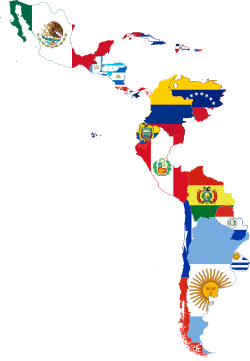
Key Facts
- Total Population: Approximately 412,323,809 people.
- Largest Economy: Mexico, with a nominal GDP of over 2.1 trillion USD.
- Dominant Language: Spanish is the primary official language across the region.
- Ethnic Composition: A tri-racial blend of Indigenous American, European, and African ancestry.
- Primary Religion: Roman Catholicism remains the predominant faith, though Protestantism is growing.
- Largest City: Mexico City, with a metropolitan population of over 21.8 million.
Economic and Demographic Overview
The economic landscape of Hispanic America varies significantly. While some nations boast high GDP per capita, others face greater economic challenges. Mexico stands as the regional economic powerhouse, followed by Brazil (though not included in this specific Hispanic dataset) and Argentina. Puerto Rico and Panama show some of the highest nominal GDP per capita figures in the region.
Urbanization is a defining feature of the region's demographics. Massive metropolitan hubs like Mexico City, Buenos Aires, and Bogotá serve as centers of commerce, politics, and culture, often dwarfing other cities in their respective countries.
| Country | Population | Nominal GDP (Billions USD) | GDP (PPP) Per Capita |
|---|---|---|---|
| Mexico | 128,932,753 | 2,120.855 | 25,966.32 |
| Argentina | 46,376,763 | 688.378 | 26,390.44 |
| Colombia | 52,882,884 | 539.53 | 19,770.18 |
| Chile | 19,116,209 | 407.85 | 29,928.25 |
| Peru | 32,971,846 | 380.9 | 16,684.88 |
Ethnology and Social Composition
The population of Hispanic America is the result of the convergence of three primary racial groups: the Indigenous peoples (descendants of the Incas, Aztecs, Mayans, Taínos, and others), Europeans (primarily Spanish and Italian), and Africans brought via the slave trade.
Unlike some other colonial societies, Hispanic America did not implement strict anti-miscegenation policies, leading to significant gene flow between these groups. This has resulted in a predominantly mixed population. Mestizos—individuals of mixed European and Indigenous ancestry—constitute the largest group overall, averaging 50% of the total population. In countries like Paraguay and Honduras, Mestizos make up 94% and 90% of the population, respectively.
Research indicates a sex-biased mating pattern during the colonial era, where European males frequently paired with Indigenous or African females. This is evidenced by the higher proportion of Amerindian and African maternal lines (MtDNA) compared to Y chromosomal lines in the current population.
Linguistic Diversity
While Spanish is the official language for the majority, the region is a bastion of linguistic diversity. Indigenous languages remain vital, particularly in Mexico, Peru, Bolivia, Guatemala, and Paraguay.
Major Indigenous Languages
- Nahuatl: The most spoken native language in Mexico.
- Quechua: An official language in Peru and widely spoken in the Andes.
- Guaraní: An official language in Paraguay and co-official in the Argentine province of Corrientes.
- Aymara: Holds official status in Bolivia.
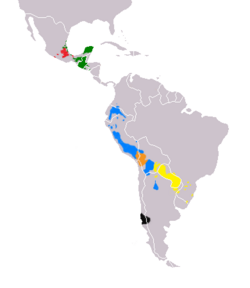
Beyond Spanish and Indigenous tongues, other European languages like English, German, Italian, and Welsh are spoken by immigrant descendants. Additionally, Creole languages—blends of European and African tongues—are common in the Caribbean. The Garifuna language, an Arawakan-based tongue with European and Caribbean influences, is spoken by the Garifuna people along the coasts of Honduras, Guatemala, and Nicaragua.
Religious Landscape
Roman Catholicism, introduced by Spanish and Portuguese colonizers, remains the dominant religion. However, the religious map is shifting. There is a notable increase in Protestant denominations, specifically Pentecostalism, which has seen massive growth among the middle classes in Central American nations like Guatemala and El Salvador.
While most countries maintain high Christian percentages (often above 90%), some nations show higher rates of unaffiliated populations. For example, Uruguay has a significant unaffiliated population at 41.5%, and Cuba shows a diverse mix with 23.2% unaffiliated and 17.9% practicing other religions.
Frequently Asked Questions
Which country in Hispanic America has the largest population?
Mexico has the largest population in the region, with approximately 128.9 million people.
What is a Mestizo?
A Mestizo is a person of mixed ancestry, typically referring to a blend of European and Indigenous American heritage.
What are the most prominent indigenous languages spoken today?
The most prominent include Nahuatl in Mexico, Quechua in Peru and Bolivia, Guaraní in Paraguay and Bolivia, and Aymara in Bolivia.
Is Roman Catholicism still the main religion in the region?
Yes, Roman Catholicism remains the predominant religion, although there is a growing trend toward Protestantism and Pentecostalism, particularly in Central America.
Which city has the largest metropolitan area in Hispanic America?
Mexico City has the largest metropolitan area, with a population of approximately 21.8 million people.