High Wycombe Governance and Political History
High Wycombe possesses a rich political legacy that stretches back to 1295, evolving from an ancient borough into a modern administrative center. From hosting Prime Ministers to maintaining eccentric civic traditions, the town's governance reflects the broader shifts in British political and administrative history.
Key Facts
- Political Shift: After being held by Conservatives since 1951, the Wycombe constituency elected a Labour MP in May 2024.
- Prime Ministerial Links: The town was home to William Petty (2nd Earl of Shelburne) and Benjamin Disraeli.
- Current Administration: Since 2020, the town has been governed by the Buckinghamshire Council, a unitary authority.
- Unique Tradition: The town continues the 17th-century practice of weighing the mayor to check for weight gain during their term.
Parliamentary History and Notable Figures
The Wycombe constituency has a long history of representation. For over seven decades, from 1951 until the general election in May 2024, the seat was held continuously by the Conservative Party. Following that election, the town is now represented by Labour MP Emma Reynolds.
Prior to this, the seat was held by Conservative MP Steve Baker until July 4, 2024. Baker was a prominent figure in eurosceptic politics as chairman of the European Research Group and served as a junior minister in the Department for Exiting the European Union (2017–2018) before resigning in 2018 in opposition to the Chequers plan.
High Wycombe's political significance is further highlighted by the figures who lived there. William Petty, the 2nd Earl of Shelburne, served as MP for the town and resided at what is now Wycombe Abbey. Benjamin Disraeli, who lived at Hughenden Manor, also had a complex relationship with the seat; after three defeats as a Radical candidate in the 1830s, he eventually won election as a Conservative in 1868 and again from 1874 to 1876. Disraeli notably delivered his first political speech from the portico of the Red Lion Hotel on High Street.
Additionally, the constituency was once represented by John Hampden (1594-1643), a key Parliamentarian commander who died during the Wars of the Three Kingdoms.
The Evolution of Local Government
The administrative structure of High Wycombe has undergone numerous transformations. Originally known as an ancient borough (a town with specific privileges granted by the crown), its status was confirmed in 1237 following disputes with the lord of the manor, Alan Basset.
Under the Municipal Corporations Act 1835, the town became a municipal borough on January 1, 1836, under the name Chepping Wycombe. This created a distinction between the borough council, which handled secular government for the built-up area, and the parish vestry, which managed ecclesiastical matters and secular issues in the surrounding rural areas.
As the town expanded, particularly into the Wycombe Marsh area, the boundaries were adjusted. In 1866, the parish was split into a civil parish for the borough and another for the rural areas. By 1896, the internal parishes merged to form a single parish called High Wycombe, though the governing body remained the Chepping Wycombe Borough Council until 1946, when it officially adopted the name High Wycombe Borough Council.
The council's physical presence also shifted over time. After meeting at the Guildhall from 1757, the council opened a Town Hall in 1904. However, the primary administrative hub became the Municipal Offices on Queen Victoria Road in 1932.
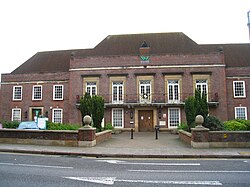
In 1974, the borough council was abolished and replaced by the Wycombe District. This arrangement lasted until 2020, when the district was abolished to form part of the Buckinghamshire Council, a single-tier unitary authority. Today, because the town is unparished, councillors representing High Wycombe act as charter trustees to appoint the town's mayor.
| Period | Governing Body / Status | Key Change |
|---|---|---|
| Before 1836 | Ancient Borough | Borough rights confirmed in 1237 |
| 1836–1974 | Municipal Borough (Chepping Wycombe) | Established via Municipal Corporations Act 1835 |
| 1974–2020 | Wycombe District | Borough council abolished |
| 2020–Present | Buckinghamshire Council | Transition to unitary authority |
The Tradition of Weighing the Mayor
One of the town's most enduring and peculiar customs is the weighing of the mayor, a ceremony practiced since 1678. At the start and conclusion of their term, the mayor is weighed publicly to determine if they have gained weight—a symbolic check to ensure the mayor has not grown "fat" at the taxpayers' expense.
Using weighing apparatus that dates back to the 19th century, the town crier announces the result. If the mayor's weight has remained stable, the crier declares "And no more!"; if they have gained weight, the announcement is "And some more!" Notably, the actual weight of the mayor is never revealed to the public.
Frequently Asked Questions
Who is the current Member of Parliament for Wycombe?
The town is currently represented by Labour MP Emma Reynolds, who was elected in the May 2024 general election.
What is the difference between High Wycombe and Chepping Wycombe?
Historically, Chepping Wycombe was the official name of the parish and the municipal borough, while High Wycombe was the more common name for the town itself. The borough council officially changed its name to High Wycombe Borough Council in 1946.
How is the mayor of High Wycombe chosen today?
Since the town is unparished and the borough council was abolished, councillors elected to the Buckinghamshire Council act as charter trustees to select the town's mayor.
Which Prime Ministers have lived in High Wycombe?
Two Prime Ministers have called the area home: William Petty, 2nd Earl of Shelburne, and Benjamin Disraeli.
What happens during the 'weighing of the mayor' ceremony?
The mayor is weighed at the beginning and end of their service using 19th-century equipment. The town crier announces whether the mayor has gained weight ("And some more!") or not ("And no more!"), though the specific weight is kept secret.