Héctor Cámpora: The Bridge to Perón's Return
Héctor Cámpora was a pivotal figure in Argentine politics, serving as a cornerstone of left-wing Peronism. While his tenure as the 38th President of Argentina was one of the shortest in the nation's history, his role was strategically essential. Cámpora acted as the political vehicle that allowed Juan Perón to return to power after years of exile and political bans.
Known affectionately as el Tío (the Uncle), Cámpora was a dentist by profession who transitioned into a high-stakes political career. His legacy continues today through La Cámpora, a modern left-wing Peronist youth organization named in his honor.
Key Facts
- Presidency: Served from May 25 to July 13, 1973.
- Political Role: Acted as the "personal delegate" for Juan Perón to bypass electoral vetoes.
- Election Victory: Won the March 1973 election with 49.6% of the vote.
- Key Action: Granted amnesty to political prisoners and restored diplomatic ties with Cuba.
- Final Post: Served as the Argentine ambassador to Mexico.
Early Life and Political Ascent
Born on March 26, 1909, in Mercedes, Buenos Aires, Héctor José Cámpora Demaestre studied dentistry at Córdoba University. After practicing in Mercedes and San Andrés de Giles, his life shifted toward politics in 1944 when he met General Juan Perón during the latter's visit as minister of labour.
Following Perón's election to the presidency in 1946, Cámpora entered the house of representatives, leading a coalition of radicals and labourists. He eventually rose to become the President of the Chamber of Deputies from 1948 to 1953. In 1953, he served as a plenipotentiary ambassador, traveling through 17 countries.
His career faced a severe setback in 1955 when the Revolución Libertadora—the movement that overthrew Perón—arrested and indicted him for embezzlement and corruption. Cámpora fled Argentina in 1956, returning three years later after the charges were dropped.
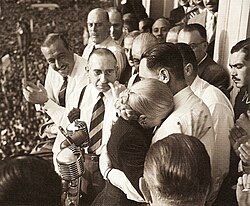
The 1973 Presidency and Political Turmoil
By 1971, Juan Perón designated Cámpora as his personal delegate. This was a strategic move to circumvent a veto issued by General Alejandro Lanusse, which prevented Perón from running for office. Cámpora ran for president in 1973 with Vicente Solano Lima, a member of the Popular Conservative Party, as his vice president.
Cámpora secured 49.6% of the vote in March 1973. Although a runoff was technically required because he lacked an absolute majority, his opponent, Ricardo Balbín, conceded to avoid a political crisis. Cámpora took office on May 25, 1973, welcomed by a million people in the Plaza de Mayo.
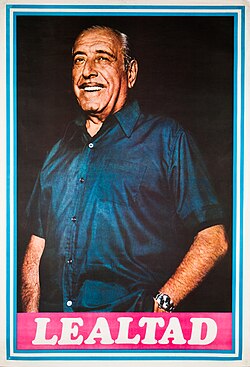
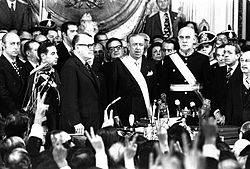
Cámpora's brief administration was marked by rapid shifts in policy. He granted amnesty to members of terrorist organizations, a move that later led to retaliatory killings of the judges who had originally sentenced those prisoners. He also restored diplomatic relations with Cuba on May 28, providing food and industrial aid to help the island bypass the United States embargo.
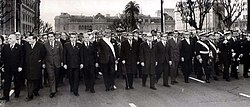
Internal Conflict and the Ezeiza Massacre
The administration struggled with internal instability, facing approximately 600 strikes and social conflicts. While the revolutionary left paused its armed struggle to participate in the democratic process, the right-wing bureaucracy of Peronism grew alarmed.
This tension peaked on June 20, 1973, during the return of Juan Perón. At the main airport in Buenos Aires, right-wing Peronist snipers attacked left-wing activists in an event known as the Ezeiza Massacre, resulting in 13 deaths and over 300 injuries.
Economic Policy and Resignation
On the economic front, Minister José Ber Gelbard attempted to implement a "social pact" between the National Bourgeoisie and CGT workers, which included salary increases and a freeze on prices.
Ultimately, Cámpora's primary purpose was fulfilled. On July 13, 1973, he resigned to clear the path for Juan Perón to reclaim the presidency. Following this, Cámpora was appointed as the Argentine ambassador to Mexico.
Final Years and Death
Following the March 1976 coup d'état that removed Isabel Perón from power, Cámpora sought asylum at the Mexican embassy in Buenos Aires. In 1979, after being diagnosed with laryngeal cancer, he was permitted to travel to Mexico. He passed away in Cuernavaca on December 18, 1980, at the age of 71.
| Role | Period | Key Detail |
|---|---|---|
| President of Chamber of Deputies | 1948–1953 | Led a coalition of labourists and radicals |
| President of Argentina | May 25 – July 13, 1973 | Served as a proxy for Juan Perón |
| Ambassador to Mexico | Post-1973 | Final diplomatic appointment |
Frequently Asked Questions
Why did Héctor Cámpora resign so quickly?
Cámpora resigned on July 13, 1973, specifically to allow Juan Perón to run for and return to the presidency, as Cámpora had served as a proxy to bypass the electoral veto against Perón.
What was the Ezeiza Massacre?
The Ezeiza Massacre occurred on June 20, 1973, when right-wing Peronist snipers attacked left-wing Peronist activists during the celebrations for Juan Perón's return to Argentina, leaving 13 dead and hundreds wounded.
What was Cámpora's professional background before politics?
Before entering politics, Héctor Cámpora was a trained dentist, having earned his degree from Córdoba University.
How did Cámpora's presidency affect relations with Cuba?
Cámpora restored diplomatic relations with Cuba on May 28, 1973, and provided industrial products and food aid to help Cuba counter the United States embargo.
What is "La Cámpora"?
La Cámpora is a modern left-wing Peronist political youth organization named after Héctor Cámpora to honor his political legacy.