Health Care Systems: Delivery, Financing, and Global Access
Health care is the comprehensive process of improving or maintaining health through the prevention, diagnosis, treatment, and cure of diseases, injuries, and physical or mental impairments. This vital service is delivered by a diverse array of professionals, including physicians, nurses, dentists, pharmacists, psychologists, and physical therapists, among others.
At its core, health care encompasses everything from routine check-ups and public health initiatives to complex surgical interventions. When functioning efficiently, these systems not only improve individual well-being and mortality rates but also drive a country's economic development and industrialization. A landmark achievement of global health care was the worldwide eradication of smallpox in 1980, a feat declared by the World Health Organization (WHO) as the first disease eliminated through deliberate human intervention.
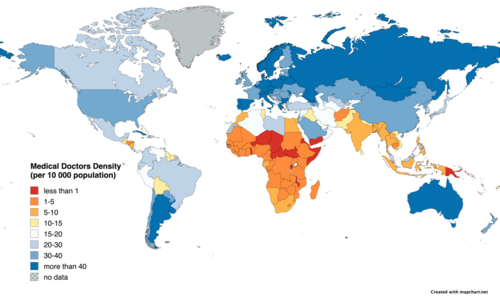
Key Facts
- Universal Coverage: Most OECD countries have achieved nearly universal health coverage, with the notable exceptions of the United States and Mexico.
- Economic Impact: In 2020, the healthcare industry accounted for 18% of the United States' gross domestic product (GDP).
- Spending vs. Outcome: Data indicates that higher spending does not always correlate with better outcomes; for example, the US has the highest costs among OECD nations but ranks 26th in life expectancy.
- Essential Components: The WHO states that a functional system requires a financing mechanism, a trained workforce, reliable data, and well-maintained facilities.
Levels of Health Care Delivery
Health care is typically organized into different levels of intensity and specialization to ensure patients receive the most appropriate care for their specific needs.
Primary Care
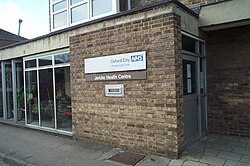
Primary care is the first point of contact for patients. It focuses on basic maternal and child health, vaccinations, family planning, and the management of chronic conditions such as hypertension, diabetes, asthma, COPD, depression, and arthritis. In the US, common reasons for visiting a primary physician include skin disorders, joint problems, and respiratory tract diseases.
Secondary and Tertiary Care
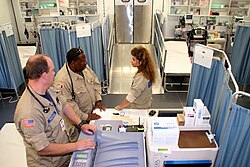
Secondary care involves more specialized services. This level is often accessed via referral from a primary provider or through self-referral. It frequently includes allied health professionals such as speech therapists, dietitians, and respiratory therapists.
Tertiary care is highly specialized consultative care, typically provided to inpatients in facilities equipped for advanced medical investigation and treatment, such as tertiary referral hospitals.
![Hospital train "Therapist Matvei Mudrov" in Khabarovsk, Russia[9]](/images/cc/b4/ccb4ae2bd784614950076a0d899d2baadd3690204780c604d0e44b891c076ce7.jpg)
![Jackson Memorial Hospital in Miami, the primary teaching hospital of the University of Miami's Miller School of Medicine and the largest hospital in the United States with 1,547 beds[15]](/images/41/f8/41f8724da0aaf3d1dc979043a96cebebdfe68326b3e927f87d836f6928221b85.jpg)

Quaternary and Community Care
Beyond tertiary care lies quaternary care, which represents an even more specialized extension of medicine. Additionally, home and community care play a critical role in the health ecosystem; statistics indicate that over 80 million Americans have taken time off work to provide care for loved ones.
Health Care Financing and Access
Access to health care is often dictated by social, economic, and political factors. Barriers to access include financial limitations (such as lack of insurance), geographical hurdles (transportation costs), sociocultural expectations, and personal limitations like low health literacy or communication barriers.
Funding Models
There are five primary methods used to fund health care systems globally, though most countries use a combination of these:
- General taxation (state, county, or municipal)
- Social health insurance
- Voluntary or private health insurance
- Out-of-pocket payments
- Donations to health charities
The Cost-Efficiency Paradox
Measuring the success of a health system often involves analyzing the percentage of GDP spent on health relative to outcomes like life expectancy. Interestingly, analysis of rich OECD countries suggests that more funding does not automatically equal better health. In some cases, for every extra $1,000 spent, life expectancy has been observed to fall by 0.4 years, suggesting that the efficacy of spending is more important than the amount.
![Life expectancy vs healthcare spending of rich OECD countries. US average of $10,447 in 2018.[35]](/images/a9/4c/a94ce03592a508744eaa4daab386b47c5a7bafa41aa71fc00935b4f37c06e401.jpg)
| Country | GDP Spend (2011/2020) | Life Expectancy (2011) |
|---|---|---|
| United States | 17.7% - 18% | 78.7 years |
| Switzerland | 11% | 82.8 years |
| Japan | Not Specified | 82.7 years |
| France | 11.6% | 82.2 years |
| OECD Average | 9.3% | 80.1 years |
Health Information Technology (HIT)
Modern health systems rely on technology to improve the accuracy and sharing of patient data. Key components include:
- Electronic Health Record (EHR): A comprehensive digital medical history that may aggregate records from multiple providers.
- Health Information Exchange (HIE): A secure framework that allows professionals and patients to share vital medical information electronically.
- Personal Health Record (PHR): A medical history maintained privately by the patient for their own use.
Frequently Asked Questions
What is the difference between primary and tertiary care?
Primary care is the first point of contact for general health needs and chronic disease management. Tertiary care is highly specialized, consultative care provided in advanced facilities, usually requiring a referral from a primary or secondary provider.
How is health care typically funded?
Funding generally comes from five sources: general taxation, social health insurance, private/voluntary insurance, out-of-pocket payments, and charitable donations.
Does spending more money on health care always increase life expectancy?
No. Data from OECD countries shows that higher spending does not always correlate with higher life expectancy. For example, the US spends significantly more per capita than other OECD nations but has a lower life expectancy than many of them.
What are the main barriers to accessing health care?
Common barriers include financial constraints (insurance coverage), geographical and logistical issues (transportation), sociocultural expectations, and personal limitations such as low income or poor health literacy.
What is an EHR?
An Electronic Health Record (EHR) is a digital version of a patient's comprehensive medical history, which can be shared across different healthcare providers to ensure coordinated care.