Haven-1 Space Station: Technical Components and Research Capabilities
The Haven-1 space station represents a significant step forward in commercial orbital infrastructure. Designed to support both scientific advancement and space tourism, the station integrates advanced propulsion, high-speed connectivity, and dedicated research facilities to maintain a sustainable presence in low Earth orbit.
Key Facts
- Propulsion: Provided by Impulse Space using nitrous oxide and ethane.
- Research: Features the Haven-1 Lab with 10 payload slots.
- Payload Capacity: Each slot supports up to 30 kg and 100 watts of power.
- Connectivity: Equipped with onboard Wi-Fi and Inter-satellite Data Relay System (IDRS) connectivity.
- Amenities: Includes a viewing dome and resting rooms, though it lacks an onboard bathroom.
Propulsion and Technical Systems
The station's movement and stability are managed by a propulsion system developed by Impulse Space. This system utilizes a storable propellant combination of nitrous oxide and ethane. The hardware architecture includes propellant tanks, fluid lines, valves, sensors, and specialized control electronics and software.
For precise maneuvering, Haven-1 employs Saiph thrusters, which serve as the reaction control thrusters to maintain the station's orientation and position in space.
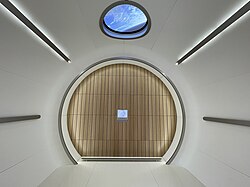
Connectivity and Onboard Amenities
To ensure seamless communication, Vast has partnered with AnySignal, TRL11, and Addvalue. These collaborations provide the station with radio frequency capabilities, advanced onboard video solutions, and Inter-satellite Data Relay System (IDRS) connectivity—a network that allows satellites to communicate with ground stations via other satellites. Residents will also have access to always-on internet via onboard Wi-Fi.
For those visiting the station, Haven-1 features a dedicated dome designed for photography and viewing the Earth. While the station provides resting rooms for its occupants, it does not contain an onboard bathroom; astronauts and tourists must utilize the facilities on the Dragon spacecraft used for their transport.
The Haven-1 Lab and Scientific Research
A central feature of the station is the Haven-1 Lab, a specialized microgravity research, development, and manufacturing platform. This facility is designed to host a variety of experiments from both government and private entities.
The lab is configured with 10 available slots. Each slot is engineered to accommodate payloads with the following specifications:
- Maximum Weight: 30 kg (66 lb)
- Maximum Power Consumption: 100 watts
Several organizations have already committed to utilizing this platform. Early payload partners include Redwire and Yuri Gravity, followed by the Japan Manned Space Systems Corporation (JAMSS), Interstellar Lab, and Exobiosphere.
Academic and Biotechnology Partnerships
Expanding its scientific reach, Vast signed memorandums of understanding on June 24, 2026, to host research for several prestigious institutions and companies across Haven-1 and the subsequent Haven-2. These partners include the Sanford Stem Cell Institute, the University of California San Diego, Auxilium Biotechnologies, LambdaVision, and BioOrbit.
Technical Specifications Summary
| Category | Details |
|---|---|
| Propulsion Provider | Impulse Space |
| Propellants | Nitrous Oxide and Ethane |
| Thruster Type | Saiph (Reaction Control) |
| Lab Capacity | 10 Payload Slots |
| Max Payload per Slot | 30 kg / 100 W |
| Connectivity Partners | AnySignal, TRL11, Addvalue |
Frequently Asked Questions
What propellants does Haven-1 use?
Haven-1 uses a storable propellant combination consisting of nitrous oxide and ethane, provided by Impulse Space.
Does Haven-1 have a bathroom?
No, Haven-1 does not have an onboard bathroom. Occupants must use the bathroom located on the Dragon spacecraft they arrived in.
What are the limitations for payloads in the Haven-1 Lab?
Each of the 10 available payload slots can accommodate a maximum weight of 30 kg (66 lb) and a maximum power draw of 100 watts.
How is internet and data handled on the station?
The station provides always-on internet via onboard Wi-Fi and utilizes radio frequency and Inter-satellite Data Relay System connectivity provided by AnySignal, TRL11, and Addvalue.
Which institutions are conducting research on Haven-1 and Haven-2?
Research partners include the Sanford Stem Cell Institute, the University of California San Diego, Auxilium Biotechnologies, LambdaVision, and BioOrbit, among others.