Han Dynasty: The Golden Age of Imperial China
The Han dynasty stands as one of the most influential eras in human history, shaping the cultural, political, and social foundations of China for centuries. Spanning from 202 BC to 220 AD, this period is often divided into two distinct phases: the Western Han and the Eastern Han, separated by the brief Xin dynasty (9–23 AD).
During its peak, the Han Empire commanded vast territories, reaching an estimated 6,500,000 square kilometers during the Eastern Han. This era saw the rise of sophisticated governance, groundbreaking scientific advancements, and the flourishing of the Silk Road, which connected China to the wider world.
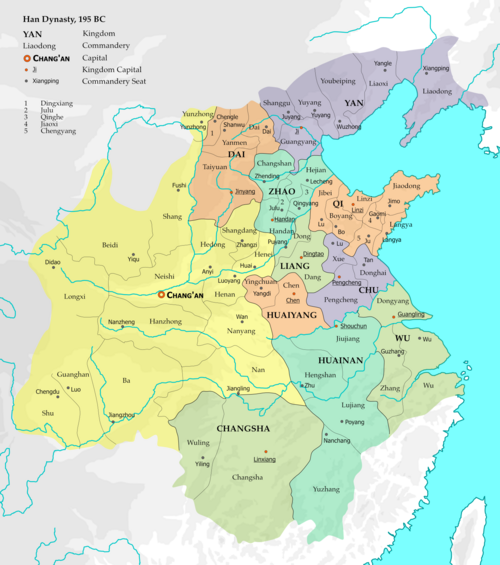
Key Facts
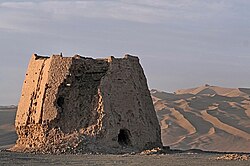
![These rammed earth ruins of a granary in Hecang Fortress (河仓城; Hécāng chéng), located approximately 11 km (7 mi) northeast of the Western Han-era Yumen Pass, were built during the Western Han (202 BC – 9 AD) and was significantly rebuilt during the Western Jin (280–316 AD).[67]](/images/da/e3/dae398b89880c7a5729b3481bf8df31861c4e896604a9c2a38fbe490bf832fcb.jpg)
- Duration: 202 BC – 220 AD (including the Xin interregnum).
- Major Eras: Western Han (202 BC – 9 AD) and Eastern Han (25–220 AD).
- Capitals: Chang'an, Luoyang, and Xuchang.
- Peak Territory: Approximately 6,500,000 km² during the Eastern Han.
- Core Beliefs: Chinese folk religion, Taoism, and the introduction of Buddhism.
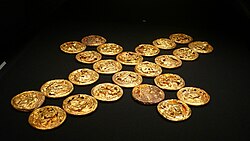
- Currency: Ban Liang and Wu Zhu coins.
The Evolution of the Han Empire
The dynasty began following the Battle of Gaixia, where Liu Bang was proclaimed emperor. The Western Han period established a strong centralized state, characterized by the rule of notable leaders such as Emperor Wu (r. 141–87 BC), who significantly expanded the empire's influence.
After the interruption of Wang Mang's Xin dynasty, the Eastern Han was established in 25 AD by Emperor Guangwu. This period saw continued territorial management through the Protectorate of the Western Regions, a vital administrative zone in the Tarim Basin that facilitated trade and security along the Silk Road.
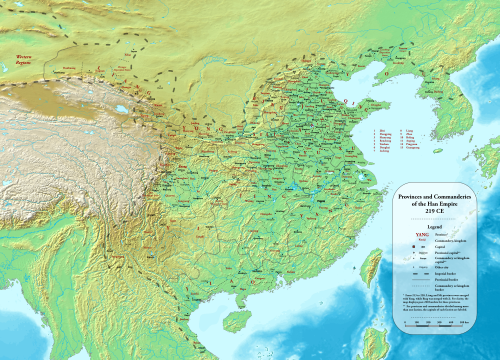
Political Structure and Governance
The Han government operated under a monarchy led by an Emperor. The administration was supported by a complex bureaucracy, including Chancellors who managed the state's affairs. Over time, the power dynamics shifted, with influential figures like Cao Cao playing significant roles during the dynasty's later years.
![Statue of a horse trampling a Xiongnu warrior, at the mausoleum of Western Han general Huo Qubing (d. 117 BC), who fought in the Han–Xiongnu War. This is the first known monumental stone statue in China.[36]](/images/a1/3c/a13cabc4b10598b8cd136417a34cd6785996b2c06c80abf95f0d1a9475f8ffa8.jpg)
Culture, Society, and Daily Life
![Bronze seal of a Xiongnu chieftain with impression and transcription, conferred by the Eastern Han government and inscribed with the following text: 漢匈奴,歸義親,漢長 ("The Chief of the Han Xiongnu, who have returned to righteousness and embraced the Han")[91]](/images/4c/92/4c921a9bd1a6871f6980f1ae527df14dee93133bca54c0579a2db84c79cf0c6d.jpg)
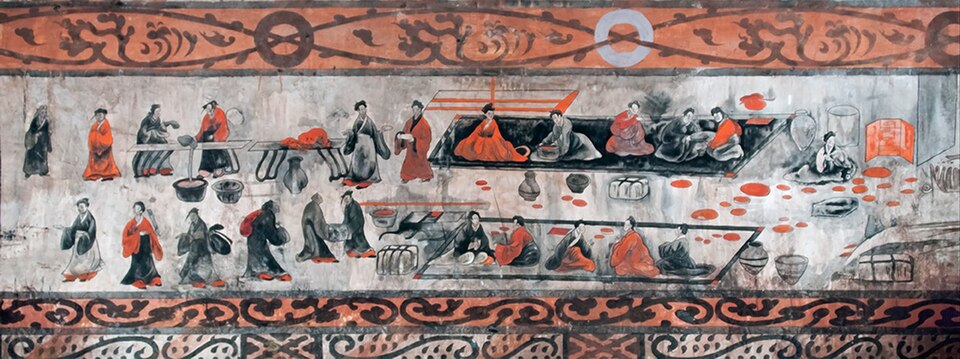
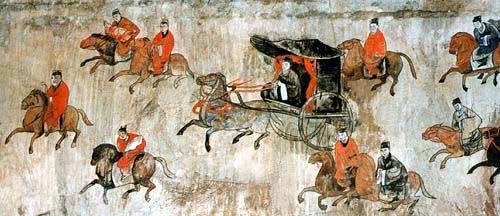
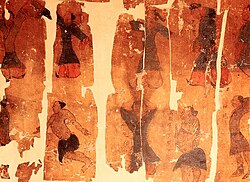
Han culture was rich and multifaceted. The concept of Hanfu (traditional Han clothing) became a hallmark of social identity. Archaeological finds, such as silk banners and intricate murals, provide a window into the lives of the elite and commoners alike.
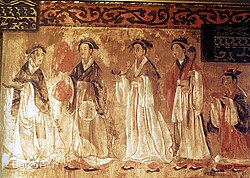
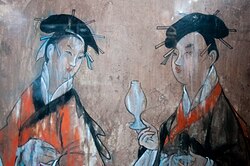
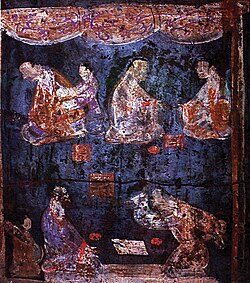
Social life included vibrant activities such as banquets, music, dance, and even acrobatics. Funerary art, found in many Han tombs, depicts these lively scenes, alongside depictions of traditional games like liubo.
Religion and Philosophy
The spiritual landscape of the Han was dominated by Chinese folk religion and Taoism. However, this era also marked the significant arrival and integration of Buddhism into the Chinese cultural fabric. Education was highly valued, with the Five Classics serving as the cornerstone of scholarly study and imperial examinations.
![A fragment of the Xiping Stone Classics; these stone-carved Five Classics installed during Emperor Ling's reign along the roadside of the imperial university right outside Luoyang, were made at the instigation of Cai Yong (132–192 AD), who feared the Classics housed in the imperial library were being interpolated by University Academicians.[218][219][220]](/images/95/64/9564f82e1d6bde10d93372ad967aad853d905f0ab7ac7b41840d82c414ffc3e5.jpg)
Scientific and Technological Achievements
![Eastern Han inscriptions on a lead ingot, using the Greek alphabet in the style of the Kushans, excavated in Shaanxi, 1st–2nd centuries AD – Gansu Provincial Museum[104]](/images/55/d6/55d604b4571bc23dbdc1fc5614064c0e25a0f1ba9e16c3417340779405db1980.jpg)
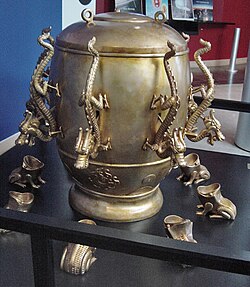
The Han dynasty was a period of remarkable innovation. From metallurgy and advanced agriculture to mechanical engineering, the era's technological prowess was unmatched. Notable inventions and advancements included:
- Seismology: The development of early seismometers to detect distant earthquakes.
- Hydraulic Engineering: Sophisticated water management systems.
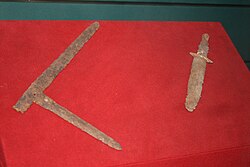
- Metallurgy: Advanced ironworking, producing tools like the ji polearm.
- Navigation: The use of steering rudders on pottery boat models suggests early maritime expertise.
Summary of Han Dynasty Eras
![Eastern Han tombs sometimes have depiction of battles between Hu barbarians, with bows and arrows and wearing pointed hats (left), against Han troops; Eastern Han-era, Tsangshan tomb, Linyi; also visible in the Yinan tombs.[144]](/images/03/8c/038ca85a923c0cf4c6f5cf33494813819714552fd3fc8dd3badd6f2f37475b18.png)
| Feature | Western Han | Eastern Han |
|---|---|---|
| Time Period | 202 BC – 9 AD | 25 – 220 AD |
| Primary Capitals | Chang'an | Luoyang, Xuchang |
| Estimated Peak Area | 6,000,000 km² | 6,500,000 km² |
| Key Characteristics | Expansion and consolidation | Cultural flourishing and Silk Road trade |
Frequently Asked Questions
![A silk banner from Mawangdui, draped over the coffin of Lady Dai (d. 168 BC), wife of the Marquess Li Cang (利蒼) (d. 186 BC), chancellor for the Kingdom of Changsha.[235]](/images/4e/70/4e7000205e26cb8e71e9d2b69a7c4aa63148db46ef961cdd2445e14626b38e93.jpg)
![A gilded bronze oil lamp in the shape of a kneeling female servant, dated to the 2nd century BC, found in the tomb of Dou Wan, wife of Liu Sheng, Prince of Zhongshan; its sliding shutter allows for adjustments in the direction and brightness in light while it also traps smoke within the body.[73][358]](/images/b8/b6/b8b6edafc6ad8badef57474f1d420ae5a9fa941d9067a3b1efbf4e999d6edaa5.jpg)
What was the significance of the Silk Road during the Han dynasty?
The Silk Road was a vital network of trade routes that connected the Han Empire to Central Asia, the Middle East, and beyond, facilitating the exchange of goods, technologies, and religions like Buddhism.
How was the Han dynasty divided?
The dynasty is primarily divided into the Western Han (202 BC – 9 AD) and the Eastern Han (25–220 AD), with a brief period known as the Xin dynasty in between.
What were the main religions practiced during this time?
The primary religious influences were Chinese folk religion and Taoism, with Buddhism being introduced and gaining traction during the era.
What kind of currency was used in the Han dynasty?
The Han dynasty utilized various forms of coinage, most notably the Ban Liang and the Wu Zhu coins.
Who were some of the most important Han emperors?
Key emperors include Emperor Gaozu (the founder), Emperor Wu, who expanded the empire significantly, and Emperor Guangwu, who restored the dynasty during the Eastern Han period.