Hammond Organ: The Evolution of the Tonewheel Legend
The Hammond organ is one of the most influential electronic instruments in music history. From its origins as a cost-effective alternative for churches to its status as a cornerstone of jazz, rock, and gospel, the instrument's unique sound has defined entire genres. At its heart, the classic Hammond utilizes additive synthesis—a method of creating complex sounds by adding together simple sine waves—driven by a mechanical system of rotating metal discs.
Key Facts

- Invention: Patented in 1934 and first released as the Model A in 1935.
- Core Technology: Original models used a tonewheel generator (electromechanical discs) to produce sound.
- Iconic Model: The B-3 (1954–1974) remains the most popular and sought-after version.
- Signature Sound: Achieved through drawbars, which allow players to mix different harmonics in real-time.
- Amplification: Often paired with a Leslie speaker, which uses a rotating horn and drum to create a shimmering chorus effect.
- Modern Era: Now produced by Hammond-Suzuki, focusing on digital emulations of the original tonewheel sound.
The Mechanics of Sound: Tonewheels and Drawbars
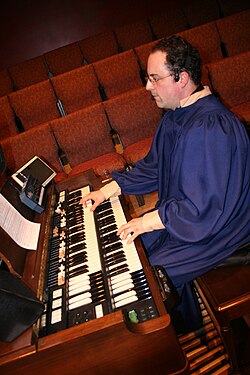
![Unlike an American Guild of Organists pedalboard, a console Hammond normally has 25 pedals.[9]](/images/ff/29/ff29a2c11977a20cde962b6e25f9c9f7f97ecf08e9d3442fd2d088023e9cc35b.jpg)
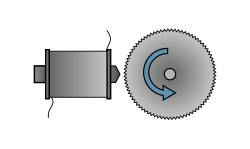
The magic of the vintage Hammond lies in its tonewheel generator. A tonewheel rotates beside an electromagnetic pickup, creating a steady electrical signal. Because these are mechanical, different versions were built for different regions; US models run at 1,200 RPM (110V/60Hz), while European models run at 1,500 RPM (240V/50Hz).
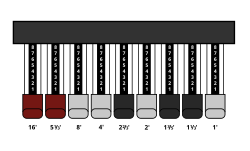
To shape the sound, players use drawbars, which function similarly to faders on a mixing console. By pulling these bars out, the player adds specific harmonics to the note. For example, the "classic" Jimmy Smith jazz sound is often achieved with the 888000000 setting (pulling out the 16′, 5 1/3′, and 8′ bars).
Controls and Interface
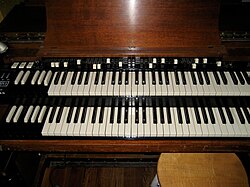
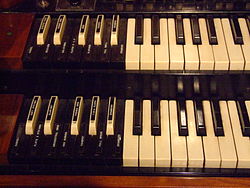
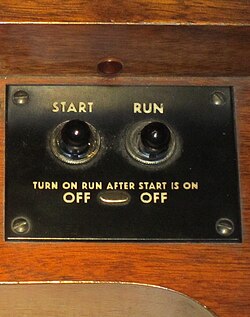
Console models typically feature two 61-note manuals (keyboards) and a 25-note pedalboard. To quickly change sounds, preset keys—which are reverse-colored—are located to the left of the manuals. Additionally, console organs like the B-3 require a two-step power process: a "Start" switch to engage the starter motor and a "Run" switch to power the main generator.
Historical Evolution
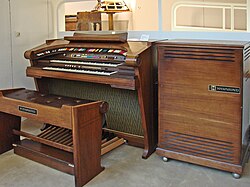
![The L-100 spinet was particularly popular in the UK.[67]](/images/8f/03/8f0300bf59ddee6442886875ea86527dc166e3fcc645041546d41e54b7c36598.jpg)
The Tonewheel Era (1935–1975)
The journey began with the Model A in 1935, which established the standard console layout. As the market grew, Hammond introduced the Model BC in 1936, adding a chorus generator to better mimic the richness of pipe organs. For church use, the Concert Model E featured a full 32-note pedalboard.
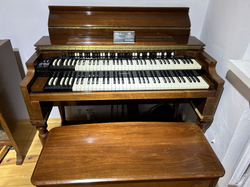
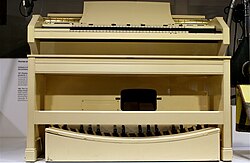
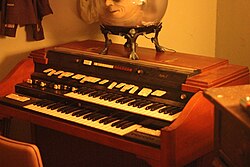
The B-3 became the gold standard of the industry, produced for two decades. Later, the A-100 series integrated amplifiers and speakers into the chassis for convenience. While the H-100 series attempted to replace the B-3, it gained a reputation for being unreliable. The T series, the final tonewheel spinets, transitioned to solid-state circuitry while retaining the mechanical generator.
![The B-3 was the most popular Hammond organ, produced from 1954 to 1974.[52]](/images/6e/df/6edf9d4cfc14be3fd60ec366fef28c6fe46001f0f8bc6730072f5dc484d8fa95.jpg)
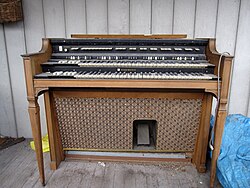
The Transition to Transistors and Digital (1967–Present)
By the mid-1970s, Hammond shifted toward integrated circuits and transistor organs to compete with brands like Lowrey and Wurlitzer. However, these models lacked the character of the tonewheels and were less popular, leading the original company to go out of business in 1985. The brand was subsequently acquired by the Suzuki Musical Instrument Corporation.
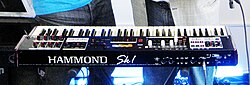
Hammond-Suzuki has since focused on digital simulations, including the "New B-3" (2002) and the modular XK series. Modern versions like the SK series expand the palette to include electric pianos and brass samples.
Amplification and the Leslie Effect
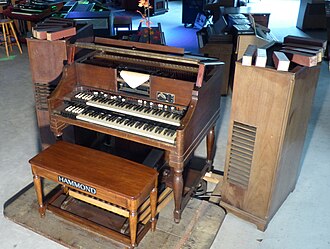
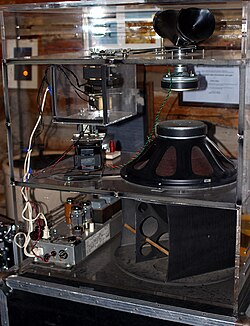
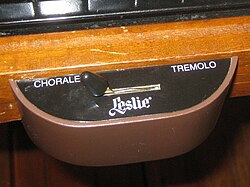
Originally, Hammond used tone cabinets to provide reverberation. However, the instrument became inextricably linked with the Leslie speaker. A Leslie speaker uses a rotating speaker and horn to create a Doppler effect, adding a swirling, three-dimensional quality to the sound. Players control this speed using a "half-moon" switch.
Clones and Modern Emulations
!["I took to riding the L100 like a bucking bronco. It weighs 350 lb; when it's on top of you, you need the adrenalin rush you get onstage to chuck it around."Keith Emerson[135]](/images/31/78/31783e9f4b35956129ebef8981a1047ff3b6021a14998d457c4b5bbfa40c4736.jpg)
Due to the weight and maintenance of original tonewheels, "clonewheel" organs emerged. Companies like Korg, Roland, and Clavia created portable digital versions. The Korg CX-3 was noted for capturing the depth of the vintage sound, while the Nord Electro used buttons and LEDs to emulate the drawbar experience.
![According to journalist Gordon Reid, the Korg CX-3 "came close to emulating the true depth and passion of a vintage Hammond".[116]](/images/de/2e/de2e26040a66d450dc48f85e6fa5109f1e5d9e85cbf05126eee055cbcf258e98.jpg)
![The Nord Electro emulated drawbars using buttons and a light-emitting diode display[121]](/images/20/3c/203c50471615e35cc4bd7424d7b74552ea13b6bc93e3847a92b9fcdc10d374d7.jpg)
Notable Players and Influence
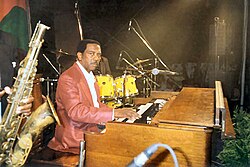
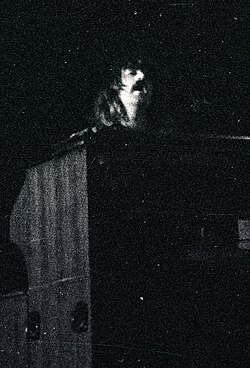
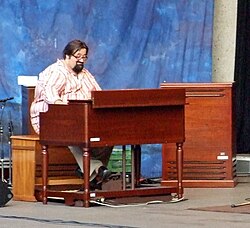
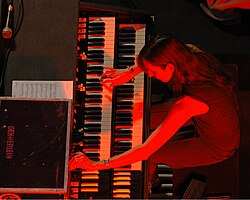
The Hammond's transition from church pews to concert stages was driven by virtuosos. Jimmy Smith brought the organ into the commercial jazz spotlight in the 1950s. In the rock era, Jon Lord of Deep Purple pushed the Hammond C-3 through overdriven Marshall amplifiers to achieve a heavy, distorted tone. Other masters include Joey DeFrancesco in jazz and Barbara Dennerlein, renowned for her pedal work.
| Model | Era | Type | Key Feature |
|---|---|---|---|
| Model A | 1935–1938 | Console | First production model |
| Model E | 1937+ | Console | 32-note pedalboard for churches |
| B-3 | 1954–1974 | Console | Most popular tonewheel model |
| L-100 | 1960s | Spinet | Popular in the UK |
| T-402 | 1970s | Spinet | Built-in drum machine |
| New B-3 | 2002 | Digital | Digital recreation of the B-3 |
Frequently Asked Questions
What is a tonewheel?
A tonewheel is a rotating metal disc with shaped teeth that creates a magnetic signal as it passes an electromagnetic pickup. This mechanical process generates the raw sine waves used in additive synthesis to create the organ's sound.
What do drawbars do on a Hammond organ?
Drawbars act as harmonic mixers. By pulling them out or pushing them in, the player determines which harmonics (overtones) are added to the fundamental note, allowing for a wide variety of timbres from mellow to piercing.
Why is the Leslie speaker important?
The Leslie speaker provides a rotating acoustic effect. By physically spinning the sound source, it creates a chorus and vibrato effect that gives the Hammond its characteristic "shimmering" or "swirling" sound.
What is the difference between a console and a spinet Hammond?
Console organs are larger, typically featuring two 61-note manuals and a 25-note pedalboard. Spinet organs are smaller, more compact versions with shorter manuals (often 44 notes) and fewer pedals.
Can the Hammond sound be achieved without a vintage organ?
Yes. Modern "clonewheel" keyboards from brands like Korg, Nord, and Roland, as well as software audio plug-ins, can accurately emulate the tonewheel and Leslie speaker effects.