Greek Architectural Orders: Doric, Ionic, and Corinthian Styles
Ancient Greek architecture is defined by three distinct systems of design known as the orders. These orders provide a standardized set of proportions and decorative elements that govern the appearance of columns and the structures they support. While these styles originated in Greece, they were adopted and modified by the Romans in the 1st century BC and have remained foundational to European Neoclassical architecture for centuries.
Although some believe the Doric order was the first to emerge, evidence suggests that the Doric and Ionic orders appeared roughly simultaneously—the Doric in mainland and western Greece, and the Ionic in the east. Both likely evolved from earlier wooden structures. While the Greeks were aware of stone columns used in Near Eastern and ancient Egyptian architecture, they innovated by making these columns a dominant feature of building exteriors rather than restricting them to interiors.
Key Facts
- Three Primary Orders: The Doric, Ionic, and Corinthian styles define classical Greek architecture.
- Roman Influence: Romans adopted these orders in the 1st century BC, modifying the capitals and proportions.
- Doric Characteristics: The simplest and heaviest order, featuring no base and a plain capital.
- Ionic Characteristics: Slender columns distinguished by scroll-like volutes on the capital.
- Corinthian Characteristics: The most ornate style, featuring capitals decorated with acanthus leaves.
- Historical Milestone: The Temple of Hera in Olympia (built just after 600 BC) is the oldest well-preserved Doric temple.
The Doric Order
The Doric order is the most austere and sturdy of the three styles. It is characterized by heavy, squat columns with a height only four to eight times their diameter. These columns lack an individual base, resting directly on the stylobate (the top step of the temple platform), though later and Roman versions introduced a base consisting of a plinth and a torus.
The shaft is detailed with 20 flutes (vertical grooves). The capital is simple, consisting of a necking or annulet (a simple ring), a convex echinus (a circular cushion-like stone), and a square abacus (a flat slab) that connects the column to the entablature.
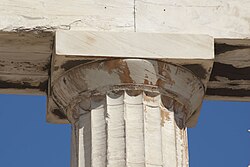
The entablature above the capital is divided into three horizontal registers. The most distinctive feature is the frieze, which is split into triglyphs (units of three vertical bands) and metopes (the plain or carved relief panels between the triglyphs).
The Ionic Order
Originating in eastern Greece and influenced by the lesser-known Aeolic order, the Ionic style is more slender and elegant than the Doric. An Ionic column is typically nine times taller than its lower diameter, with a shaft height of eight diameters. It features 24 flutes and a base composed of two convex moldings called tori, separated by a scotia (a concave molding).
The most recognizable feature of the Ionic order is the capital, which contains two opposed volutes—spiral, scroll-like ornaments. The echinus of the capital is often decorated with an egg-and-dart motif. Additionally, Ionic columns often employ entasis, a subtle curved tapering of the shaft to create an optical illusion of strength and straightness.
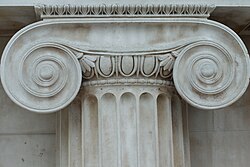
The Ionic entablature differs from the Doric in that its frieze lacks triglyphs and metopes, often featuring a continuous band of carved figures or ornaments instead. The architrave typically consists of three stepped bands known as fasciae.
The Corinthian Order
The Corinthian order is the most elaborate and decorative of the three. It utilizes a slender fluted shaft with 24 flutes and a height generally ten times its diameter. Its defining characteristic is the ornate capital, which is adorned with two rows of acanthus leaves and four small scrolls.
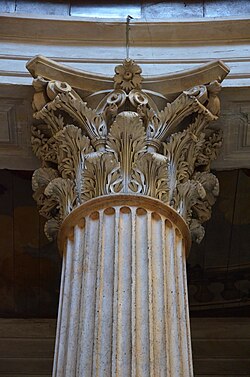
According to the Roman writer Vitruvius, the Corinthian order was invented by the 5th-century BC Greek sculptor Callimachus. The Choragic Monument of Lysicrates in Athens, built between 335 and 334 BC, stands as the oldest known building utilizing this order. While it was the most decorative, it was the writings of Vitruvius in the 1st century BC that officially raised the Corinthian style to a formal rank.
Comparison of Greek Architectural Orders
| Order | Proportions | Flutes | Capital Feature | Origin | Personification |
|---|---|---|---|---|---|
| Doric | 1:8 | 20 | Necking / Annulet | Mainland Greece | Man |
| Ionic | 1:9 | 24 | Volutes | Ionia & Aegean Sea | Woman |
| Corinthian | 1:10 | 24 | Acanthus leaves | Attica, Greece | Maiden |
Frequently Asked Questions
Which Greek order is the oldest?
While the Doric order is often considered the earliest, there is no definitive evidence to support this. It appears that the Doric and Ionic orders emerged around the same time in different regions of Greece.
How do the Roman versions of these orders differ from the Greek?
The Romans adopted the Greek orders in the 1st century BC and modified the capitals. Specifically, Roman Doric columns have smaller proportions, making them appear lighter than their Greek counterparts.
What is the difference between a triglyph and a metope?
Found in the Doric frieze, a triglyph is a vertical block with three grooves, while a metope is the space between two triglyphs, which may be left plain or decorated with carved reliefs.
Who is credited with inventing the Corinthian order?
The Roman writer Vitruvius credited the invention of the Corinthian order to Callimachus, a Greek sculptor who lived during the 5th century BC.
What is entasis in Ionic columns?
Entasis is a slight convex curving or tapering of the column shaft, used to prevent the column from appearing concave or weak to the human eye.