Governorate of the Río de la Plata
The Governorate of the Río de la Plata (1549–1776) was a critical administrative division of the Spanish Empire located in the region surrounding the Río de la Plata. Originally established as a renaming of the New Andalusia Governorate, this territory spanned a vast area between 470 and 670 leagues south of the mouth of the Río Santiago along the Pacific coast.
For much of its existence, the governorate operated under the authority of the Viceroyalty of Peru, which had been founded in 1542. Legally, it fell under the jurisdiction of the Royal Audience of Charcas—a high court and administrative body—though the Royal Audience of Buenos Aires enjoyed brief periods of independence between 1661 and 1671, and again after 1783.
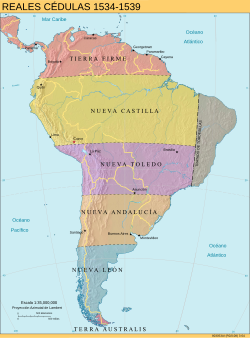
Key Facts
- Duration: Established in 1549 and dissolved in 1776.
- Administrative Shift: Transitioned from the New Andalusia Governorate to the Governorate of the Río de la Plata.
- Territorial Change: Paraguay was separated into its own administration in 1617.
- Final Status: Replaced by the Viceroyalty and Intendancy of Buenos Aires during the Bourbon reforms.
- Key Cities: Buenos Aires served as a primary hub, while Asunción acted as the capital during the early period.
Evolution of Governance
The Era of New Andalusia and Early Settlement
The early years of Spanish presence were marked by instability and the efforts of adelantados (explorers granted official authorization to conquer and govern). Pedro de Mendoza first founded Buenos Aires between 1534 and 1537, though the settlement faced early hardships. Following Mendoza, Juan de Ayolas founded Fort Corpus Christi and established Asunción as a central point of operations.
This period was characterized by internal disputes and conflict with indigenous populations. For example, Alvar Núñez Cabeza de Vaca led a victorious campaign against the Guarani in 1542 before being arrested and sent to Spain for trial.
Consolidation and the Separation of Paraguay
By the mid-16th century, the administration began to stabilize. Domingo Martínez de Irala, who served multiple terms, encouraged colonists to integrate with local women to build a permanent society. However, the region remained volatile, with several foundations—such as San Francisco and Santa Cruz de la Sierra—failing during the tenure of Francisco Ortiz de Vergara.
A significant turning point occurred in 1617 when the Guayrá region was separated to form the independent Governorate of Paraguay. This left the Governorate of the Río de la Plata to focus more heavily on the southern Atlantic coast.
![The audiencias of the Viceroyalty of Peru c.1650. The Audience of Charcas is section 5.[2]](/images/58/08/58084bf182503975c3f1b4ca2c1d18ea18e71503531a233e2aa0350b6c8be82c.webp)
Conflict, Trade, and the Bourbon Reforms
The later years of the governorate were defined by territorial disputes with other European powers and the struggle for commercial freedom. The Portuguese frequently contested the region, leading to a cycle of capture and recapture of Colonia del Sacramento. Meanwhile, governors like José Martínez de Salazar repeatedly requested the right to engage in free commerce, challenging the strict trade monopolies of the Spanish Crown.
Military efforts also focused on repelling foreign incursions, including the expulsion of the English from the Falkland Islands under Francisco de Paula Bucarelli y Ursúa and the repelling of French ships by Pedro Baigorrí Ruiz.
Administrative Summary
| Feature | Details |
|---|---|
| Established | 1549 (as a renaming of New Andalusia) |
| Dissolved | 1776 |
| Higher Authority | Viceroyalty of Peru |
| Judicial Authority | Royal Audience of Charcas / Royal Audience of Buenos Aires |
| Successor State | Viceroyalty of the Río de la Plata |
Frequently Asked Questions
What was an adelantado?
An adelantado was a Spanish explorer and conqueror who was granted a royal license to explore, settle, and govern a specific territory in the New World.
When did Paraguay become a separate administration?
Paraguay was separated from the Governorate of the Río de la Plata in 1617, becoming its own separate governorate.
What was the significance of Colonia del Sacramento?
Colonia del Sacramento was a strategic point of contention between Spain and Portugal, changing hands multiple times throughout the 17th and 18th centuries.
How did the governorate end?
The governorate was abolished in 1776 as part of the Bourbon reforms, which replaced it with the Viceroyalty and Intendancy of Buenos Aires to improve administrative efficiency and defense.
Who refounded Buenos Aires in 1580?
Buenos Aires was refounded in 1580 by Lt. Governor Juan de Garay.