Global Innovation Index: Measuring National Capacity for Innovation
The Global Innovation Index (GII) is a comprehensive annual ranking that evaluates countries based on their capacity for and success in innovation. Published by the World Intellectual Property Organization (WIPO), the index serves as a critical benchmark for governments and organizations to assess their standing in the global knowledge economy.
Established in 2007 by Soumitra Dutta, INSEAD, and the British magazine World Business, the GII has evolved into a globally recognized tool. While it was previously published in partnership with Cornell University and INSEAD, it is now managed by WIPO. The index integrates both objective and subjective data from prestigious sources, including the World Bank, the World Economic Forum, and the International Telecommunication Union.
Key Facts
- Publisher: World Intellectual Property Organization (WIPO).
- Frequency: Published annually since 2007.
- Scope: The 2025 report scores 139 economies, representing 93.6% of the world's population.
- Top Performer: Switzerland currently holds the top rank in the 2025 index.
- Global Recognition: Mentioned in a 2019 United Nations General Assembly resolution on science, technology, and innovation for sustainable development.
Methodology and Framework
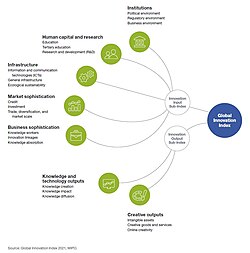
The GII utilizes a structured mathematical approach to determine rankings. The final score is a simple average of two primary sub-indices: the Innovation Input Index and the Innovation Output Index.
- Innovation Input Index: Composed of five pillars that measure the conditions conducive to innovation.
- Innovation Output Index: Composed of two pillars that measure the actual results of innovation efforts.
Each pillar is further broken down into up to five indicators, with scores calculated using a weighted average method. For the 2025 edition, the conceptual framework employs 78 different indicators.
Data Requirements for Inclusion
To ensure statistical reliability, the GII sets strict minimum data coverage requirements. For the 2025 ranking, an economy must provide data for at least 35 indicators in the Input Sub-Index and 15 indicators in the Output Sub-Index, including scores for at least two sub-pillars per pillar.
Analysis of the 2025 Rankings
The 2025 rankings highlight a strong concentration of high-income economies at the top of the index. Switzerland continues to lead, followed by Sweden and the United States. Notably, China stands out as the only upper middle-income economy in the top 10.
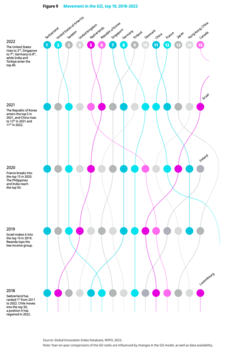
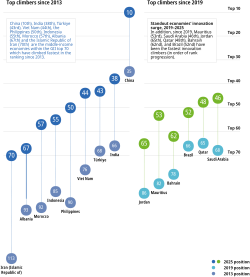
The index also tracks "climbers"—economies that show significant improvement in their rankings over time, though WIPO notes that these comparisons must account for changes in the GII model and data availability.
| Rank | Country/Region | Score | Income Group |
|---|---|---|---|
| 1 | Switzerland | 66.0 | High-income |
| 2 | Sweden | 62.6 | High-income |
| 3 | United States | 61.7 | High-income |
| 4 | South Korea | 60.0 | High-income |
| 5 | Singapore | 59.9 | High-income |
| 6 | United Kingdom | 59.1 | High-income |
| 7 | Finland | 57.7 | High-income |
| 8 | Netherlands | 57.0 | High-income |
| 9 | Denmark | 56.9 | High-income |
| 10 | China | 56.6 | Upper middle-income |
Thematic Focus and Criticism
Beyond the rankings, the GII explores a specific innovation theme every two years. These themes address critical global challenges; for example, the 2020 theme, "Who will finance innovation?", examined the evolution of financing mechanisms. Other previous themes have focused on agricultural, environmental, and health innovation.
Academic Criticism
Despite its widespread use, the GII has faced criticism from scholars. Some argue that the index attributes too much significance to factors not integral to innovation, such as "Ease of Paying Taxes" or "Electricity Output." A 2024 study by Sarcina et al. suggested that the pillars are too aggregated, masking the true determinants of innovation performance. The researchers proposed that the model should be redefined to include geographical, demographic, and socio-economic factors, as the drivers of innovation vary by a country's stage of development.
Frequently Asked Questions
Who publishes the Global Innovation Index?
The index is published annually by the World Intellectual Property Organization (WIPO).
How is the GII score calculated?
The score is a simple average of two sub-indices: the Innovation Input Index (measuring conditions) and the Innovation Output Index (measuring results).
What are the requirements for a country to be ranked in 2025?
An economy needs data for at least 35 indicators in the Input Sub-Index and 15 in the Output Sub-Index, with scores for at least two sub-pillars per pillar.
Which country is ranked first in the 2025 GII?
Switzerland is ranked first with a score of 66.0.
Does the GII cover more than just rankings?
Yes, every two years the index features a deep-dive theme, such as innovation financing or health innovation, to provide broader context on the global innovation landscape.