Glasshouses Mill: A History of Industrial Heritage in North Yorkshire
Nestled in the village of Glasshouses, North Yorkshire, Glasshouses Mill stands as a testament to England's rich industrial past. Originally established on the site of a corn mill, this historic complex evolved over nearly two centuries from a specialized textile facility into a versatile space for modern business and residential living.
Key Facts
- Location: Glasshouses, North Yorkshire, England.
- Original Purpose: Built between 1812 and 1814 to spin flax.
- Architectural Status: Grade II listed as of 2007.
- Key Materials: Constructed from sandstone with slate, stone slate, and tile roofs.
- Operational Shift: Converted from flax to hemp spinning in 1899.
- Closure: The mill ceased industrial operations in 1972.
The Evolution of Production and Power
The mill's early years were defined by the processing of flax, a plant fiber used to make linen. Between 1812 and 1814, the facility was established to meet the demands of the textile trade. The site underwent significant expansion under the ownership of the Metcalfe family, who acquired the mill in 1835. They expanded the footprint by adding east and west wings, followed by offices and warehouses in 1844 and 1852.
To keep pace with industrial growth, the mill's power sources were continuously upgraded. In 1851, a larger watermill—designed by the renowned engineering firm William Fairbairn & Sons—was installed, supported by a massive 10 million gallon reservoir. As technology advanced, the mill integrated a steam engine in 1857, a gas plant in 1864, and a water turbine in 1871.
Supporting Infrastructure
The industrial site was more than just a factory; it was a hub for the local community. In 1878, a boiler house and joiners' shop were added. Furthermore, the architect W. R. Corson designed several surrounding buildings to support the workforce, including a school, a chapel, and residential housing.
Architectural Design and Layout
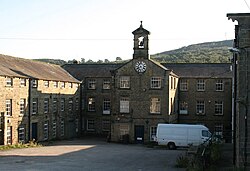
The mill is a striking example of industrial sandstone architecture. It features quoins—the dressed stones used to reinforce the corners of the walls—and a variety of roofing materials including slate and tile. The structure rises across two and three storeys in a U-shaped plan centered around a courtyard.
The layout is divided into three primary ranges: the central range consists of twelve bays, the west wing contains nine bays (with six to the north), and the east wing comprises 15 bays plus an extension. A notable feature of the central block is a three-bay extension that houses a clock and a bell tower.
| Period/Year | Key Development | Purpose/Feature |
|---|---|---|
| 1812–1814 | Initial Construction | Flax spinning |
| 1835–1852 | Metcalfe Family Expansion | Wings, warehouses, and offices |
| 1851 | Fairbairn & Sons Watermill | Powered by 10 million gallon reservoir |
| 1857–1871 | Power Upgrades | Steam engine, gas plant, and water turbine |
| 1899 | Production Shift | Converted to hemp spinning |
| 1972 | Closure | Converted for small businesses |
| 2016 | Residential Conversion | Conversion into housing |
Frequently Asked Questions
What was Glasshouses Mill originally used for?
The mill was built between 1812 and 1814 specifically to spin flax, although it was constructed on the site of a previous corn mill.
Who were the primary owners of the mill?
The mill was owned by the Metcalfe family starting in 1835 and was later purchased by the Atkinson family in 1912.
What power sources did the mill utilize over time?
The mill utilized a variety of power sources, including a large watermill (fed by a 10 million gallon reservoir), a steam engine installed in 1857, and a water turbine added in 1871.
When did the mill stop operating as a textile factory?
The mill officially closed its industrial operations in 1972.
What is the current status of the building?
The building was granted Grade II listed status in 2007 for its historical significance. After serving as a hub for small businesses, work began in 2016 to convert the site into residential housing.