Glasgow Queen Street Station
Glasgow Queen Street (Scottish Gaelic: Sràid na Banrighinn) is a primary passenger railway terminus serving the heart of Glasgow, Scotland. While smaller than its counterpart, Glasgow Central, it remains one of the most critical transport hubs in the country. Between April 2024 and March 2025, it ranked as the third-busiest station in Scotland and the 30th-busiest across Great Britain.
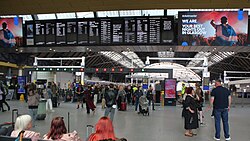
The station is characterized by its unique dual-level layout, providing essential connections to Edinburgh, the Highlands, and the surrounding suburban network. In recent years, the station has undergone a massive transformation to modernize its facilities and increase capacity for the growing number of passengers.
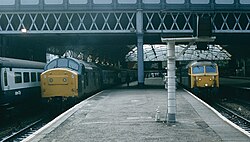
Key Facts
- Location: Glasgow, Scotland (Fare Zone 1).
- Management: Managed by ScotRail and overseen by the SPT (Strathclyde Partnership for Transport).
- Capacity: 9 platforms in total (7 High Level, 2 Low Level).
- Recent Growth: Passenger numbers rose from 2.299 million in 2020/21 to 14.951 million in 2024/25.
- Major Upgrade: A £120 million redevelopment completed in 2021 introduced a new modern concourse.
Historical Evolution
The station was established by the Edinburgh and Glasgow Railway and first opened on February 21, 1842, under the name Dundas Street. It was later renamed Queen Street, though its iconic curved glass train shed was not completed until 1878. During this era, the station was redesigned by James Carswell, who introduced electric lighting—one of the first instances of electricity being used in Glasgow.
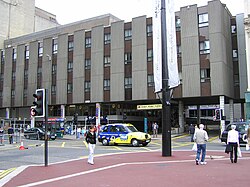
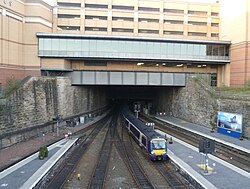
Historically, the journey out of the station involved a steep climb through the Queen Street Tunnel toward Cowlairs. Until 1909, trains required a rope operated by a stationary engine to navigate this 1 in 42 gradient. In 1966, the closure of the rival Buchanan Street station due to the Beeching cuts (a major restructuring of British railways) forced Queen Street to absorb services to Stirling, Perth, Inverness, Dundee, and Aberdeen, leading to significant congestion due to the station's confined location.
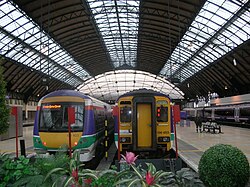
Modernization and Expansion
The 21st century brought significant technological and structural upgrades. In 2016, the High Level station closed for 20 weeks to allow for the replacement of 1,800 meters of track within the Queen Street Tunnel. This was a prerequisite for the electrification of the Glasgow to Edinburgh via Falkirk line, which saw the introduction of Class 380 and Class 385 electric multiple units (EMUs) between 2017 and 2018.
From 2017 to 2021, Network Rail executed a £120 million redevelopment. This project demolished outdated 1960s buildings and a 1970s hotel extension to create a striking new glass atrium and expanded concourse. Platforms 2 through 5 were also lengthened to accommodate larger trains. This effort was recognized in September 2024 when the project won an industry award for its design and the successful integration of the high and low-level stations.
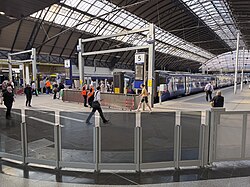
Station Layout and Services
The station is divided into two distinct operational levels, each serving different geographic regions.
High Level Station
The High Level is the larger terminus, serving as the gateway to the North and East. It handles services to Edinburgh Waverley via Falkirk High, as well as routes to Stirling, Perth, Inverness, and the West Highland Line (Oban and Mallaig). It consists of platforms 1 through 7, with the fleet now consisting largely of electric trains.
Low Level Station
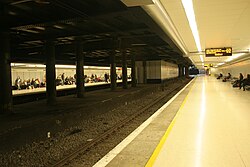
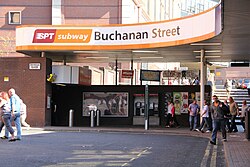
The Low Level consists of platforms 8 and 9 and serves as a central stop on the North Clyde Line. This electrified suburban network connects Glasgow to Helensburgh, Balloch, Milngavie, and Airdrie, with some services continuing to Edinburgh via Bathgate. It utilizes Class 318, 320, and 334 trains.
Station Summary
| Feature | High Level | Low Level |
|---|---|---|
| Platforms | 1–7 | 8–9 |
| Primary Routes | Edinburgh, Highlands, Aberdeen | North Clyde Line, Suburban Glasgow |
| Traction | Electric / Diesel | Electric |
| Key Destinations | Inverness, Fort William, Oban | Helensburgh, Balloch, Airdrie |
Frequently Asked Questions
How many platforms are at Glasgow Queen Street?
The station has a total of 9 platforms: 7 located at the High Level and 2 at the Low Level.
What is the difference between the High Level and Low Level stations?
The High Level is a terminus for long-distance and regional services heading north and east (such as to Edinburgh and Inverness). The Low Level is a through-station serving the suburban North Clyde Line.
When was the recent redevelopment completed?
The £120 million redevelopment project, which included the construction of a new concourse and the extension of platforms, was officially completed on October 4, 2021.
Which train companies operate from the station?
The primary operator is ScotRail. Additionally, the Caledonian Sleeper provides services to Fort William, and Lumo operates services between Glasgow and London King's Cross.
Why did the station have to use a rope to pull trains in the past?
Due to the steep 1 in 42 gradient of the tunnel leading to Cowlairs, stationary engines and ropes were used to haul trains until 1909, before modern locomotive power made this unnecessary.