The Elegant Gladiolus: A Comprehensive Guide to the Sword Lily
Known for their striking vertical spikes and vibrant colors, the Gladiolus is a genus of perennial flowering plants that brings architectural drama to gardens worldwide. Often referred to as the "sword lily," its name is derived from the Latin word gladius, meaning sword—a nod to the distinct shape of its foliage. While many recognize them as popular cut flowers, these plants possess a rich botanical history and fascinating biological adaptations.
Key Facts
- Family: Iridaceae (the iris family).
- Distribution: Primarily found in South Africa, tropical Africa, Asia, and Mediterranean Europe.
- Diversity: Approximately 300 accepted species and hybrids.
- Unique Feature: Leaves exhibit anisotropic superhydrophobicity, allowing them to shed rain in a specific direction.
- Symbolism: The birth flower of August and the symbolic flower of Punjab.
Botanical Description and Biology
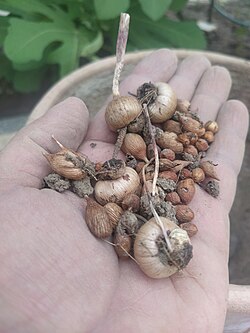
Gladioli grow from corms—round, symmetrical underground storage organs similar to those of crocuses—which are protected by several layers of brownish, fibrous tunics.
The stems are typically unbranched and produce between one and nine narrow, sword-shaped leaves. These leaves feature longitudinal grooves and a specialized three-level surface structure. This structure consists of micro-striations and aligned micro-protrusions coated with waxy nano-flakes, which create anisotropic superhydrophobicity (a property where a surface repels water in a specific direction), enabling the plant to shed rainfall droplets efficiently.
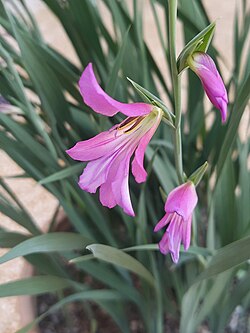
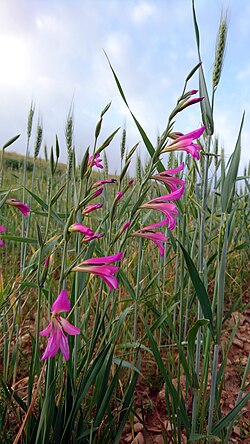
The flowers of wild species are relatively modest, often measuring up to 40 mm across. In contrast, the giant flower spikes seen in commercial horticulture are the result of centuries of selective breeding and hybridization. These spikes are one-sided and feature secund flowers (flowers arranged on one side of the stem), each protected by two leathery green bracts.
The petals and sepals are nearly identical in appearance and are therefore called tepals. These are fused at the base to form a funnel-shaped tube. The largest tepal arches over three stamens, while the style splits into three spoon-shaped branches. The plant produces a 3-locular ovary containing many winged, brown seeds.
Taxonomy and Global Distribution
First described by Carl Linnaeus in 1753, the genus Gladiolus is vast. As of August 2025, Plants of the World Online recognizes nearly 300 species and hybrids. The center of diversity for the genus is the Cape Floristic Region of South Africa, where about 260 species are endemic. Tropical Africa hosts around 76 species, while approximately 10 species are native to Eurasia.
Over time, taxonomic classifications have evolved. Genera that were once considered distinct, such as Acidanthera, Anomalesia, Homoglossum, and Oenostachys, are now integrated into the Gladiolus genus.
Ecology and Pollination
In South Africa, these plants were originally pollinated by long-tongued anthophorini bees. However, the pollination system has diversified to include sunbirds, long-tongued flies, and various moths, including noctuid and hawk-moths. In Europe, some hybrid varieties are pollinated by small wasps, though they are less efficient due to the size of the flowers. The European Hawk-moth (Macroglossum stellatarum) is also known to visit these blooms for nectar.
Beyond pollination, gladioli serve as food sources for certain insects, including gladiolus thrips and the larvae of some Lepidoptera (butterfly and moth) species, such as the large yellow underwing.
Horticulture and Cultivation
Gardeners prize gladioli for their wide array of colors, ranging from cream and orange to deep red and purple. Most commercial varieties fall into three main hybrid groups: 'Grandiflorus', 'Primulines', and 'Nanus'.
Genetics and Breeding
Most Gladiolus species are diploid, meaning they have two sets of chromosomes (2n=30). However, the 'Grandiflora' hybrids are tetraploid (2n=4x=60), a trait inherited from one of their primary parental species, Gladiolus dalenii.
Growing Tips
In temperate climates, corms should generally be lifted in autumn and stored in a frost-free environment before being replanted in the spring. Some hardier species and 'Nanus' hybrids can withstand temperatures as low as −26 °C (−15 °F) and may be left in the ground if winters are dry.
To ensure healthy growth, gardeners should:
- Provide moisture during the growing season.
- Stake large-flowered types as soon as the flower heads appear.
- Allow leaves to die back naturally before lifting corms.
- Divide clumps every few years to maintain vigor.
Growers should be mindful of pests such as Thrip simplex (thrips) and the wasp Dasyproctus bipunctatus, which can burrow into the flowers and cause them to collapse.
Cultural Significance and Art
The gladiolus appears frequently in art and popular culture. Vincent van Gogh captured the flower's beauty in his 1886 work, Vase with Red Gladioli. In music, Scott Joplin composed the "Gladiolus Rag," and the singer Morrissey is well-known for incorporating the flowers into his performances.
The flower also holds various traditional meanings:
- Anniversaries: Associated with the fortieth wedding anniversary.
- Mythology: The Graeco-Roman god Pluto was said to wear a wreath of a type of gladiolus (known as phasganion or xiphion).
- Tradition: They are traditionally given to finishers of the International Four Days Marches Nijmegen, symbolizing victory.
Summary of Gladiolus Characteristics
| Feature | Details |
|---|---|
| Common Name | Sword Lily |
| Plant Type | Perennial cormous flowering plant |
| Primary Distribution | South Africa, Tropical Africa, Asia, Mediterranean Europe |
| Chromosome Count | Diploid (2n=30) or Tetraploid (2n=60) |
| Hybrid Groups | Grandiflorus, Primulines, Nanus |
| Key Pollinators | Bees, Sunbirds, Hawk-moths, Flies |
Frequently Asked Questions
Why is it called the "Sword Lily"?
The name comes from the Latin word gladius, meaning sword, which describes the long, narrow, and pointed shape of the plant's leaves.
How do I propagate Gladioli?
They can be propagated either by planting seeds or by using small cormlets that develop as offsets from the parent corm. In both cases, it typically takes several years for the plant to reach flowering size.
What is the difference between a bulb and a corm?
While often used interchangeably in gardening, a corm is a swollen underground stem base that stores nutrients, whereas a true bulb consists of modified leaf bases (scales) surrounding a central bud.
Are all Gladioli frost-sensitive?
No. While many hybrids must be lifted and stored in winter, some European species and 'Nanus' hybrids are very hardy, capable of surviving temperatures as low as −26 °C (−15 °F).
What makes the 'Grandiflora' hybrids different genetically?
Unlike most species which are diploid (30 chromosomes), 'Grandiflora' hybrids are tetraploid, possessing 60 chromosomes. This is largely due to the influence of the tetraploid species Gladiolus dalenii.