German Open Access Repositories: Infrastructure and Digital Scholarship
Germany has established a robust network of digital open access repositories—digital archives designed to store and provide free, public access to scholarly work. These collections ensure that research outputs, including journal articles, book chapters, and raw data, are available to the global community without financial barriers.
As of March 2018, the UK-based Directory of Open Access Repositories reported that approximately 161 institutions across Germany maintain these repositories, reflecting a strong national commitment to transparent and accessible science.
Key Facts
- 161 institutions in Germany maintained repositories as of March 2018.
- BASE is regarded by experts as the most comprehensive registry for German repositories.
- The highest concentration of repositories is found in Baden-Württemberg, North Rhine-Westphalia, and Bavaria.
- Repositories house a variety of materials, including data, book chapters, and journal articles.
Locating German Research: Registries and Tools
To navigate the vast landscape of digital scholarship, researchers rely on registries—centralized databases that index where specific research is stored. In Germany, the primary national registries are the Bielefeld Academic Search Engine (BASE) and the Deutsche Initiative für Netzwerkinformation (DINI).
Beyond national tools, German repositories are also indexed in several international registries, which facilitate global discovery. These include:
- OpenDOAR (Directory of Open Access Repositories)
- ROAR (Registry of Open Access Repositories)
- OAI-PMH Registered Data Providers, a service of the Open Archives Initiative that uses a standardized protocol for metadata harvesting.
Leading Repositories and Regional Distribution
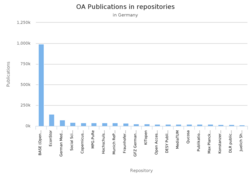
The scale of these repositories varies significantly. In 2012, several institutions stood out for their massive digital asset collections. The ZBW – Leibniz-Informationszentrum Wirtschaft's EconStor led the way with 290,000 items, followed by the Deutsches Zentrum für Luft- und Raumfahrt's elib with 46,136 items.
Other significant collections include German Medical Science (41,753 items), Universität Bielefeld's PUB (32,695 items), and the Alfred-Wegener-Institut's ePIC (29,480 items).
Geographically, the distribution of these repositories mirrors population density. The most heavily populated Länder (federal states) host the majority of these archives, specifically Baden-Württemberg (28), North Rhine-Westphalia (27), and Bavaria (22).
| Repository Name | Institution | Number of Items |
|---|---|---|
| EconStor | ZBW – Leibniz-Informationszentrum Wirtschaft | 290,000 |
| elib | Deutsches Zentrum für Luft- und Raumfahrt | 46,136 |
| German Medical Science | Various | 41,753 |
| PUB | Universität Bielefeld | 32,695 |
| ePIC | Alfred-Wegener-Institut | 29,480 |
Future Developments
The evolution of digital archiving continues to be a focal point for the academic community. Highlighting this ongoing development, the 2019 "International Conference on Open Repositories" was scheduled to take place in Hamburg.
Frequently Asked Questions
What is an open access repository?
An open access repository is a digital collection of scholarly research—such as articles, data, and book chapters—that is made available for anyone to read and download for free.
Which registry is best for finding German repositories?
Experts consider the Bielefeld Academic Search Engine (BASE) to be the most comprehensive registry for repositories located in Germany.
Which German states have the most repositories?
The highest numbers are found in Baden-Württemberg (28), North Rhine-Westphalia (27), and Bavaria (22).
What types of content are stored in these repositories?
These repositories contain a wide range of research outputs, including journal articles, book chapters, and scientific data.
How many institutions in Germany maintain repositories?
According to the Directory of Open Access Repositories, approximately 161 institutions in Germany maintained repositories as of March 2018.