George Gallup: The Pioneer of Public Opinion Polling
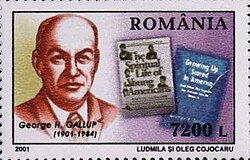
In the modern era, we take for granted the ability to gauge the mood of a nation through a few thousand phone calls or online surveys. This scientific approach to measuring the collective mind was pioneered by George Horace Gallup, an American statistician who transformed how politicians, businesses, and the public understand opinion. By introducing rigorous survey sampling techniques—the process of selecting a small, representative group to reflect the views of a larger population—Gallup turned guesswork into a science.
Key Facts
- Full Name: George Horace Gallup
- Born: November 18, 1901, in Jefferson, Iowa
- Died: July 26, 1984, in Tschingel ob Gunten, Switzerland
- Major Invention: The Gallup poll, a statistically based measure of public opinion
- Education: B.A., M.A., and Ph.D. from the University of Iowa
- Key Achievement: Correctly predicted Franklin Roosevelt's 1936 victory using a representative sample
Early Life and Academic Foundations
Born to a dairy farmer in Jefferson, Iowa, George Gallup displayed an entrepreneurial spirit from a young age. As a teenager, he used earnings from delivering milk to launch his own high school newspaper. This early interest in communication and information gathering followed him to the University of Iowa, where he served as the editor of The Daily Iowan and earned his doctorate in 1928.
Before becoming a household name in polling, Gallup held several prestigious academic and professional roles. He served as the head of the Department of Journalism at Drake University and later as a professor of journalism and advertising at Northwestern University. By 1932, he had moved to New York City to join the advertising agency Young and Rubicam, eventually rising to the position of vice president.
The Birth of the Gallup Poll
Gallup's foray into political polling began in 1932 while assisting his mother-in-law, Ola Babcock Miller, in her campaign for Iowa Secretary of State. Her victory during the Democratic landslide of that year sparked Gallup's lifelong fascination with the intersection of statistics and politics.
In 1935, he founded the American Institute of Public Opinion. He achieved national fame in 1936 during the U.S. Presidential election. While the widely respected Literary Digest magazine predicted a loss for Franklin Roosevelt based on over two million questionnaires, Gallup correctly predicted Roosevelt's victory. The difference lay in the methodology: while the magazine had a larger volume of responses, Gallup used a representative sample of just 50,000 selectively chosen respondents, proving that the quality and composition of a sample are more important than its raw size.
Expansion and Professional Legacy
Gallup continued to expand his influence, launching the Gallup International Association in 1947 to bring polling standards to a global scale. He also co-founded the Market Research Council, the National Council on Public Polls, and the American Association for Public Opinion Research. In 1948, he partnered with Claude E. Robinson to create Gallup & Robinson, an advertising research firm.
By 1958, he consolidated his various ventures into The Gallup Organization, the entity that continues to influence global public opinion research today.
Challenges and Later Years
Despite his successes, Gallup experienced a significant professional setback in 1948. His organization predicted that Thomas Dewey would defeat Harry S. Truman by 5% to 15%. In reality, Truman won by 4.5%. Gallup later attributed this error to the timing of the poll; by ending the survey three weeks before Election Day, the poll failed to capture Truman's late-stage momentum.
George Gallup spent his final years in Switzerland, where he passed away from a heart attack in 1984 at the age of 82.
Summary of George Gallup's Career
| Period/Year | Role or Achievement | Significance |
|---|---|---|
| 1923–1928 | University of Iowa | Earned B.A., M.A., and Ph.D. |
| 1935 | Founded American Institute of Public Opinion | Established his first polling company |
| 1936 | Roosevelt vs. Landon Prediction | Validated representative sampling over raw volume |
| 1947 | Gallup International Association | Expanded polling methodology globally |
| 1958 | The Gallup Organization | Unified all polling operations |
Frequently Asked Questions
What is a Gallup poll?
A Gallup poll is a statistically based survey that uses representative sampling to measure the opinions of a larger population based on the responses of a smaller, carefully selected group.
Why was the 1936 election prediction so important?
It proved that a smaller, scientifically selected representative sample (50,000 people) was more accurate than a massive but non-representative sample (over two million people), establishing the gold standard for modern polling.
Did George Gallup ever make a mistake in his predictions?
Yes. In the 1948 U.S. Presidential election, he incorrectly predicted a victory for Thomas Dewey over Harry S. Truman because polling ended too early to capture Truman's late comeback.
Where was George Gallup buried?
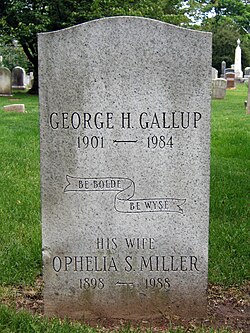
George Gallup is buried in Princeton Cemetery.
What other organizations did George Gallup help establish?
Beyond his own company, he was instrumental in founding the Market Research Council, the National Council on Public Polls, and the American Association for Public Opinion Research.